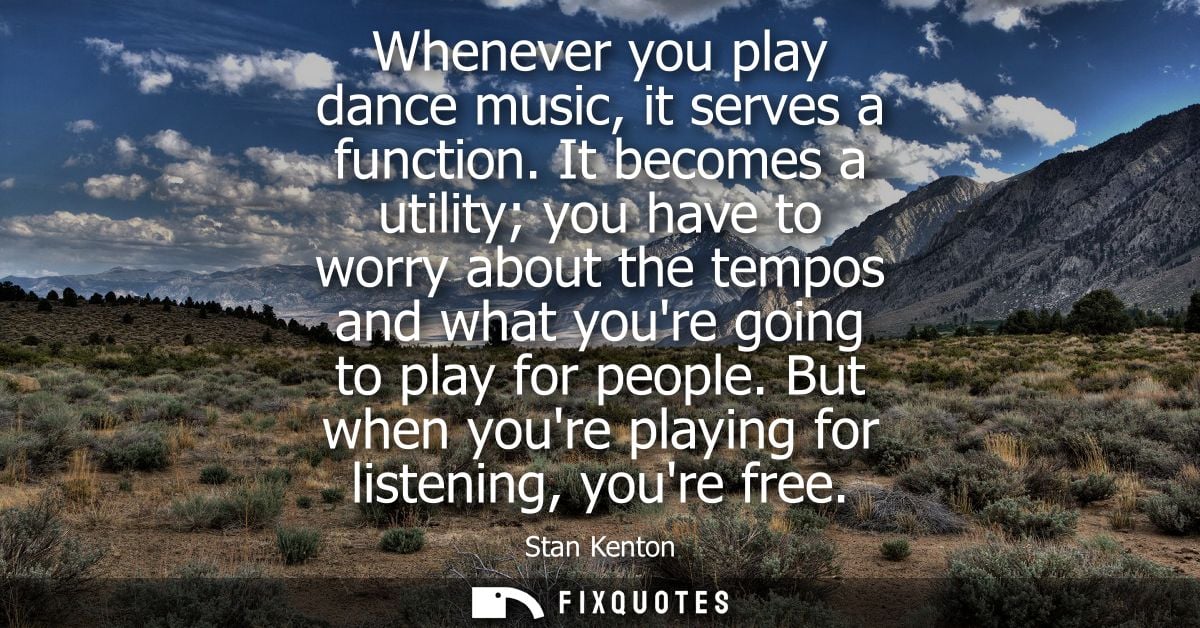
"Whenever you play dance music, it serves a function. It becomes a utility; you have to worry about the tempos and what you're going to play for people. But when you're playing for listening, you're free"
About this Quote
The subtext is Kenton defending the kind of big-band modernism he championed when swing’s commercial center of gravity was shifting. His “listening” category smuggles in artistic autonomy: the right to stretch form, to surprise, to write charts that don’t flatten themselves into an easy two-step. It’s also a subtle critique of audience power. In dance settings, the crowd is the client and the band is accountable; in listening settings, the artist gets to be accountable to the music itself.
Context matters: mid-century jazz was constantly negotiating whether it was entertainment, art, or both. Kenton’s statement reveals the pressure point. “Free” doesn’t mean careless; it means unburdened by function, allowed to be difficult, moody, even inconvenient. He’s arguing for a space where rhythm stops being a leash and becomes a choice.
Quote Details
| Topic | Music |
|---|---|
| Source | Help us find the source |
| Cite |
Citation Formats
APA Style (7th ed.)
Kenton, Stan. (2026, January 16). Whenever you play dance music, it serves a function. It becomes a utility; you have to worry about the tempos and what you're going to play for people. But when you're playing for listening, you're free. FixQuotes. https://fixquotes.com/quotes/whenever-you-play-dance-music-it-serves-a-131413/
Chicago Style
Kenton, Stan. "Whenever you play dance music, it serves a function. It becomes a utility; you have to worry about the tempos and what you're going to play for people. But when you're playing for listening, you're free." FixQuotes. January 16, 2026. https://fixquotes.com/quotes/whenever-you-play-dance-music-it-serves-a-131413/.
MLA Style (9th ed.)
"Whenever you play dance music, it serves a function. It becomes a utility; you have to worry about the tempos and what you're going to play for people. But when you're playing for listening, you're free." FixQuotes, 16 Jan. 2026, https://fixquotes.com/quotes/whenever-you-play-dance-music-it-serves-a-131413/. Accessed 6 Apr. 2026.