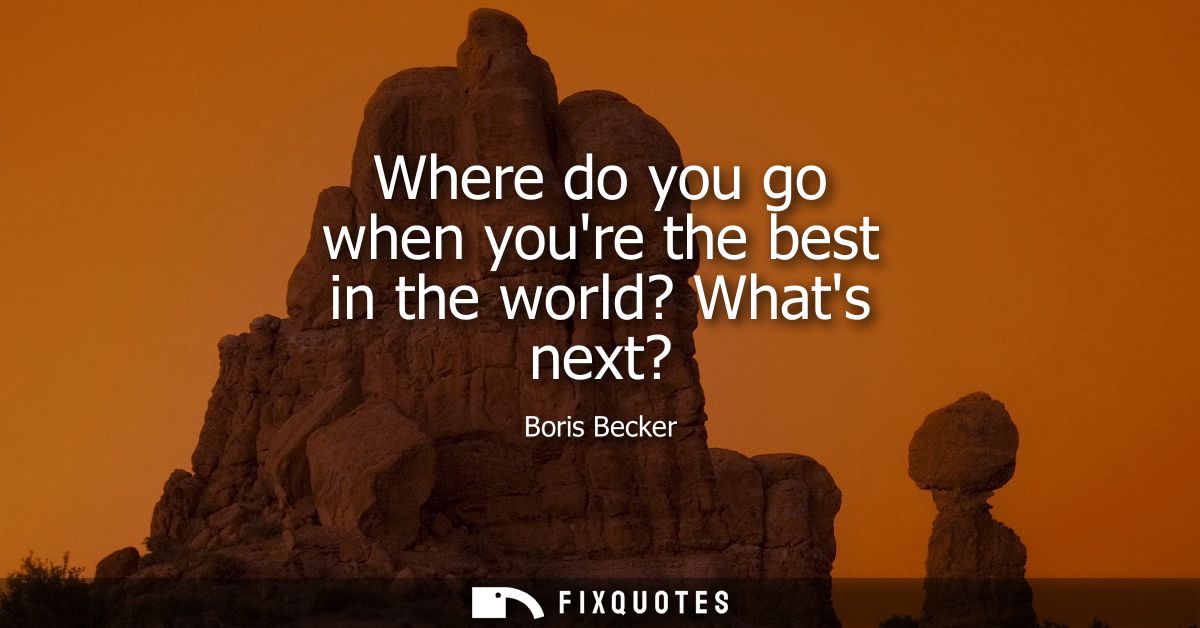
"Where do you go when you're the best in the world? What's next?"
About this Quote
The swagger in Boris Becker's question is real, but the ache underneath it is louder. "Where do you go when you're the best in the world? What's next?" isn’t a victory lap; it’s the moment after the champagne, when the room goes quiet and the scoreboard stops giving you instructions. For an athlete, greatness is supposed to be a destination. Becker treats it like an address you can’t live at for long.
The line works because it turns supremacy into a problem. "Best in the world" sounds like closure, a neat narrative ending. Becker punctures that myth with two short questions that refuse the comfort of a period. The subtext is destabilizing: if identity has been built on winning, what happens when winning becomes normal, or when your body, luck, or era shifts? Ambition doesn’t disappear at the summit; it mutates into something harsher - maintenance, legacy, reinvention, survival.
Context matters because Becker wasn’t a feel-good underdog story. He was a prodigy who reached the mountaintop early, which compresses the arc of desire. When you peak young, the "next" can feel like a threat, not an opportunity. The quote also hints at a broader cultural trap we set for champions: we demand domination, then act surprised when they look restless, reckless, or hollow. Becker’s question is a peek behind the highlight reel - the recognition that the hardest opponent might be the future, once the world has already called you "the best."
The line works because it turns supremacy into a problem. "Best in the world" sounds like closure, a neat narrative ending. Becker punctures that myth with two short questions that refuse the comfort of a period. The subtext is destabilizing: if identity has been built on winning, what happens when winning becomes normal, or when your body, luck, or era shifts? Ambition doesn’t disappear at the summit; it mutates into something harsher - maintenance, legacy, reinvention, survival.
Context matters because Becker wasn’t a feel-good underdog story. He was a prodigy who reached the mountaintop early, which compresses the arc of desire. When you peak young, the "next" can feel like a threat, not an opportunity. The quote also hints at a broader cultural trap we set for champions: we demand domination, then act surprised when they look restless, reckless, or hollow. Becker’s question is a peek behind the highlight reel - the recognition that the hardest opponent might be the future, once the world has already called you "the best."
Quote Details
| Topic | Success |
|---|---|
| Source | Help us find the source |
| Cite |
Citation Formats
APA Style (7th ed.)
Becker, Boris. (2026, January 17). Where do you go when you're the best in the world? What's next? FixQuotes. https://fixquotes.com/quotes/where-do-you-go-when-youre-the-best-in-the-world-73033/
Chicago Style
Becker, Boris. "Where do you go when you're the best in the world? What's next?" FixQuotes. January 17, 2026. https://fixquotes.com/quotes/where-do-you-go-when-youre-the-best-in-the-world-73033/.
MLA Style (9th ed.)
"Where do you go when you're the best in the world? What's next?" FixQuotes, 17 Jan. 2026, https://fixquotes.com/quotes/where-do-you-go-when-youre-the-best-in-the-world-73033/. Accessed 11 Mar. 2026.
More Quotes by Boris
Add to List