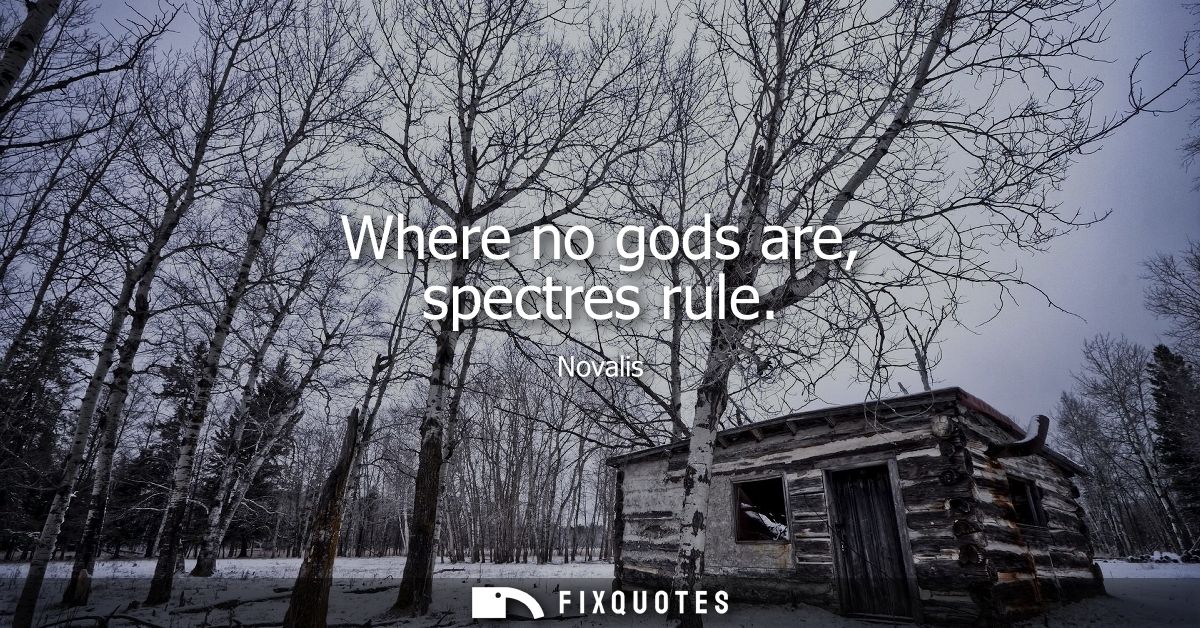
"Where no gods are, spectres rule"
About this Quote
Vacuum theology is never empty for long. Novalis compresses an entire diagnosis of modernity into six words: when a culture evicts its gods, it doesn’t get pure reason; it gets hauntings. The line works because it refuses the tidy Enlightenment story that disbelief automatically equals clarity. Instead it suggests a darker continuity: the human appetite for the absolute will reappear, but in distorted forms.
“Gods” here aren’t just church doctrine. They’re shared metaphysical anchors - narratives that authorize meaning, suffering, duty, and limits. Remove them and you don’t arrive at neutrality; you arrive at “spectres”: substitutes that feel weighty but lack substance, the eerie leftovers of belief without the stabilizing architecture of faith. Spectres can be superstition, ideology, conspiracy, nationalism, even the cult of the self. They’re persuasive precisely because they masquerade as liberation while quietly re-enchanting the world with anxieties and compulsions.
The Romantic context matters. Novalis is writing at the hinge of the late 18th century: the French Revolution’s promise curdling into terror, mechanistic science rising, old religious authority weakening. German Romanticism didn’t simply pine for medieval piety; it worried that disenchantment would make people more manipulable, not less - hungry for meaning, primed to project it onto phantoms.
There’s irony in the phrasing, too: “rule” is political. Spectres don’t just appear; they govern. The warning isn’t that unbelief is sinful, but that societies that abandon coherent sacred frameworks often end up ruled by the incoherent ones they pretend to outgrow.
“Gods” here aren’t just church doctrine. They’re shared metaphysical anchors - narratives that authorize meaning, suffering, duty, and limits. Remove them and you don’t arrive at neutrality; you arrive at “spectres”: substitutes that feel weighty but lack substance, the eerie leftovers of belief without the stabilizing architecture of faith. Spectres can be superstition, ideology, conspiracy, nationalism, even the cult of the self. They’re persuasive precisely because they masquerade as liberation while quietly re-enchanting the world with anxieties and compulsions.
The Romantic context matters. Novalis is writing at the hinge of the late 18th century: the French Revolution’s promise curdling into terror, mechanistic science rising, old religious authority weakening. German Romanticism didn’t simply pine for medieval piety; it worried that disenchantment would make people more manipulable, not less - hungry for meaning, primed to project it onto phantoms.
There’s irony in the phrasing, too: “rule” is political. Spectres don’t just appear; they govern. The warning isn’t that unbelief is sinful, but that societies that abandon coherent sacred frameworks often end up ruled by the incoherent ones they pretend to outgrow.
Quote Details
| Topic | Deep |
|---|---|
| Source | Verified source: Die Christenheit oder Europa (Novalis, 1799)
Evidence: Wo keine Götter sind, walten Gespenster, und die eigentliche Entstehungszeit der europäischen Gespenster, die auch ihre Gestalt ziemlich vollständig erklärt, ist die Periode des Übergangs der griechischen Götterlehre in das Christentum. (In the Project Gutenberg text: line 358 (no printed page given there)). This is the primary-language form of the commonly translated quote “Where no gods are, spectres rule.” It appears in Novalis’s text usually known as the speech/essay “Europa,” published under the title “Die Christenheit oder Europa.” The work was written and delivered to a private circle in 1799; it was first printed only in excerpt form in 1802 and first published in full in 1826 (posthumously). Other candidates (1) The German Classics of the 19th and 20th Century (Vol. 1-14) (Various, 2023) compilation95.0% ... NOVALIS. TRANSLATED. BY. FREDERIC. H. HEDGE. Where no gods are, spectres rule. The best thing that the French ach... |
| Cite |
Citation Formats
APA Style (7th ed.)
Novalis. (2026, February 8). Where no gods are, spectres rule. FixQuotes. https://fixquotes.com/quotes/where-no-gods-are-spectres-rule-12937/
Chicago Style
Novalis. "Where no gods are, spectres rule." FixQuotes. February 8, 2026. https://fixquotes.com/quotes/where-no-gods-are-spectres-rule-12937/.
MLA Style (9th ed.)
"Where no gods are, spectres rule." FixQuotes, 8 Feb. 2026, https://fixquotes.com/quotes/where-no-gods-are-spectres-rule-12937/. Accessed 12 Feb. 2026.
More Quotes by Novalis
Add to List