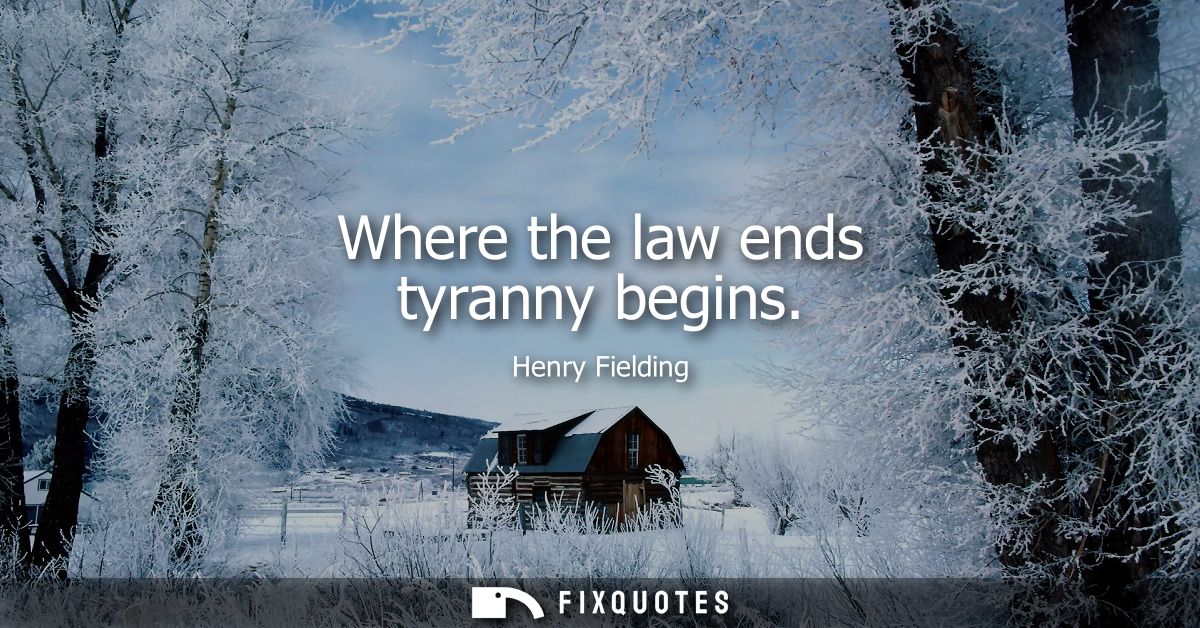
"Where the law ends tyranny begins"
About this Quote
A neat little tripwire of a sentence, built to sound like common sense until you realize it’s an accusation. “Where the law ends tyranny begins” isn’t a dreamy tribute to rules; it’s a warning about what happens when power slips its leash. Fielding, a novelist with a magistrate’s practical eye, writes like someone who has watched authority improvise and call it necessity. The line’s force comes from its stark border imagery: law is not a vibe or a moral aspiration but a boundary. Cross it and you’re no longer in the messy realm of politics; you’re in tyranny.
The subtext is less “laws are good” than “power always wants exceptions.” Tyranny doesn’t arrive with a crown and trumpets; it shows up as the moment someone decides procedure is optional because the situation is special, urgent, or too important for constraints. Fielding’s phrasing makes that creep legible. It collapses the distance between “no clear rule” and “abuse,” insisting that ambiguity is not neutral terrain. If there’s no enforceable limit, the strongest actor writes the rules in real time.
Context matters: Fielding lived in an England still haunted by civil conflict, censorship fights, and the constant argument over who gets to interpret authority - Parliament, the Crown, the courts. His world was thick with patronage and arbitrary enforcement, the kind of system where “the law” could be both shield and weapon. The quote works because it refuses romance: liberty isn’t secured by good intentions, but by hard edges that even the righteous aren’t allowed to step over.
The subtext is less “laws are good” than “power always wants exceptions.” Tyranny doesn’t arrive with a crown and trumpets; it shows up as the moment someone decides procedure is optional because the situation is special, urgent, or too important for constraints. Fielding’s phrasing makes that creep legible. It collapses the distance between “no clear rule” and “abuse,” insisting that ambiguity is not neutral terrain. If there’s no enforceable limit, the strongest actor writes the rules in real time.
Context matters: Fielding lived in an England still haunted by civil conflict, censorship fights, and the constant argument over who gets to interpret authority - Parliament, the Crown, the courts. His world was thick with patronage and arbitrary enforcement, the kind of system where “the law” could be both shield and weapon. The quote works because it refuses romance: liberty isn’t secured by good intentions, but by hard edges that even the righteous aren’t allowed to step over.
Quote Details
| Topic | Justice |
|---|---|
| Source | Help us find the source |
| Cite |
Citation Formats
APA Style (7th ed.)
Fielding, Henry. (2026, January 15). Where the law ends tyranny begins. FixQuotes. https://fixquotes.com/quotes/where-the-law-ends-tyranny-begins-143956/
Chicago Style
Fielding, Henry. "Where the law ends tyranny begins." FixQuotes. January 15, 2026. https://fixquotes.com/quotes/where-the-law-ends-tyranny-begins-143956/.
MLA Style (9th ed.)
"Where the law ends tyranny begins." FixQuotes, 15 Jan. 2026, https://fixquotes.com/quotes/where-the-law-ends-tyranny-begins-143956/. Accessed 13 Feb. 2026.
More Quotes by Henry
Add to List