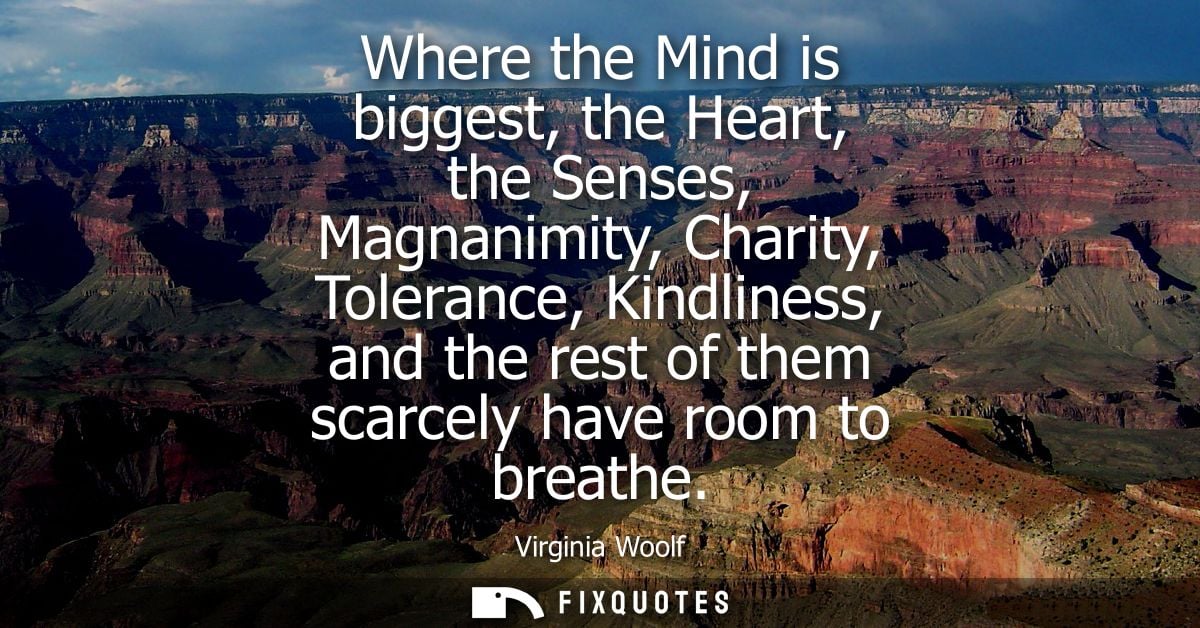
"Where the Mind is biggest, the Heart, the Senses, Magnanimity, Charity, Tolerance, Kindliness, and the rest of them scarcely have room to breathe"
About this Quote
Her list is doing quiet violence. “Heart” and “Senses” arrive first, the basic instruments of living and perceiving, then the civic virtues - “Magnanimity, Charity, Tolerance, Kindliness” - the social oxygen of a community. By stacking them, Woolf suggests these aren’t decorative traits but a whole ecology. The punch is in “scarcely have room to breathe,” a metaphor that turns genius into a poorly ventilated room: impressive, airless, self-suffocating.
Context matters. Woolf wrote in a culture that celebrated public intellect in male-coded forms: the donnish talker, the gatekeeping critic, the confident rationalist who could convert conversation into a lecture. Her modernism pushed against that authority, arguing that consciousness is not just argument but sensation, fragility, contradiction. The subtext is feminist without being sloganized: when a society rewards braininess as dominance, it trains people to treat empathy as an afterthought.
The intent isn’t anti-intellectual. It’s anti-aggrandizement. Woolf wants a mind capacious enough to make space - for feeling, for perception, for other people - rather than one that wins by crowding the room.
Quote Details
| Topic | Wisdom |
|---|---|
| Source | Help us find the source |
| Cite |
Citation Formats
APA Style (7th ed.)
Woolf, Virginia. (2026, January 17). Where the Mind is biggest, the Heart, the Senses, Magnanimity, Charity, Tolerance, Kindliness, and the rest of them scarcely have room to breathe. FixQuotes. https://fixquotes.com/quotes/where-the-mind-is-biggest-the-heart-the-senses-36811/
Chicago Style
Woolf, Virginia. "Where the Mind is biggest, the Heart, the Senses, Magnanimity, Charity, Tolerance, Kindliness, and the rest of them scarcely have room to breathe." FixQuotes. January 17, 2026. https://fixquotes.com/quotes/where-the-mind-is-biggest-the-heart-the-senses-36811/.
MLA Style (9th ed.)
"Where the Mind is biggest, the Heart, the Senses, Magnanimity, Charity, Tolerance, Kindliness, and the rest of them scarcely have room to breathe." FixQuotes, 17 Jan. 2026, https://fixquotes.com/quotes/where-the-mind-is-biggest-the-heart-the-senses-36811/. Accessed 5 Apr. 2026.