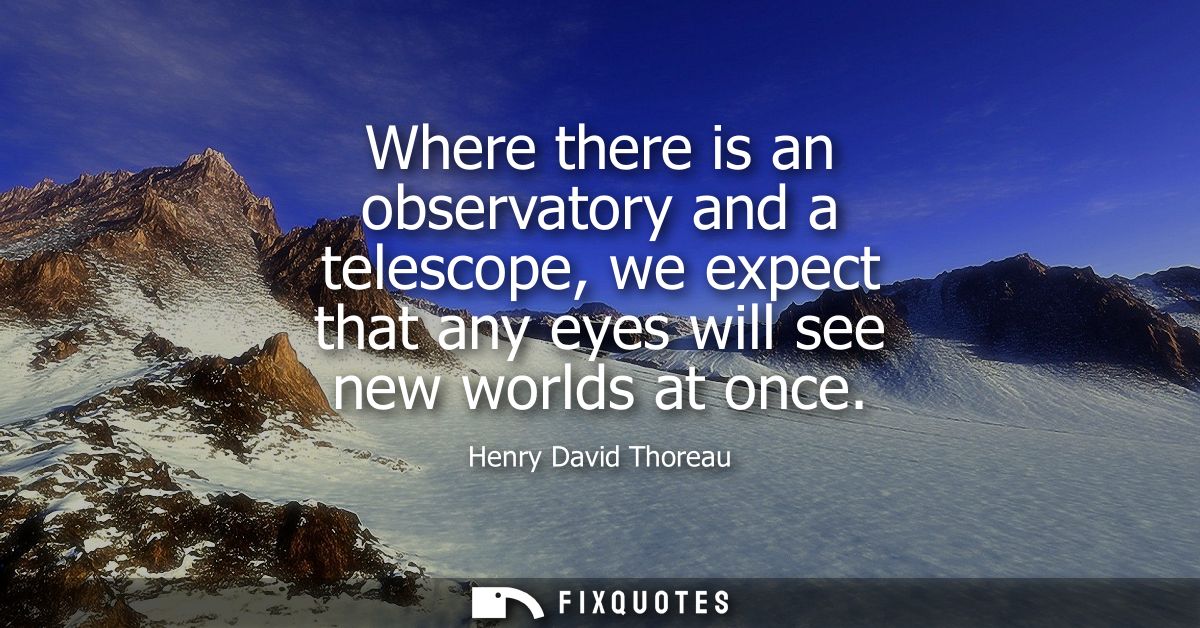
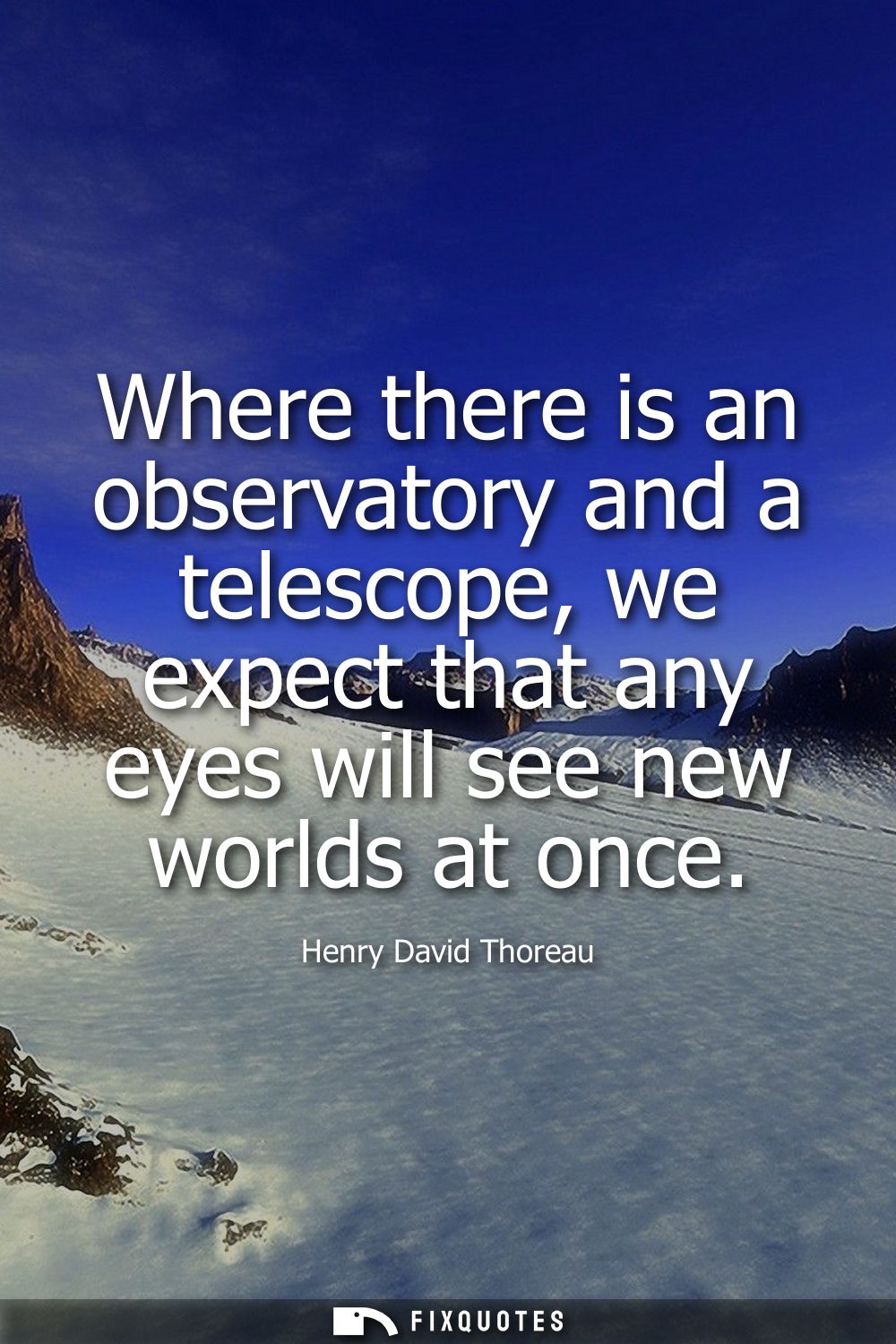
"Where there is an observatory and a telescope, we expect that any eyes will see new worlds at once"
About this Quote
The phrasing does the work. "Any eyes" sounds democratic, almost utopian, then turns suspicious. Thoreau implies that eyes are not equal; attention is a discipline, not a default setting. An observatory can be a civic monument to curiosity or a shrine to complacency, depending on whether anyone has learned how to look. By making discovery feel automatic, the sentence exposes how easily modern culture confuses access with insight.
Context matters: Thoreau writes in a 19th-century America intoxicated by invention, measurement, and expansion, where "new worlds" are both literal celestial bodies and the ideological promise of frontier destiny. He tests that confidence. The real frontier, for Thoreau, is inward: perception sharpened by solitude, skepticism, and moral clarity. The telescope becomes a mirror. If you cannot see newly with your own unaided senses, the lens may only magnify your expectations, not your understanding.
Quote Details
| Topic | Science |
|---|---|
| Source | Help us find the source |
| Cite |
Citation Formats
APA Style (7th ed.)
Thoreau, Henry David. (2026, January 17). Where there is an observatory and a telescope, we expect that any eyes will see new worlds at once. FixQuotes. https://fixquotes.com/quotes/where-there-is-an-observatory-and-a-telescope-we-28801/
Chicago Style
Thoreau, Henry David. "Where there is an observatory and a telescope, we expect that any eyes will see new worlds at once." FixQuotes. January 17, 2026. https://fixquotes.com/quotes/where-there-is-an-observatory-and-a-telescope-we-28801/.
MLA Style (9th ed.)
"Where there is an observatory and a telescope, we expect that any eyes will see new worlds at once." FixQuotes, 17 Jan. 2026, https://fixquotes.com/quotes/where-there-is-an-observatory-and-a-telescope-we-28801/. Accessed 27 Mar. 2026.