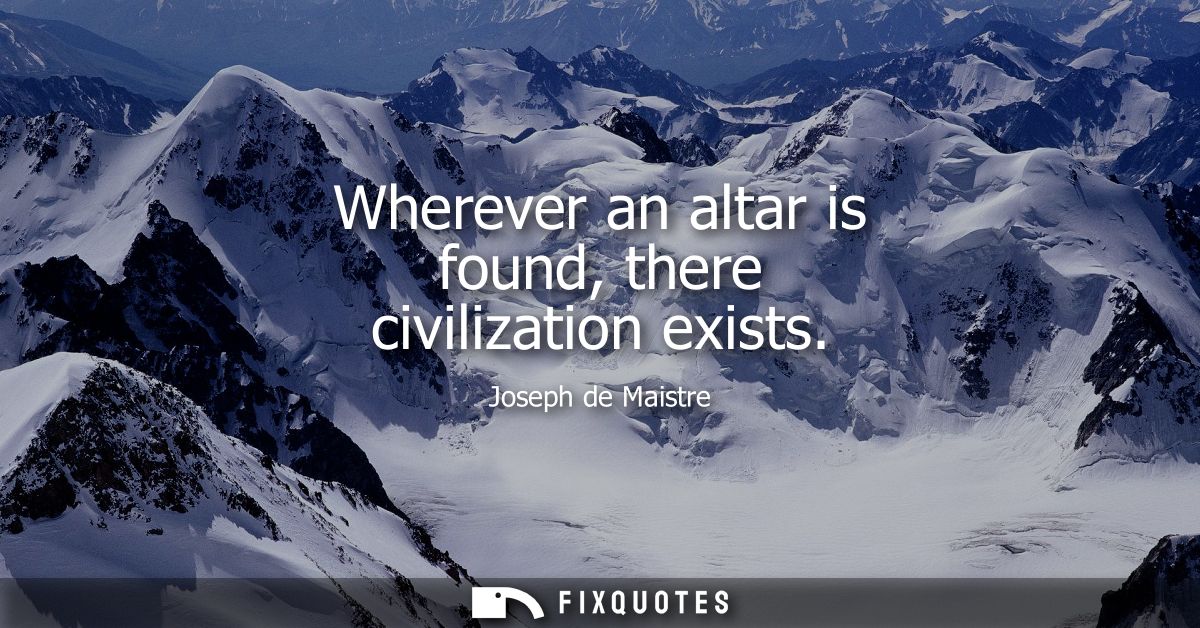
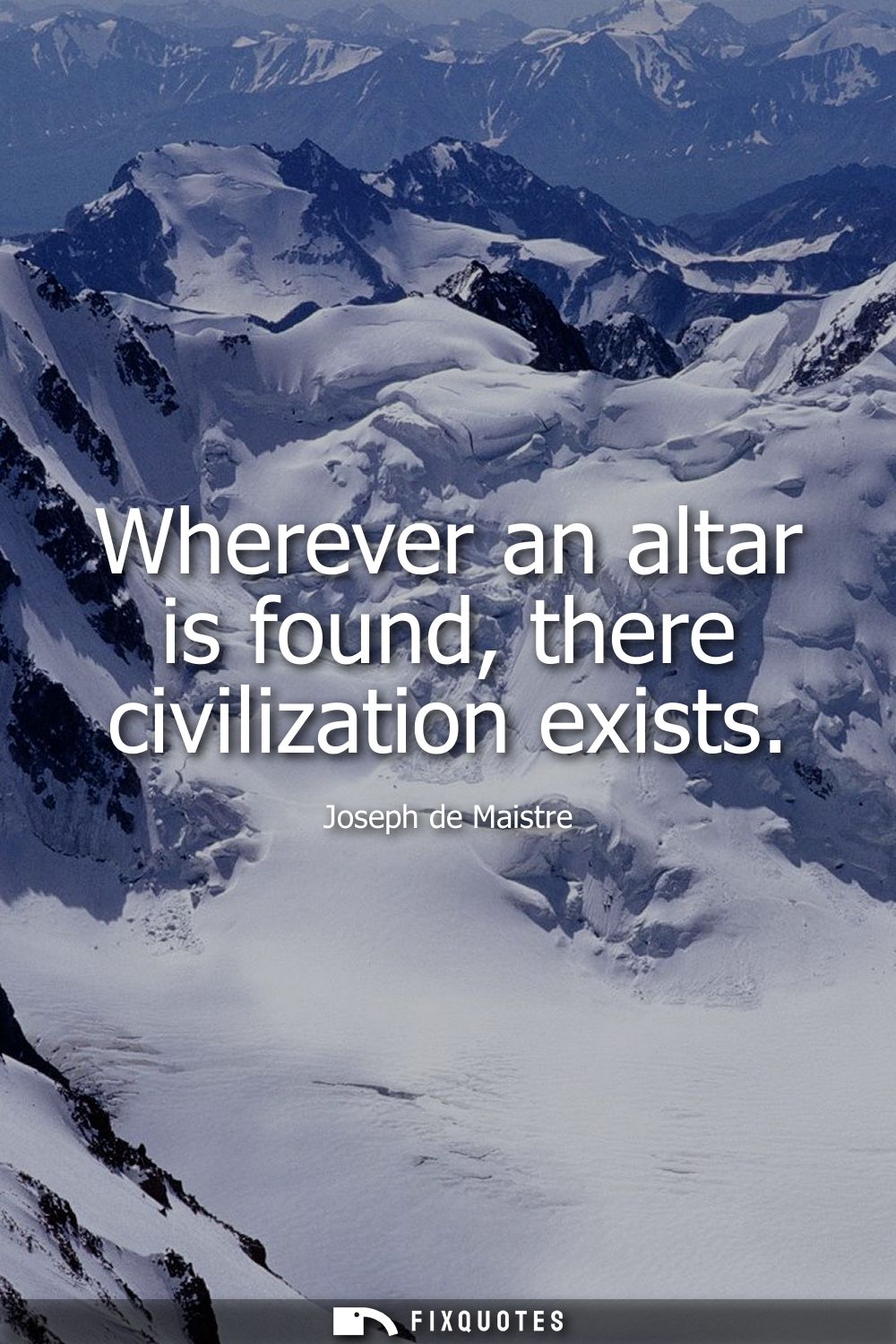
"Wherever an altar is found, there civilization exists"
About this Quote
Civilization, for de Maistre, is not a matter of roads, markets, or parliaments; it is a posture of submission. “Wherever an altar is found” smuggles in a whole political theology: humans become civilized the moment they kneel before something higher than themselves. The altar is doing double duty here. It’s literal (Catholic worship, sacrifice, ritual) and institutional (a public, durable site where authority is sanctified). In that sense the line is less an observation than a border checkpoint: show me your sacred center, and I’ll tell you whether you qualify as “civilized.”
The intent is polemical. De Maistre, a Savoyard diplomat writing in the long aftershock of the French Revolution, watched Enlightenment rationalism topple throne and Church and then slide into the Terror. His work is famous for treating that bloodletting as proof that desacralized politics doesn’t become neutral; it becomes predatory. An altar, in his framing, is society admitting limits: guilt, judgment, obligation, the idea that power answers to something it didn’t create. Without that, “civilization” is just technique and appetite wearing a powdered wig.
The subtext is also aggressively Eurocentric. By equating civilization with an altar, de Maistre ties legitimacy to a specifically religious architecture of order, one that conveniently resembles Catholic Christendom. It’s a conservative provocation that still lands because it identifies a persistent truth modern states prefer to deny: politics always builds altars, even when it bans incense. Nations, flags, constitutions, “values” become sacred objects; the question isn’t whether we worship, but what we’re willing to sacrifice.
The intent is polemical. De Maistre, a Savoyard diplomat writing in the long aftershock of the French Revolution, watched Enlightenment rationalism topple throne and Church and then slide into the Terror. His work is famous for treating that bloodletting as proof that desacralized politics doesn’t become neutral; it becomes predatory. An altar, in his framing, is society admitting limits: guilt, judgment, obligation, the idea that power answers to something it didn’t create. Without that, “civilization” is just technique and appetite wearing a powdered wig.
The subtext is also aggressively Eurocentric. By equating civilization with an altar, de Maistre ties legitimacy to a specifically religious architecture of order, one that conveniently resembles Catholic Christendom. It’s a conservative provocation that still lands because it identifies a persistent truth modern states prefer to deny: politics always builds altars, even when it bans incense. Nations, flags, constitutions, “values” become sacred objects; the question isn’t whether we worship, but what we’re willing to sacrifice.
Quote Details
| Topic | Faith |
|---|---|
| Source | Help us find the source |
| Cite |
Citation Formats
APA Style (7th ed.)
Maistre, Joseph de. (2026, January 18). Wherever an altar is found, there civilization exists. FixQuotes. https://fixquotes.com/quotes/wherever-an-altar-is-found-there-civilization-5990/
Chicago Style
Maistre, Joseph de. "Wherever an altar is found, there civilization exists." FixQuotes. January 18, 2026. https://fixquotes.com/quotes/wherever-an-altar-is-found-there-civilization-5990/.
MLA Style (9th ed.)
"Wherever an altar is found, there civilization exists." FixQuotes, 18 Jan. 2026, https://fixquotes.com/quotes/wherever-an-altar-is-found-there-civilization-5990/. Accessed 6 Apr. 2026.
More Quotes by Joseph
Add to List