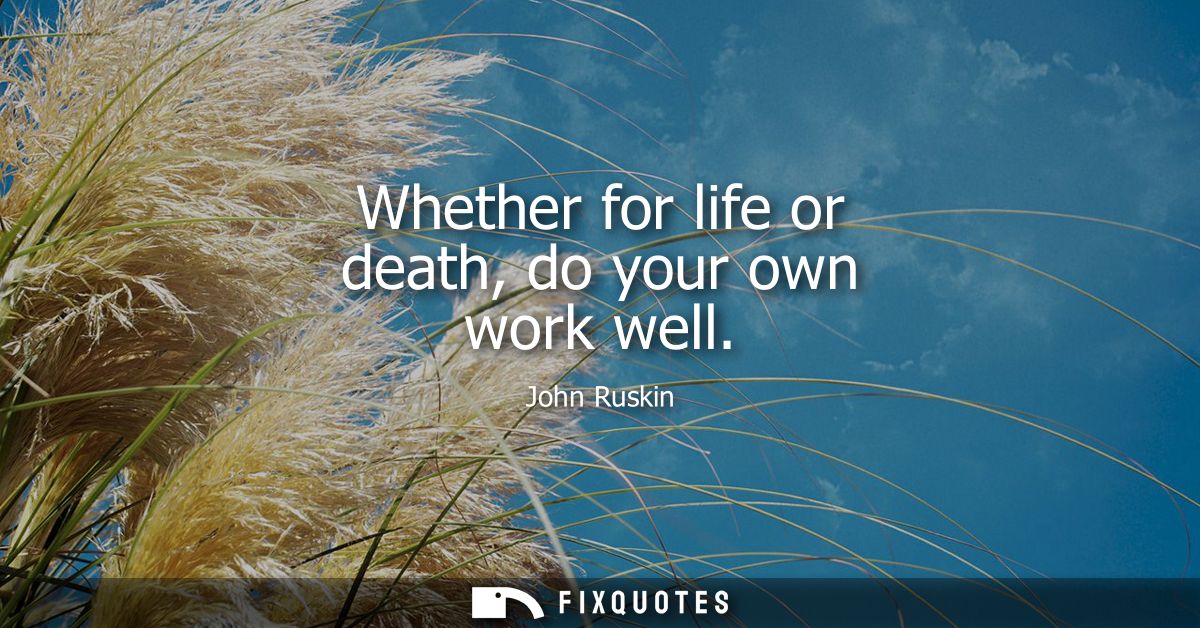
"Whether for life or death, do your own work well"
About this Quote
A moral drill-sergeant sentence dressed up as calm Victorian counsel, Ruskin’s line turns craftsmanship into an ethical test with real stakes. “Whether for life or death” is deliberate overkill: he yokes the ordinary (work) to the ultimate (mortality), collapsing any comfortable distinction between “important” labor and the tasks we treat as beneath our full attention. The point isn’t melodrama; it’s pressure. If the consequences might be everything, then carelessness becomes a kind of quiet violence.
The subtext is anti-performative. “Do your own work” reads like a rebuke to status-chasing and delegated virtue: don’t outsource competence, don’t hide behind titles, don’t confuse management with mastery. Ruskin is also policing authenticity. In an era when industrial production was accelerating and workmanship was being abstracted into systems, he insists on the dignity - and discipline - of the individual hand and mind. “Well” is the key word: not efficiently, not profitably, not impressively, but properly.
Context matters. Ruskin spent his career arguing that aesthetics can’t be separated from ethics: bad art and shoddy buildings were symptoms of a society that degrades labor and the people who do it. This sentence sounds personal, but it’s social critique compressed into a maxim. If you can’t be trusted to make a chair joint, a drawing, a policy, or a promise with integrity, you can’t be trusted with anything that claims to serve human life.
The subtext is anti-performative. “Do your own work” reads like a rebuke to status-chasing and delegated virtue: don’t outsource competence, don’t hide behind titles, don’t confuse management with mastery. Ruskin is also policing authenticity. In an era when industrial production was accelerating and workmanship was being abstracted into systems, he insists on the dignity - and discipline - of the individual hand and mind. “Well” is the key word: not efficiently, not profitably, not impressively, but properly.
Context matters. Ruskin spent his career arguing that aesthetics can’t be separated from ethics: bad art and shoddy buildings were symptoms of a society that degrades labor and the people who do it. This sentence sounds personal, but it’s social critique compressed into a maxim. If you can’t be trusted to make a chair joint, a drawing, a policy, or a promise with integrity, you can’t be trusted with anything that claims to serve human life.
Quote Details
| Topic | Work Ethic |
|---|---|
| Source | Help us find the source |
| Cite |
Citation Formats
APA Style (7th ed.)
Ruskin, John. (2026, January 18). Whether for life or death, do your own work well. FixQuotes. https://fixquotes.com/quotes/whether-for-life-or-death-do-your-own-work-well-18422/
Chicago Style
Ruskin, John. "Whether for life or death, do your own work well." FixQuotes. January 18, 2026. https://fixquotes.com/quotes/whether-for-life-or-death-do-your-own-work-well-18422/.
MLA Style (9th ed.)
"Whether for life or death, do your own work well." FixQuotes, 18 Jan. 2026, https://fixquotes.com/quotes/whether-for-life-or-death-do-your-own-work-well-18422/. Accessed 13 Feb. 2026.
More Quotes by John
Add to List