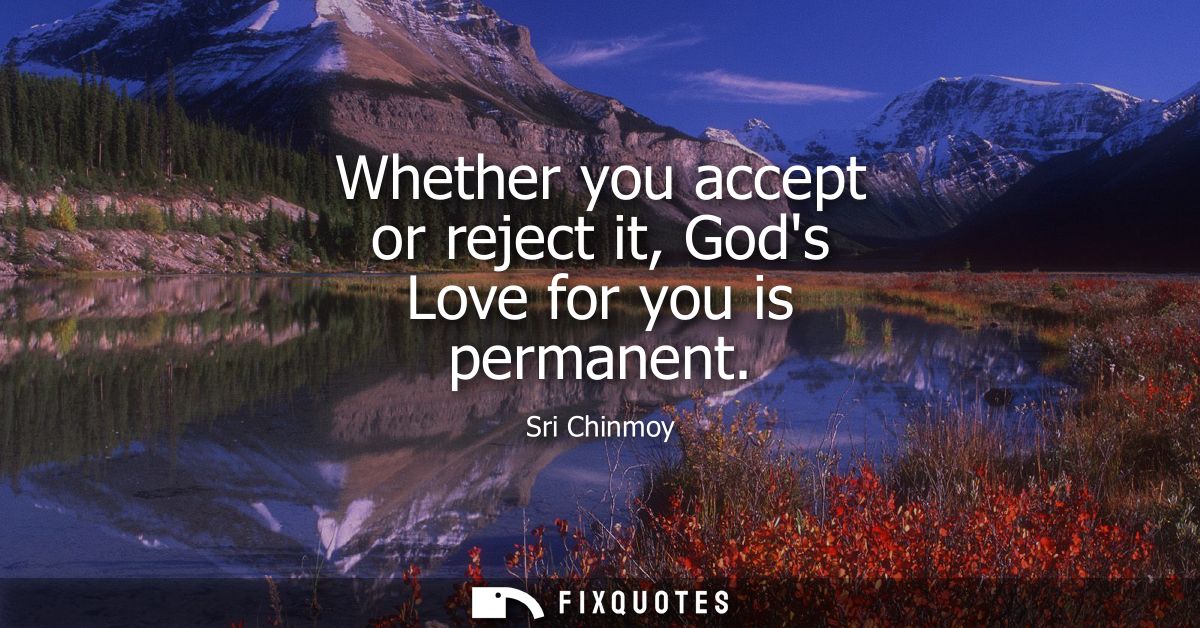
"Whether you accept or reject it, God's Love for you is permanent"
About this Quote
Permanence is the power move here. Sri Chinmoy frames divine love as a constant that does not negotiate with your mood, your doubt, or your theology. The line sounds comforting, but it also quietly disarms the modern habit of treating belief like a subscription you can cancel when it stops serving you. By insisting that God's love persists "whether you accept or reject it", he relocates the center of gravity: the real drama is not God's attitude toward you, but your capacity to receive what is already there.
The subtext is psychological as much as spiritual. If love is permanent, then shame loses one of its favorite bargaining chips: the fear that you're one failure away from being spiritually exiled. Chinmoy's phrasing offers a kind of metaphysical amnesty, one that bypasses the transactional logic many people inherit from moralistic religion (behave, and you are loved; stray, and you are punished). It's also subtly directive. If rejection doesn't change the fact of love, then rejecting it starts to look less like rebellion and more like self-denial.
Context matters: Chinmoy was a modern spiritual teacher speaking to a global audience hungry for interior practice, not institutional gatekeeping. This sentence fits that ecosystem: portable, soothing, and designed to be practiced as a mental stance. It's less an argument for God's existence than a strategic reframing of the relationship, turning faith from a fragile achievement into a willingness to stop resisting what, in his view, has already been granted.
The subtext is psychological as much as spiritual. If love is permanent, then shame loses one of its favorite bargaining chips: the fear that you're one failure away from being spiritually exiled. Chinmoy's phrasing offers a kind of metaphysical amnesty, one that bypasses the transactional logic many people inherit from moralistic religion (behave, and you are loved; stray, and you are punished). It's also subtly directive. If rejection doesn't change the fact of love, then rejecting it starts to look less like rebellion and more like self-denial.
Context matters: Chinmoy was a modern spiritual teacher speaking to a global audience hungry for interior practice, not institutional gatekeeping. This sentence fits that ecosystem: portable, soothing, and designed to be practiced as a mental stance. It's less an argument for God's existence than a strategic reframing of the relationship, turning faith from a fragile achievement into a willingness to stop resisting what, in his view, has already been granted.
Quote Details
| Topic | God |
|---|---|
| Source | Help us find the source |
| Cite |
Citation Formats
APA Style (7th ed.)
Chinmoy, Sri. (2026, January 15). Whether you accept or reject it, God's Love for you is permanent. FixQuotes. https://fixquotes.com/quotes/whether-you-accept-or-reject-it-gods-love-for-you-7733/
Chicago Style
Chinmoy, Sri. "Whether you accept or reject it, God's Love for you is permanent." FixQuotes. January 15, 2026. https://fixquotes.com/quotes/whether-you-accept-or-reject-it-gods-love-for-you-7733/.
MLA Style (9th ed.)
"Whether you accept or reject it, God's Love for you is permanent." FixQuotes, 15 Jan. 2026, https://fixquotes.com/quotes/whether-you-accept-or-reject-it-gods-love-for-you-7733/. Accessed 16 Mar. 2026.
More Quotes by Sri
Add to List