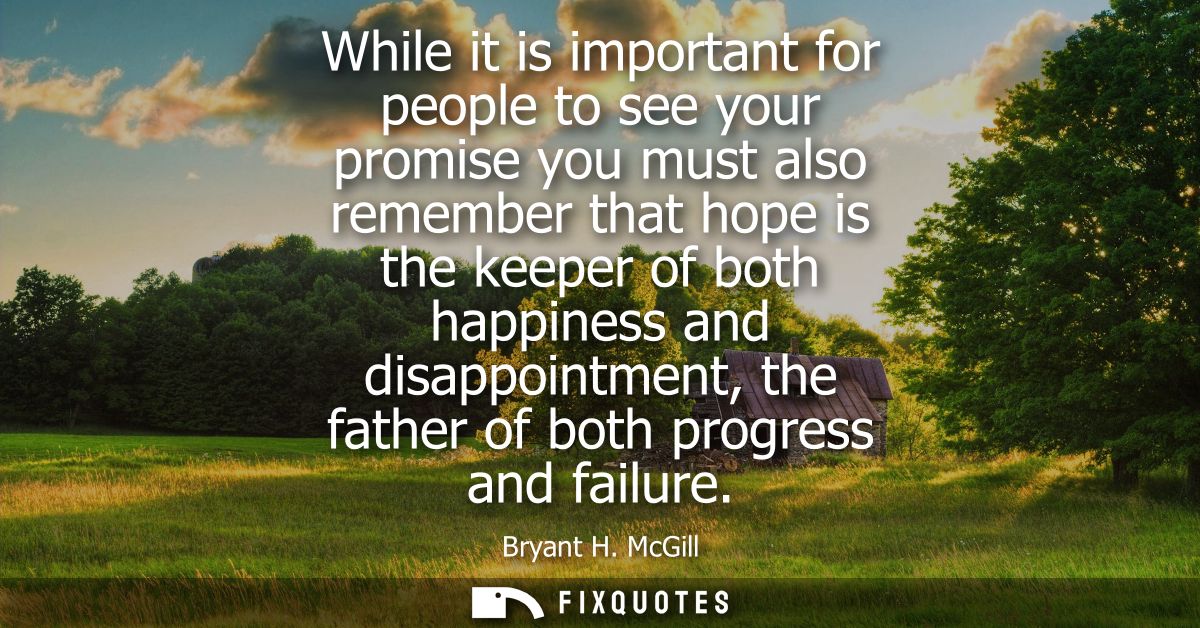
"While it is important for people to see your promise, you must also remember that hope is the keeper of both happiness and disappointment, the father of both progress and failure"
About this Quote
The engine of the line is its doubling: hope isn’t framed as a virtue with a halo, but as a mechanism with two outputs. “Keeper of both happiness and disappointment” is quietly unsentimental. Hope preserves joy by giving it a future tense; it also preserves pain by continually reopening the gap between what is and what should be. McGill’s subtext is a warning against hope-as-branding: when you sell your “promise,” you also sell the audience a timeline, and timelines breed letdowns.
Calling hope the “father of both progress and failure” pushes the thought into the realm of consequence. Progress requires the delusion that effort will pay off; failure is the tax that delusion collects. The context here feels self-help adjacent, but the intent is less “stay positive” than “stay lucid.” Hope is not a moral badge. It’s a force multiplier. It can animate a life - and it can wreck one - depending on how honestly you budget for disappointment.
Quote Details
| Topic | Hope |
|---|---|
| Source | Help us find the source |
| Cite |
Citation Formats
APA Style (7th ed.)
McGill, Bryant H. (2026, February 16). While it is important for people to see your promise, you must also remember that hope is the keeper of both happiness and disappointment, the father of both progress and failure. FixQuotes. https://fixquotes.com/quotes/while-it-is-important-for-people-to-see-your-139432/
Chicago Style
McGill, Bryant H. "While it is important for people to see your promise, you must also remember that hope is the keeper of both happiness and disappointment, the father of both progress and failure." FixQuotes. February 16, 2026. https://fixquotes.com/quotes/while-it-is-important-for-people-to-see-your-139432/.
MLA Style (9th ed.)
"While it is important for people to see your promise, you must also remember that hope is the keeper of both happiness and disappointment, the father of both progress and failure." FixQuotes, 16 Feb. 2026, https://fixquotes.com/quotes/while-it-is-important-for-people-to-see-your-139432/. Accessed 5 Mar. 2026.