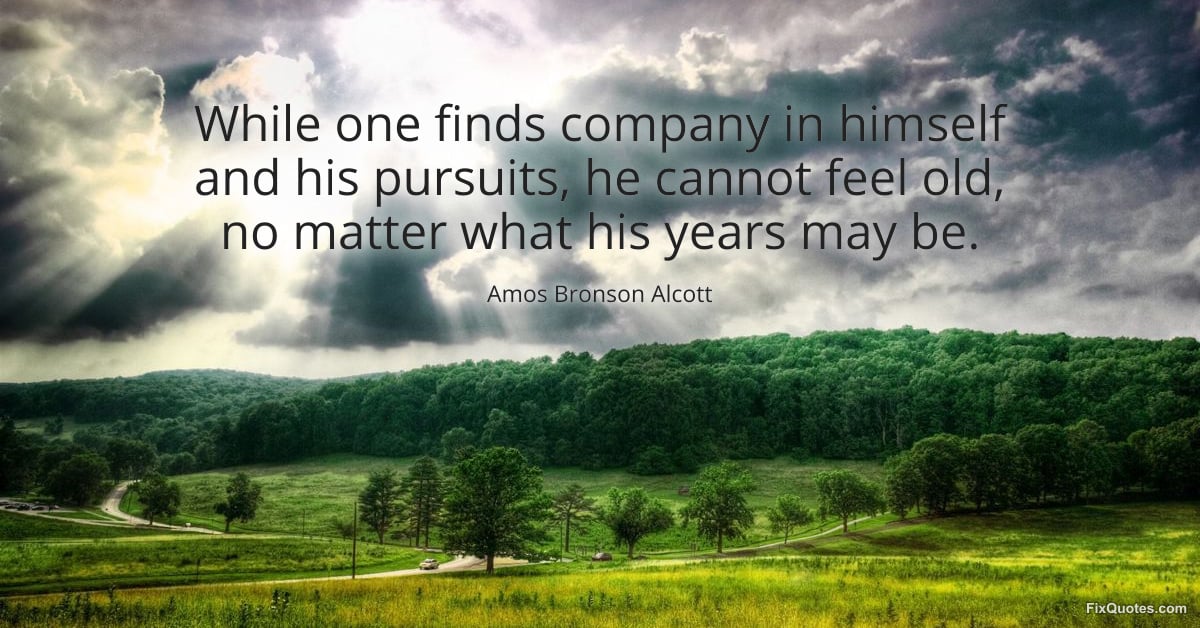
"While one finds company in himself and his pursuits, he cannot feel old, no matter what his years may be"
About this Quote
The line turns “old” from a biological fact into a social emotion. Alcott’s real target isn’t wrinkles, it’s the cultural script that equates age with redundancy. He offers an alternative metric: vitality measured by inward attention and chosen work. “Pursuits” matters here. He’s not praising idle solitude; he’s talking about projects, study, craft, moral improvement - the kind of ongoing apprenticeship he believed education should cultivate for life, not just for youth. That framing reflects his era’s preoccupation with character formation, but it also pushes against it: rather than seeing age as a period of decline and dependence, he imagines it as sustained agency.
There’s also a quiet discipline implied. Being “in company” with oneself is not automatic; it’s learned. In that sense, the quote functions like a pedagogical prompt: practice the inner life now, so later you won’t need constant external validation to feel current. Alcott makes aging negotiable, not by denying time, but by refusing its most humiliating interpretation.
Quote Details
| Topic | Aging |
|---|---|
| Source | Help us find the source |
| Cite |
Citation Formats
APA Style (7th ed.)
Alcott, Amos Bronson. (2026, January 15). While one finds company in himself and his pursuits, he cannot feel old, no matter what his years may be. FixQuotes. https://fixquotes.com/quotes/while-one-finds-company-in-himself-and-his-169251/
Chicago Style
Alcott, Amos Bronson. "While one finds company in himself and his pursuits, he cannot feel old, no matter what his years may be." FixQuotes. January 15, 2026. https://fixquotes.com/quotes/while-one-finds-company-in-himself-and-his-169251/.
MLA Style (9th ed.)
"While one finds company in himself and his pursuits, he cannot feel old, no matter what his years may be." FixQuotes, 15 Jan. 2026, https://fixquotes.com/quotes/while-one-finds-company-in-himself-and-his-169251/. Accessed 5 Apr. 2026.