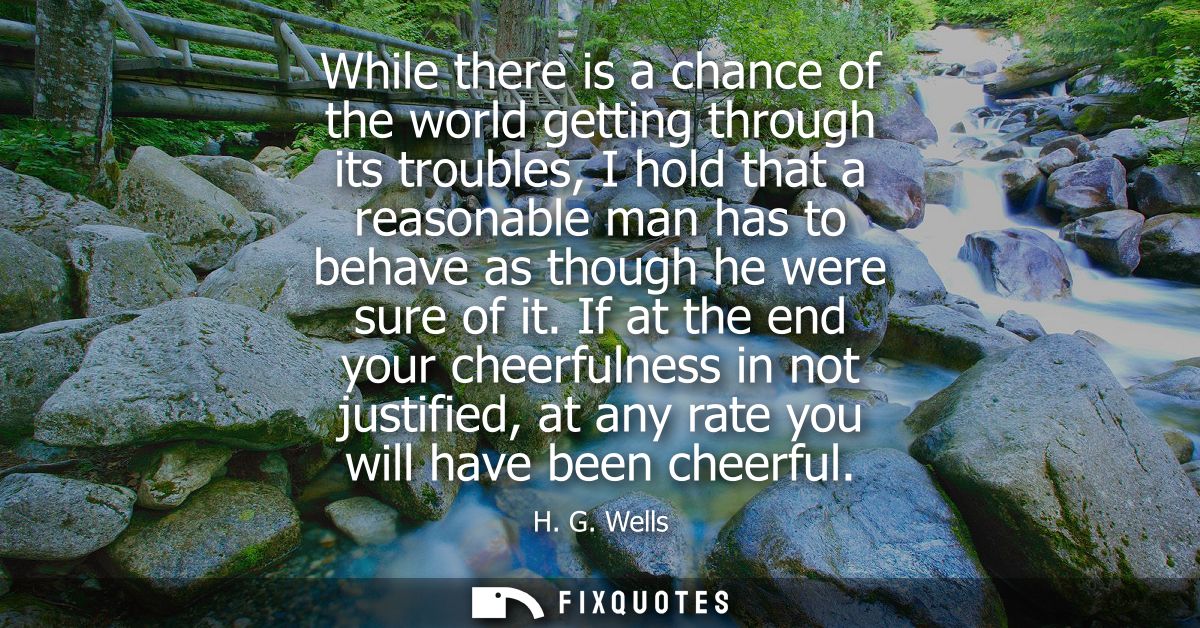
"While there is a chance of the world getting through its troubles, I hold that a reasonable man has to behave as though he were sure of it. If at the end your cheerfulness in not justified, at any rate you will have been cheerful"
About this Quote
Wells is selling optimism the way a hard-nosed engineer sells a bridge: not as a mood, but as a working assumption. The sly twist is that he doesn’t ask you to believe everything will be fine; he asks you to act as if it will. “A reasonable man” is doing a lot of work here. Reason, in Wells’s hands, isn’t a cold tally of probabilities that leads to despair; it’s a discipline that refuses to let fear commandeer behavior. Cheerfulness becomes a tool of survival, almost a civic duty, rather than a personality trait.
The subtext is anti-doomer before doomerism had a name. Wells lived through the era that turned progress into a cruel joke: industrial squalor, imperial violence, World War I, and the gathering storm that would become World War II. He’d written prophetic nightmares about scientific modernity (The Time Machine, The War of the Worlds), so this isn’t naive sunshine. It’s a writer of catastrophes insisting that catastrophes don’t get to dictate your posture.
The last line lands with dry, almost bracing pragmatism: even if you’re wrong, you’ve still extracted something valuable from the time you had. Wells reframes optimism as a low-risk wager. Pessimism offers the ego a perverse comfort (I told you so); cheerfulness offers agency. In a century that trained people to expect collapse, he argues that hope isn’t a prediction. It’s a choice with better daily returns.
The subtext is anti-doomer before doomerism had a name. Wells lived through the era that turned progress into a cruel joke: industrial squalor, imperial violence, World War I, and the gathering storm that would become World War II. He’d written prophetic nightmares about scientific modernity (The Time Machine, The War of the Worlds), so this isn’t naive sunshine. It’s a writer of catastrophes insisting that catastrophes don’t get to dictate your posture.
The last line lands with dry, almost bracing pragmatism: even if you’re wrong, you’ve still extracted something valuable from the time you had. Wells reframes optimism as a low-risk wager. Pessimism offers the ego a perverse comfort (I told you so); cheerfulness offers agency. In a century that trained people to expect collapse, he argues that hope isn’t a prediction. It’s a choice with better daily returns.
Quote Details
| Topic | Optimism |
|---|---|
| Source | Help us find the source |
More Quotes by Wells
Add to List