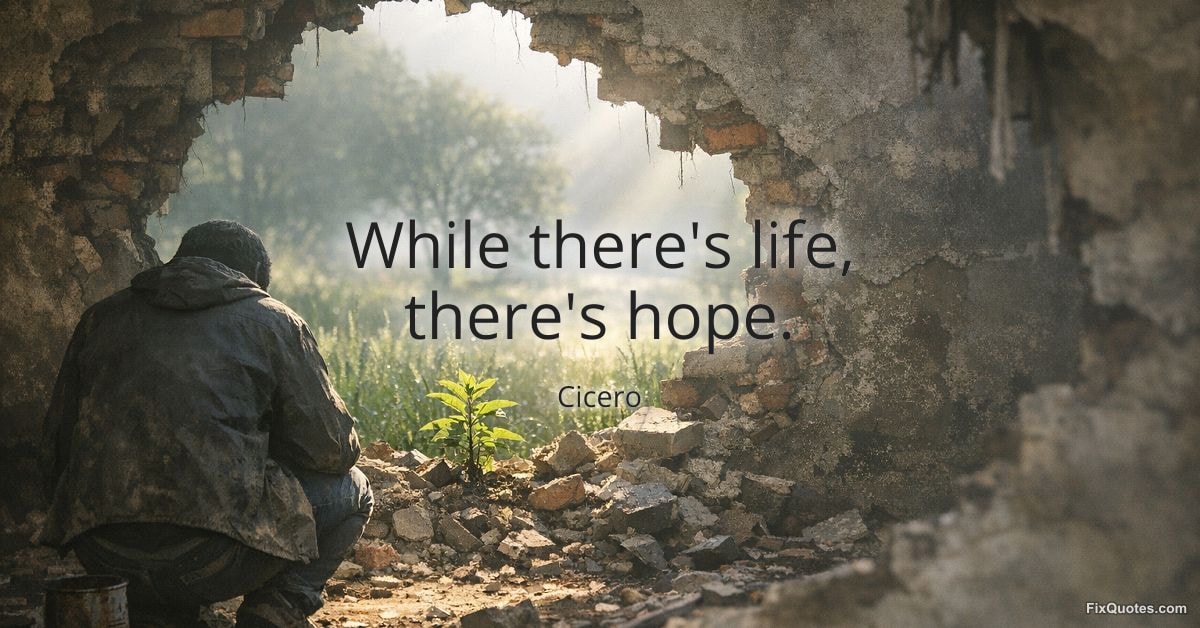
"While there's life, there's hope"
About this Quote
Cicero’s line is often printed on greeting cards, but in his mouth it lands closer to a legal maxim than a lullaby. “While there’s life, there’s hope” isn’t a claim about optimism as a personality trait; it’s a tactical reminder that possibility persists as long as the game isn’t over. The phrasing matters: “while” makes hope conditional and time-bound, tethered to breath and circumstance, not to wishful thinking. Cicero, the Roman statesman-philosopher who watched the Republic buckle under civil war and strongmen, knew that politics is rarely about purity and often about endurance.
The subtext is stoic without being fully Stoic: emotions are secondary, agency is primary. Hope here functions less as comfort than as instruction: keep negotiating, keep arguing, keep maneuvering, because outcomes remain malleable until death closes the case. It’s the mentality of the advocate who believes the jury can still be moved, the exile who thinks a recall is still imaginable, the defendant who trusts that time can create openings. Rome’s late-republican chaos made that logic visceral; fortunes reversed overnight, alliances shifted, and tomorrow’s victor could be today’s condemned.
There’s also an implicit boundary: once life ends, hope becomes irrelevant noise. That hard edge gives the sentence its power. Cicero isn’t offering a sunny worldview; he’s drawing a line between the living realm of contingency and the finality of death. In a culture that prized virtus and public action, the quote flatters persistence as a civic virtue: staying alive is staying in the argument.
The subtext is stoic without being fully Stoic: emotions are secondary, agency is primary. Hope here functions less as comfort than as instruction: keep negotiating, keep arguing, keep maneuvering, because outcomes remain malleable until death closes the case. It’s the mentality of the advocate who believes the jury can still be moved, the exile who thinks a recall is still imaginable, the defendant who trusts that time can create openings. Rome’s late-republican chaos made that logic visceral; fortunes reversed overnight, alliances shifted, and tomorrow’s victor could be today’s condemned.
There’s also an implicit boundary: once life ends, hope becomes irrelevant noise. That hard edge gives the sentence its power. Cicero isn’t offering a sunny worldview; he’s drawing a line between the living realm of contingency and the finality of death. In a culture that prized virtus and public action, the quote flatters persistence as a civic virtue: staying alive is staying in the argument.
Quote Details
| Topic | Hope |
|---|---|
| Source | Unverified source: Letters to Atticus (Epistulae ad Atticum), Book 9, Letter 10 (Cicero, -49)
Evidence: Book IX, Letter 10, section 3. The English aphorism “While there's life, there's hope” is a later paraphrase of Cicero’s line in a letter to Atticus written during the Civil War period (dated to 49 BC). The relevant Latin in this passage is commonly cited as: “ut aegroto, dum anima est, spes esse... Other candidates (2) A Dictionary of Proverbs (Jennifer Speake, 2008) compilation95.0% ... While there's LIFE there's hope Cf. Theocritus Idyll iv . 42 ἐλπίδες ἐν ζωοῖσιν there's hope among the living ; C... Cicero (Cicero) compilation40.0% ow since perturbations of mind create misery while quietness of mind makes life |
More Quotes by Cicero
Add to List