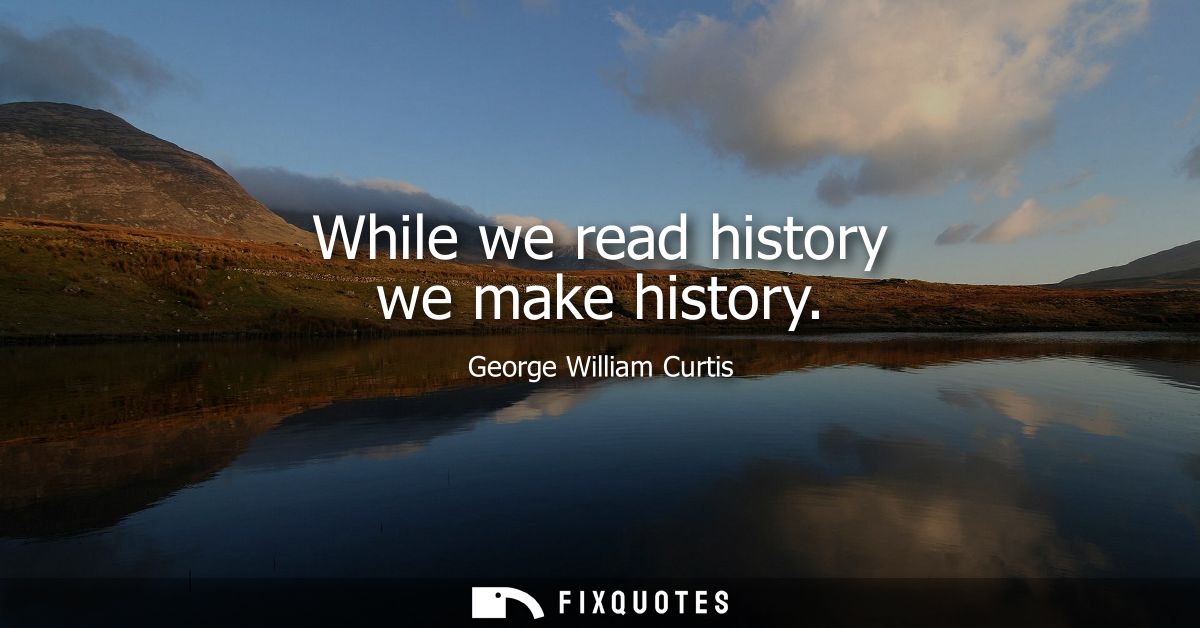
"While we read history we make history"
About this Quote
Curtis slips a quiet provocation into a sentence that looks like a truism. “While we read history we make history” refuses the comforting idea that history is a sealed archive, something safely “back then.” The line’s engine is simultaneity: while. It insists that interpretation is not a passive hobby but an active force, that the very act of selecting, emphasizing, and retelling the past rearranges the present.
The intent is partly democratic and partly admonitory. Curtis, a 19th-century American essayist shaped by reform politics and a fast-changing republic, is speaking to a public learning to treat books, newspapers, and speeches as tools of citizenship. Reading is portrayed as a civic act with consequences, not an escape from consequences. The subtext: you don’t get to hide behind “that’s just what happened.” The stories a society chooses to consume become the stories it authorizes to govern it.
Why it works is its neat reversal of roles. History is usually the teacher and we are the students. Curtis flips it: the student is also writing the lesson plan. Even our attention becomes power. Which battles get remembered, which voices get footnoted, which injustices get framed as “inevitable” - those choices shape policy, identity, and what future generations will call common sense.
In a culture that prizes “being informed,” Curtis warns that information is never neutral. Reading is participation, and participation leaves fingerprints.
The intent is partly democratic and partly admonitory. Curtis, a 19th-century American essayist shaped by reform politics and a fast-changing republic, is speaking to a public learning to treat books, newspapers, and speeches as tools of citizenship. Reading is portrayed as a civic act with consequences, not an escape from consequences. The subtext: you don’t get to hide behind “that’s just what happened.” The stories a society chooses to consume become the stories it authorizes to govern it.
Why it works is its neat reversal of roles. History is usually the teacher and we are the students. Curtis flips it: the student is also writing the lesson plan. Even our attention becomes power. Which battles get remembered, which voices get footnoted, which injustices get framed as “inevitable” - those choices shape policy, identity, and what future generations will call common sense.
In a culture that prizes “being informed,” Curtis warns that information is never neutral. Reading is participation, and participation leaves fingerprints.
Quote Details
| Topic | Learning |
|---|
More Quotes by George
Add to List