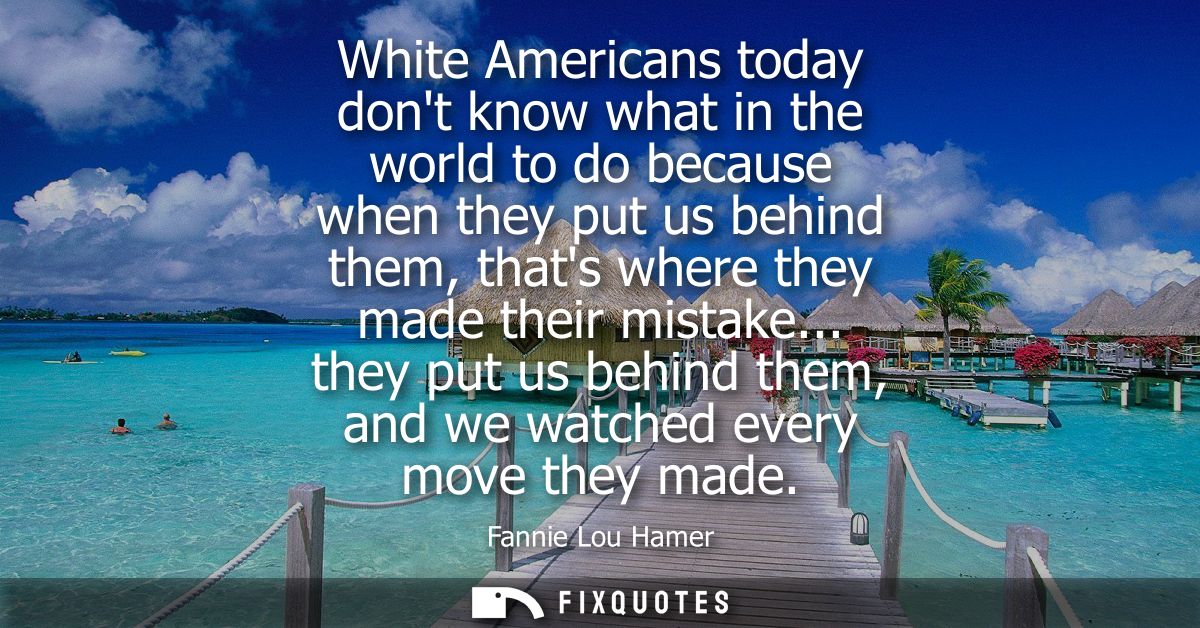
"White Americans today don't know what in the world to do because when they put us behind them, that's where they made their mistake... they put us behind them, and we watched every move they made"
About this Quote
The line works because it flips the grammar of white supremacy. "Behind them" is meant to be a fixed position: segregated, subordinate, unseen. Hamer turns that spatial metaphor into a tactical blunder. Putting Black people "behind" made them witnesses. Forced proximity to power - in kitchens, fields, buses, back doors, ballot lines - produced an intimate education in how authority is performed and protected. "We watched every move they made" isn't just observation; it's surveillance from below, the kind that makes the powerful suddenly self-conscious. The watcher is no longer the state.
Context matters. Hamer is speaking from the heart of the Civil Rights Movement, a Mississippi sharecropper-turned-organizer who survived racist terror and state violence. Her credibility comes from having been targeted for trying to vote. So the subtext lands hard: you built a system that depended on Black invisibility, yet you insisted on Black presence everywhere your comfort required service. Now that presence has political memory.
It's also a warning about the fragility of dominance. The mistake wasn't cruelty; it was underestimating the intelligence produced by endurance. Hamer frames liberation as something forged in forced observation - and she makes white panic sound like the inevitable price of being watched back.
Quote Details
| Topic | Equality |
|---|---|
| Source | Help us find the source |
| Cite |
Citation Formats
APA Style (7th ed.)
Hamer, Fannie Lou. (2026, January 16). White Americans today don't know what in the world to do because when they put us behind them, that's where they made their mistake... they put us behind them, and we watched every move they made. FixQuotes. https://fixquotes.com/quotes/white-americans-today-dont-know-what-in-the-world-126107/
Chicago Style
Hamer, Fannie Lou. "White Americans today don't know what in the world to do because when they put us behind them, that's where they made their mistake... they put us behind them, and we watched every move they made." FixQuotes. January 16, 2026. https://fixquotes.com/quotes/white-americans-today-dont-know-what-in-the-world-126107/.
MLA Style (9th ed.)
"White Americans today don't know what in the world to do because when they put us behind them, that's where they made their mistake... they put us behind them, and we watched every move they made." FixQuotes, 16 Jan. 2026, https://fixquotes.com/quotes/white-americans-today-dont-know-what-in-the-world-126107/. Accessed 2 Apr. 2026.