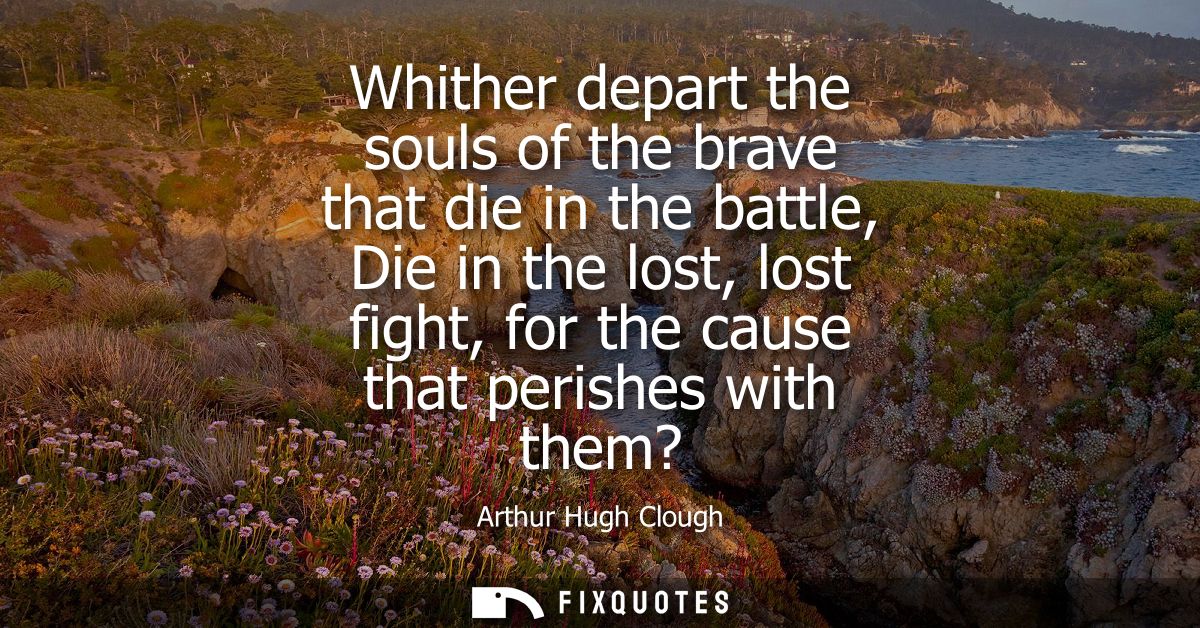
"Whither depart the souls of the brave that die in the battle, die in the lost, lost fight, for the cause that perishes with them?"
About this Quote
The subtext is a crisis of moral bookkeeping. Victorian culture loved noble sacrifice, especially when it could be narrated as progress. Clough refuses that comforting arithmetic. His brave are brave, yes, but their courage purchases nothing durable; the cause "perishes with them". That line is brutal because it strips war of its most popular after-market accessory: meaning.
Context matters. Writing in the mid-19th century, Clough is positioned between fading religious certainties and a modern skepticism that can still feel like betrayal. He’s not cynically sneering at idealism; he’s interrogating it under pressure, when faith in providence and faith in political movements both look fragile. The rhetorical question becomes an ethical test: if there is no cosmic storage unit for wasted valor, do we keep praising the beautiful deaths, or do we finally demand better reasons to ask people to die?
Quote Details
| Topic | War |
|---|---|
| Source | Help us find the source |
| Cite |
Citation Formats
APA Style (7th ed.)
Clough, Arthur Hugh. (2026, February 19). Whither depart the souls of the brave that die in the battle, die in the lost, lost fight, for the cause that perishes with them? FixQuotes. https://fixquotes.com/quotes/whither-depart-the-souls-of-the-brave-that-die-in-38871/
Chicago Style
Clough, Arthur Hugh. "Whither depart the souls of the brave that die in the battle, die in the lost, lost fight, for the cause that perishes with them?" FixQuotes. February 19, 2026. https://fixquotes.com/quotes/whither-depart-the-souls-of-the-brave-that-die-in-38871/.
MLA Style (9th ed.)
"Whither depart the souls of the brave that die in the battle, die in the lost, lost fight, for the cause that perishes with them?" FixQuotes, 19 Feb. 2026, https://fixquotes.com/quotes/whither-depart-the-souls-of-the-brave-that-die-in-38871/. Accessed 22 Mar. 2026.