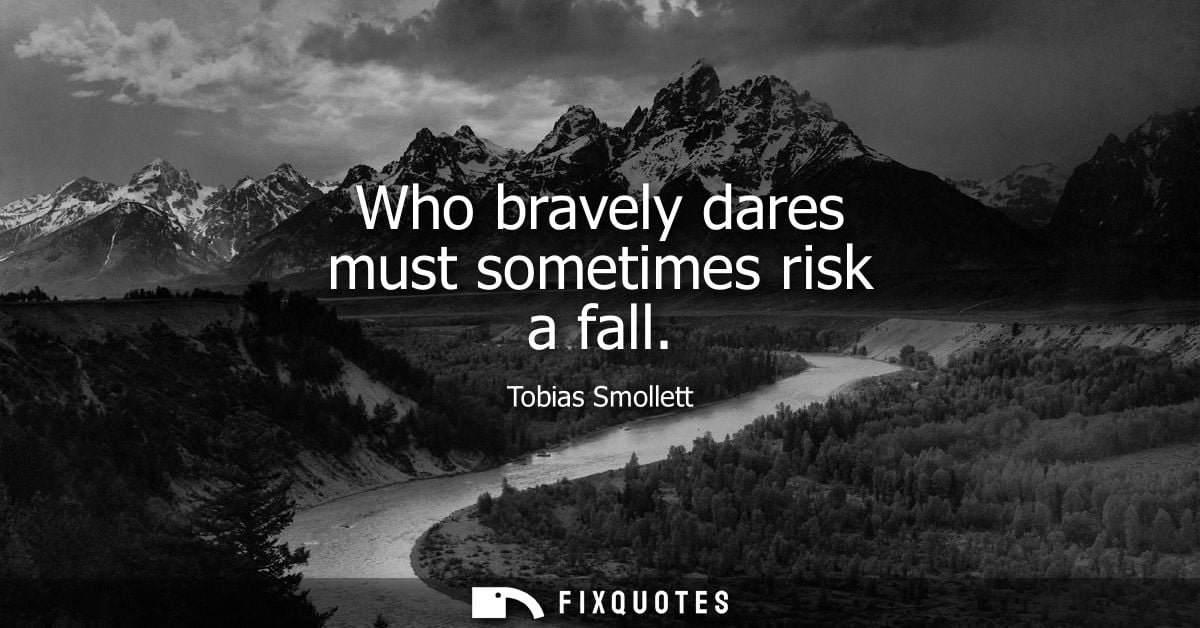
"Who bravely dares must sometimes risk a fall"
About this Quote
Smollett’s line flatters courage while quietly reminding you that heroism is a contact sport. “Bravely dares” is not the glossy, inspirational dare of posters and pep talks; it’s the older, rougher sense of stepping into uncertainty with your eyes open. The sentence is engineered around inevitability. Not “may” risk a fall, but “must sometimes” - a clause that shrugs at misfortune the way an 18th-century novelist might shrug at a drunk duel, a botched scheme, or a shipwrecked ambition. Risk isn’t the price of entry; it’s baked into the act.
The subtext is practical, even a little corrective. Smollett wrote in a culture that romanticized valor (military glory, gentlemanly daring, imperial adventure) while also running on debt, patronage, and reputations that could collapse overnight. The “fall” is elastic: literal injury, social disgrace, financial ruin, moral backsliding. It gestures at a world where consequences are not abstract lessons but public events, and where the brave are often punished not for villainy but for exposure.
What makes the line work is its balancing act. It grants dignity to the risk-taker without sanctifying success. In Smollett’s fiction and era, aspiration is frequently comic, bruising, and instructive: people reach beyond their station, their luck, their judgment - and gravity does the editing. The intent isn’t to scare you off; it’s to strip bravado of its alibi. If you dare, you’re consenting to the possibility of becoming a cautionary tale.
The subtext is practical, even a little corrective. Smollett wrote in a culture that romanticized valor (military glory, gentlemanly daring, imperial adventure) while also running on debt, patronage, and reputations that could collapse overnight. The “fall” is elastic: literal injury, social disgrace, financial ruin, moral backsliding. It gestures at a world where consequences are not abstract lessons but public events, and where the brave are often punished not for villainy but for exposure.
What makes the line work is its balancing act. It grants dignity to the risk-taker without sanctifying success. In Smollett’s fiction and era, aspiration is frequently comic, bruising, and instructive: people reach beyond their station, their luck, their judgment - and gravity does the editing. The intent isn’t to scare you off; it’s to strip bravado of its alibi. If you dare, you’re consenting to the possibility of becoming a cautionary tale.
Quote Details
| Topic | Motivational |
|---|---|
| Source | Help us find the source |
More Quotes by Tobias
Add to List