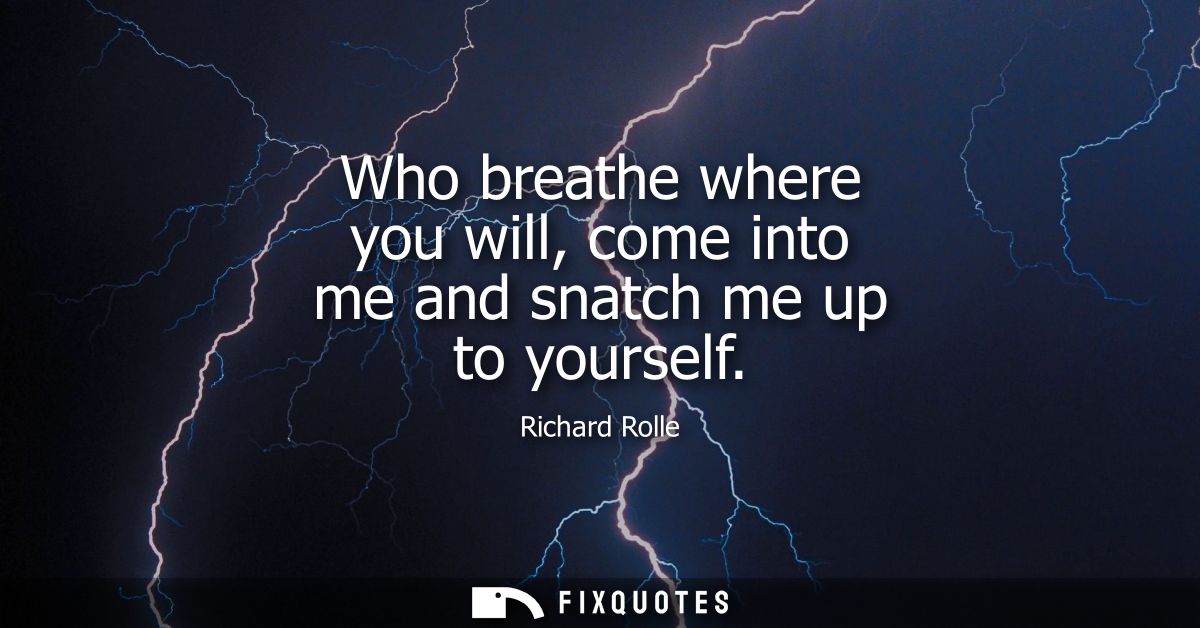
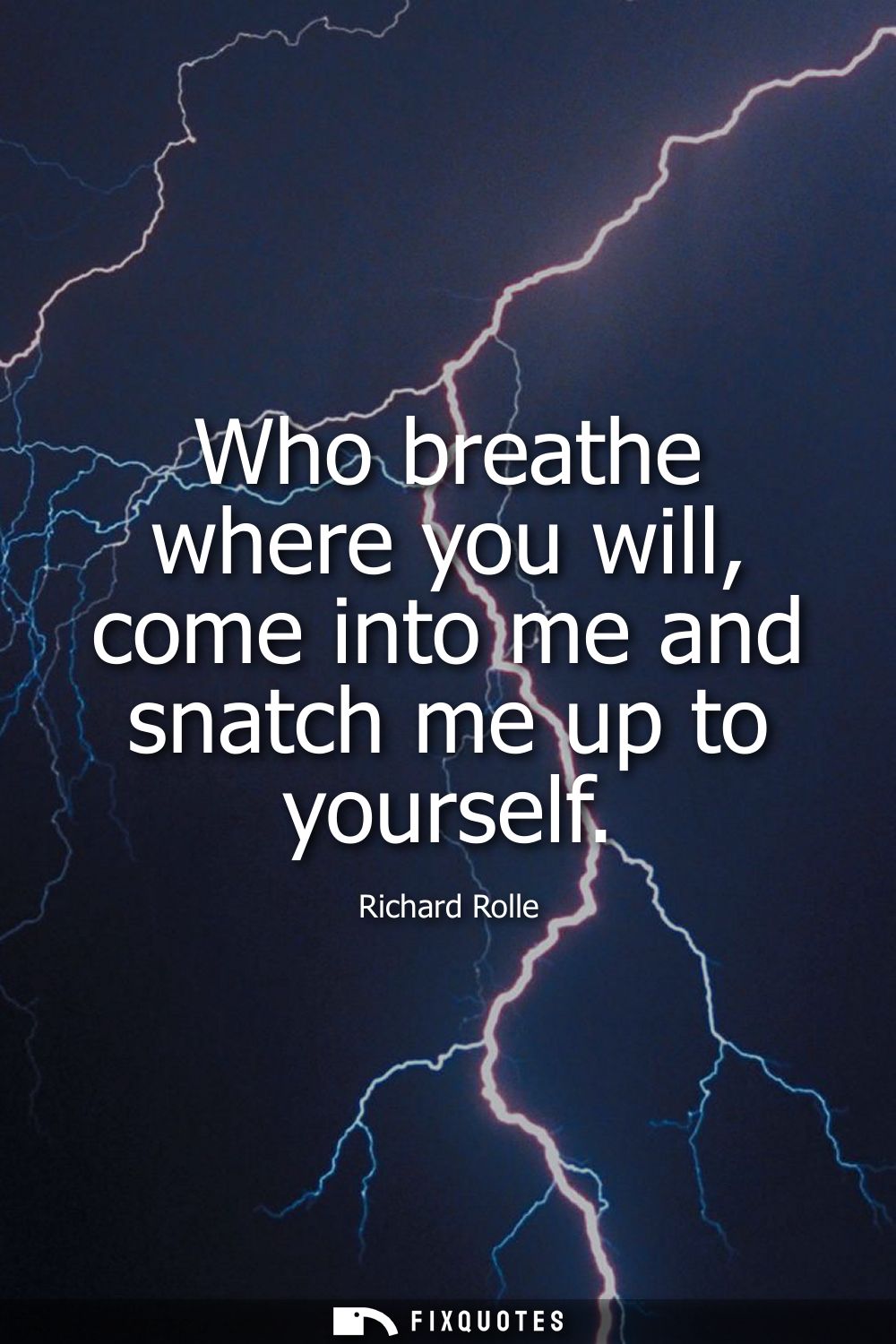
"Who breathe where you will, come into me and snatch me up to yourself"
About this Quote
An ecstatic dare disguised as a plea, Rolle’s line makes spirituality feel less like doctrine and more like physical abduction. “Who breathe where you will” opens with a startling looseness: the divine isn’t pinned to a church, a relic, or a correct opinion. God is breath, mobile and invasive, crossing borders the way air does. That first clause carries a quiet rebuke to spiritual gatekeeping, insisting that grace is not owned by institutions or even by the seeker’s effort.
Then the sentence tightens into appetite and vulnerability: “come into me and snatch me up to yourself.” Rolle doesn’t ask to be instructed; he asks to be taken. The verb “snatch” is the masterstroke: abrupt, a little violent, charged with desire. It turns salvation into a kind of rapture with teeth, implying that the self is not merely improved but interrupted. Subtextually, the speaker is tired of managing his own holiness. He wants surrender that feels like rescue.
Context matters: Rolle is writing out of the medieval English mystical tradition, where intense interior experience (heat, sweetness, song) was treated as evidence that the sacred could be felt in the body, not just argued in the mind. The line’s intimacy also hints at the risks of that tradition: it flirts with erotic language to describe God, collapsing the distance between human longing and divine presence. The intent is not to shock for its own sake, but to make devotion credible by making it visceral.
Then the sentence tightens into appetite and vulnerability: “come into me and snatch me up to yourself.” Rolle doesn’t ask to be instructed; he asks to be taken. The verb “snatch” is the masterstroke: abrupt, a little violent, charged with desire. It turns salvation into a kind of rapture with teeth, implying that the self is not merely improved but interrupted. Subtextually, the speaker is tired of managing his own holiness. He wants surrender that feels like rescue.
Context matters: Rolle is writing out of the medieval English mystical tradition, where intense interior experience (heat, sweetness, song) was treated as evidence that the sacred could be felt in the body, not just argued in the mind. The line’s intimacy also hints at the risks of that tradition: it flirts with erotic language to describe God, collapsing the distance between human longing and divine presence. The intent is not to shock for its own sake, but to make devotion credible by making it visceral.
Quote Details
| Topic | Prayer |
|---|---|
| Source | Help us find the source |
| Cite |
Citation Formats
APA Style (7th ed.)
Rolle, Richard. (2026, January 16). Who breathe where you will, come into me and snatch me up to yourself. FixQuotes. https://fixquotes.com/quotes/who-breathe-where-you-will-come-into-me-and-116050/
Chicago Style
Rolle, Richard. "Who breathe where you will, come into me and snatch me up to yourself." FixQuotes. January 16, 2026. https://fixquotes.com/quotes/who-breathe-where-you-will-come-into-me-and-116050/.
MLA Style (9th ed.)
"Who breathe where you will, come into me and snatch me up to yourself." FixQuotes, 16 Jan. 2026, https://fixquotes.com/quotes/who-breathe-where-you-will-come-into-me-and-116050/. Accessed 25 Mar. 2026.
More Quotes by Richard
Add to List