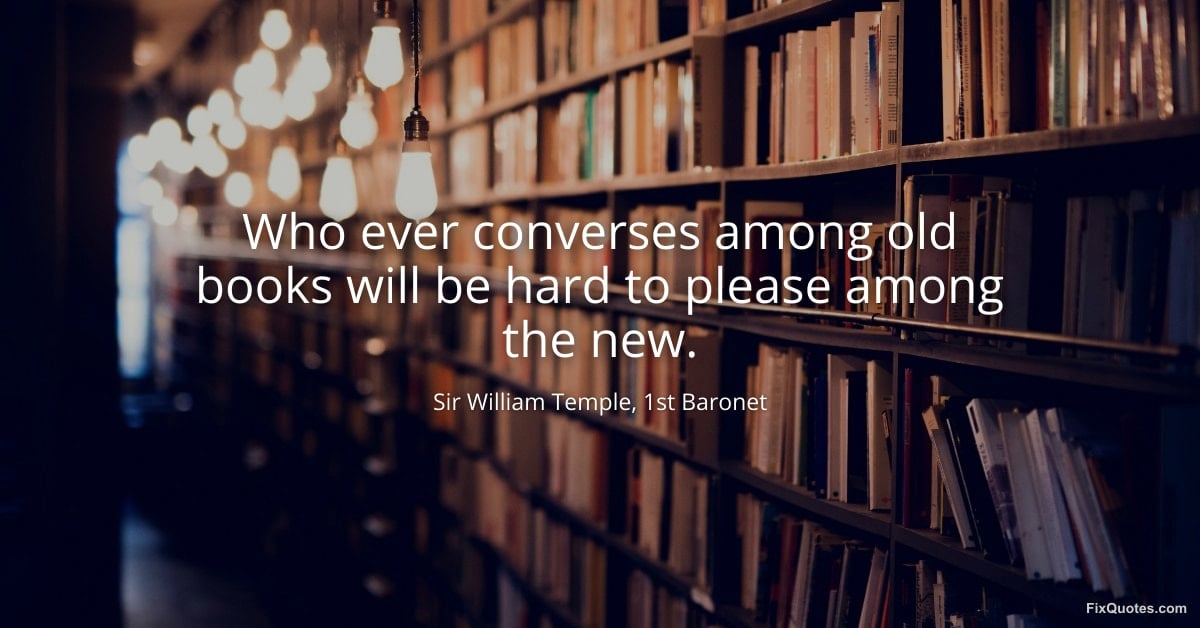
"Who ever converses among old books will be hard to please among the new"
About this Quote
“Hard to please” is doing double duty. On its face, it’s a badge of discernment: classics raise standards. Underneath, it hints at a social cost. If you form your taste in dialogue with writers who had fewer incentives to be instantly legible or market-friendly, contemporary work can register as rushed, trend-chasing, or overly certain of its own relevance. Temple is naming a mismatch between tempos: old books assume you will come to them; new books often feel obliged to come to you.
Contextually, the sentiment fits a long tradition of early modern and Enlightenment anxiety about novelty. Printing, expanding literacy, and a growing market for “new” titles made freshness a selling point. Temple’s skepticism reads less like nostalgia for dust and more like suspicion of the churn: when newness becomes the pitch, depth becomes optional. The subtext isn’t that modern writing can’t be great; it’s that greatness rarely advertises itself as “new.”
Quote Details
| Topic | Book |
|---|---|
| Source | Help us find the source |
| Cite |
Citation Formats
APA Style (7th ed.)
Baronet, Sir William Temple, 1st. (2026, January 28). Who ever converses among old books will be hard to please among the new. FixQuotes. https://fixquotes.com/quotes/who-ever-converses-among-old-books-will-be-hard-170319/
Chicago Style
Baronet, Sir William Temple, 1st. "Who ever converses among old books will be hard to please among the new." FixQuotes. January 28, 2026. https://fixquotes.com/quotes/who-ever-converses-among-old-books-will-be-hard-170319/.
MLA Style (9th ed.)
"Who ever converses among old books will be hard to please among the new." FixQuotes, 28 Jan. 2026, https://fixquotes.com/quotes/who-ever-converses-among-old-books-will-be-hard-170319/. Accessed 12 Feb. 2026.