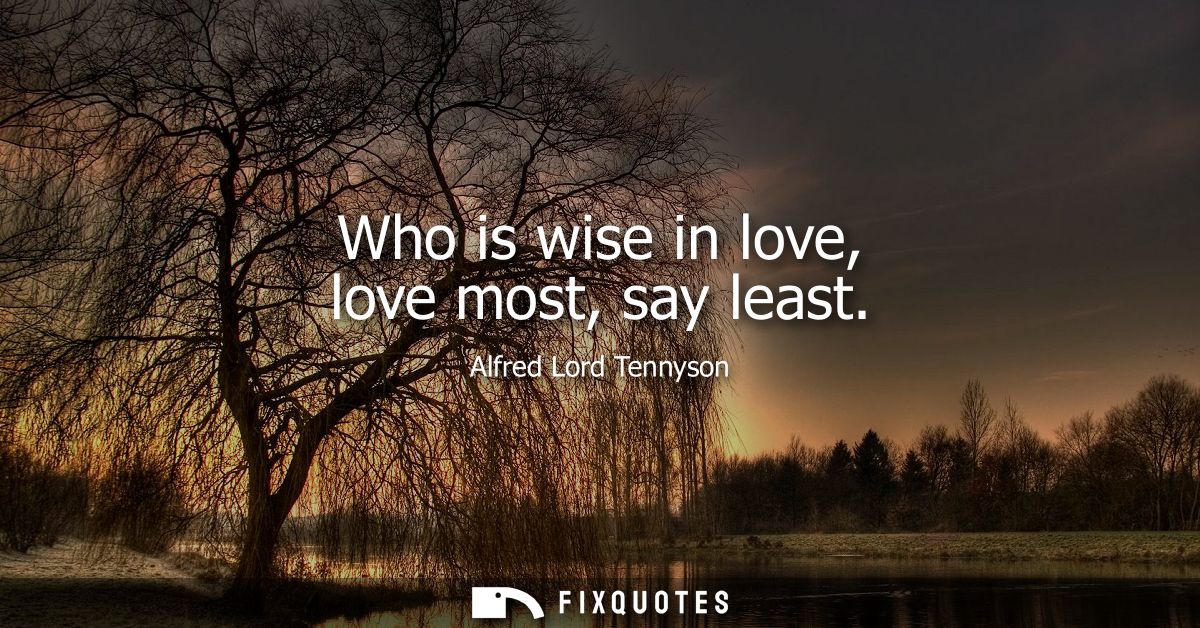
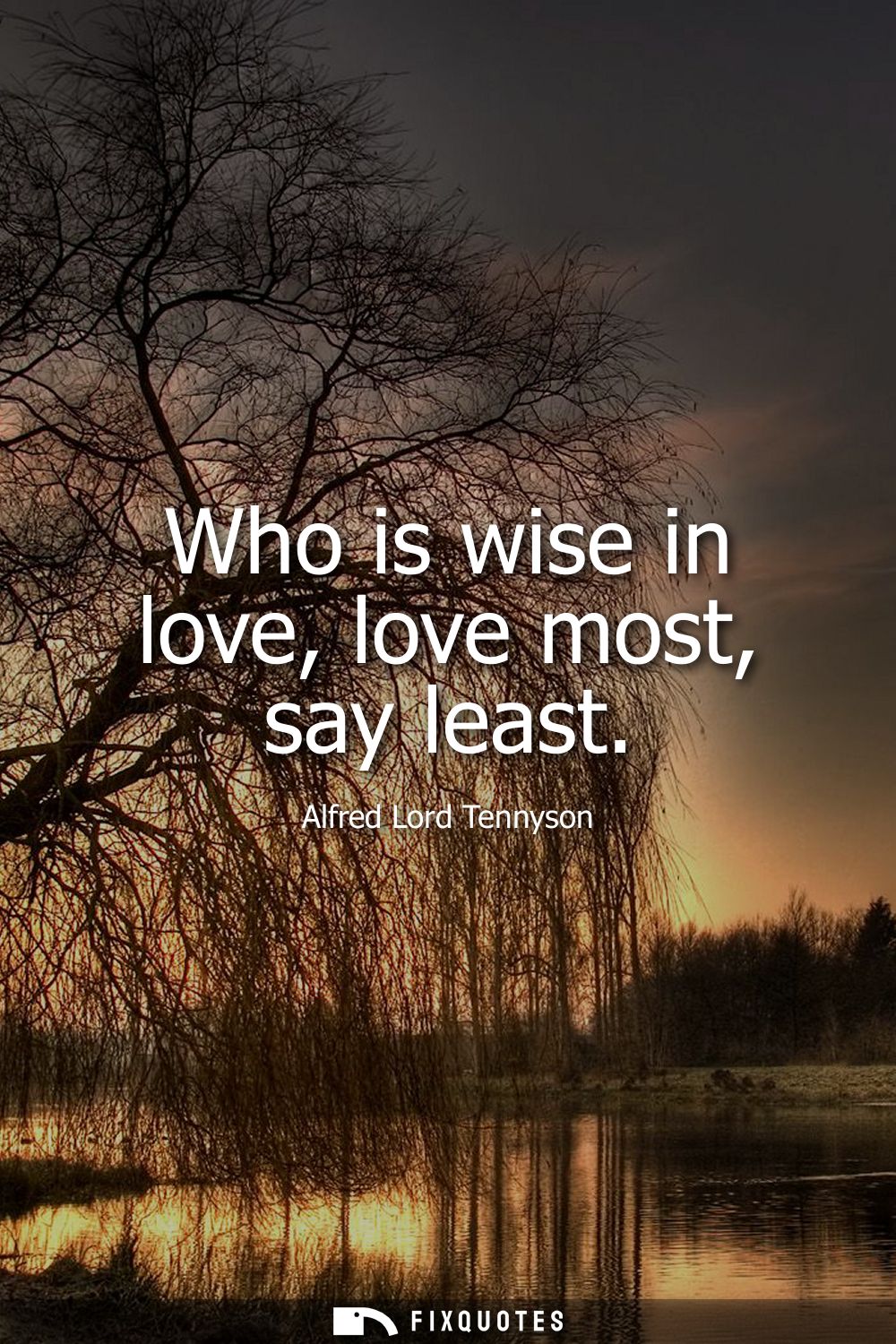
"Who is wise in love, love most, say least"
About this Quote
Aphorisms like this are Tennyson at his most Victorian: a pocket-sized moral, polished until it glints, and quietly barbed. “Wise in love” sounds like a compliment, but it’s also a warning. Wisdom here isn’t cleverness or conquest; it’s restraint. The line argues that real depth of feeling doesn’t need a press release. The more serious the love, the less performative the language around it.
The syntax does half the work. The choppy, imperative rhythm (“love most, say least”) feels like a maxim whispered across a drawing room: control yourself, don’t spill. Tennyson is making an aesthetic claim (silence as elegance) and a social one (silence as safety). In a culture obsessed with propriety, reputation, and the dangers of emotional excess, talk is risk. Words can cheapen what they claim to honor; they can also expose you to ridicule, gossip, or betrayal. Saying less becomes both proof of sincerity and a shield.
There’s subtextual irony, too: a poet famous for sumptuous language insisting that love should be tacit. It’s not anti-expression so much as anti-verbosity, anti-sentimentality, anti-display. Tennyson knew that declarations can be a kind of vanity, turning another person into an audience. “Wise in love” suggests an ethic of attention: love as practice rather than proclamation.
Placed against Victorian ideals of stoicism and emotional discipline, the line reads like cultural coaching for intimacy under surveillance. It’s also timelessly modern: if love is real, it doesn’t need to be constantly narrated.
The syntax does half the work. The choppy, imperative rhythm (“love most, say least”) feels like a maxim whispered across a drawing room: control yourself, don’t spill. Tennyson is making an aesthetic claim (silence as elegance) and a social one (silence as safety). In a culture obsessed with propriety, reputation, and the dangers of emotional excess, talk is risk. Words can cheapen what they claim to honor; they can also expose you to ridicule, gossip, or betrayal. Saying less becomes both proof of sincerity and a shield.
There’s subtextual irony, too: a poet famous for sumptuous language insisting that love should be tacit. It’s not anti-expression so much as anti-verbosity, anti-sentimentality, anti-display. Tennyson knew that declarations can be a kind of vanity, turning another person into an audience. “Wise in love” suggests an ethic of attention: love as practice rather than proclamation.
Placed against Victorian ideals of stoicism and emotional discipline, the line reads like cultural coaching for intimacy under surveillance. It’s also timelessly modern: if love is real, it doesn’t need to be constantly narrated.
Quote Details
| Topic | Love |
|---|---|
| Source | Help us find the source |
| Cite |
Citation Formats
APA Style (7th ed.)
Tennyson, Alfred Lord. (2026, January 18). Who is wise in love, love most, say least. FixQuotes. https://fixquotes.com/quotes/who-is-wise-in-love-love-most-say-least-3661/
Chicago Style
Tennyson, Alfred Lord. "Who is wise in love, love most, say least." FixQuotes. January 18, 2026. https://fixquotes.com/quotes/who-is-wise-in-love-love-most-say-least-3661/.
MLA Style (9th ed.)
"Who is wise in love, love most, say least." FixQuotes, 18 Jan. 2026, https://fixquotes.com/quotes/who-is-wise-in-love-love-most-say-least-3661/. Accessed 30 Mar. 2026.
More Quotes by Alfred
Add to List