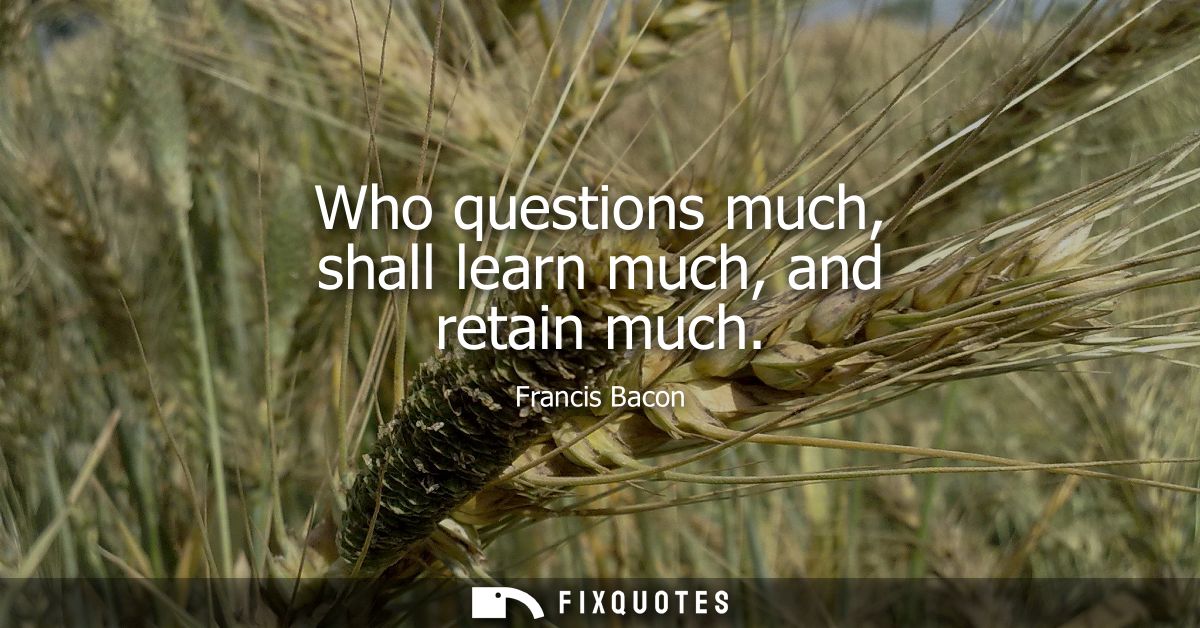
"Who questions much, shall learn much, and retain much"
About this Quote
Bacon’s line reads like a compact piece of self-help, but it’s really a power tool disguised as piety. “Who questions much” isn’t mere curiosity; it’s an ethic of suspicion aimed at the era’s inherited certainties. In late-Elizabethan and Jacobean England, knowledge still leaned heavily on authority: the church, classical texts, aristocratic “wisdom.” Bacon’s project was to reroute that prestige away from reverence and toward method. Questioning becomes a kind of civic duty for the mind.
The sentence is engineered to reward skepticism. Its rhythm is transactional: question more, get more - learn much, retain much. That’s a subtle pitch to the ambitious reader. Bacon, a statesman as much as a philosopher, understood incentives. He’s selling a practice that produces results, not a posture that wins arguments. The subtext is quietly anti-scholastic: if you’re not interrogating, you’re not thinking, you’re reciting.
“Retain much” is the kicker. Bacon isn’t praising endless doubt or performative contrarianism. He’s arguing that inquiry improves memory because it builds structure - you remember what you’ve stress-tested, what you’ve had to defend against your own objections. Questioning turns information into understanding, and understanding sticks.
There’s also a political edge. Questioning trains independence, and independent minds are harder to govern by myth. Bacon’s modernity is in that wager: a society that prizes questions over deference will produce knowledge with consequences - scientific, economic, and ideological.
The sentence is engineered to reward skepticism. Its rhythm is transactional: question more, get more - learn much, retain much. That’s a subtle pitch to the ambitious reader. Bacon, a statesman as much as a philosopher, understood incentives. He’s selling a practice that produces results, not a posture that wins arguments. The subtext is quietly anti-scholastic: if you’re not interrogating, you’re not thinking, you’re reciting.
“Retain much” is the kicker. Bacon isn’t praising endless doubt or performative contrarianism. He’s arguing that inquiry improves memory because it builds structure - you remember what you’ve stress-tested, what you’ve had to defend against your own objections. Questioning turns information into understanding, and understanding sticks.
There’s also a political edge. Questioning trains independence, and independent minds are harder to govern by myth. Bacon’s modernity is in that wager: a society that prizes questions over deference will produce knowledge with consequences - scientific, economic, and ideological.
Quote Details
| Topic | Knowledge |
|---|---|
| Source | Later attribution: The Art of Asking Better Questions (J.R. Briggs, 2025) modern compilationISBN: 9781514011126 · ID: LshCEQAAQBAJ
Evidence:
... Who questions much , shall learn much , and retain much . FRANCIS BACON ONA N A WARM SUMMER FRIDAY NIGHT , friends gathered on the back patio of a Capitol Hill home in Washington , DC , for a night of steaks , jumbo shrimp , and good ... |
| Cite |
Citation Formats
APA Style (7th ed.)
Bacon, Francis. (2026, February 8). Who questions much, shall learn much, and retain much. FixQuotes. https://fixquotes.com/quotes/who-questions-much-shall-learn-much-and-retain-6671/
Chicago Style
Bacon, Francis. "Who questions much, shall learn much, and retain much." FixQuotes. February 8, 2026. https://fixquotes.com/quotes/who-questions-much-shall-learn-much-and-retain-6671/.
MLA Style (9th ed.)
"Who questions much, shall learn much, and retain much." FixQuotes, 8 Feb. 2026, https://fixquotes.com/quotes/who-questions-much-shall-learn-much-and-retain-6671/. Accessed 20 Mar. 2026.
More Quotes by Francis
Add to List