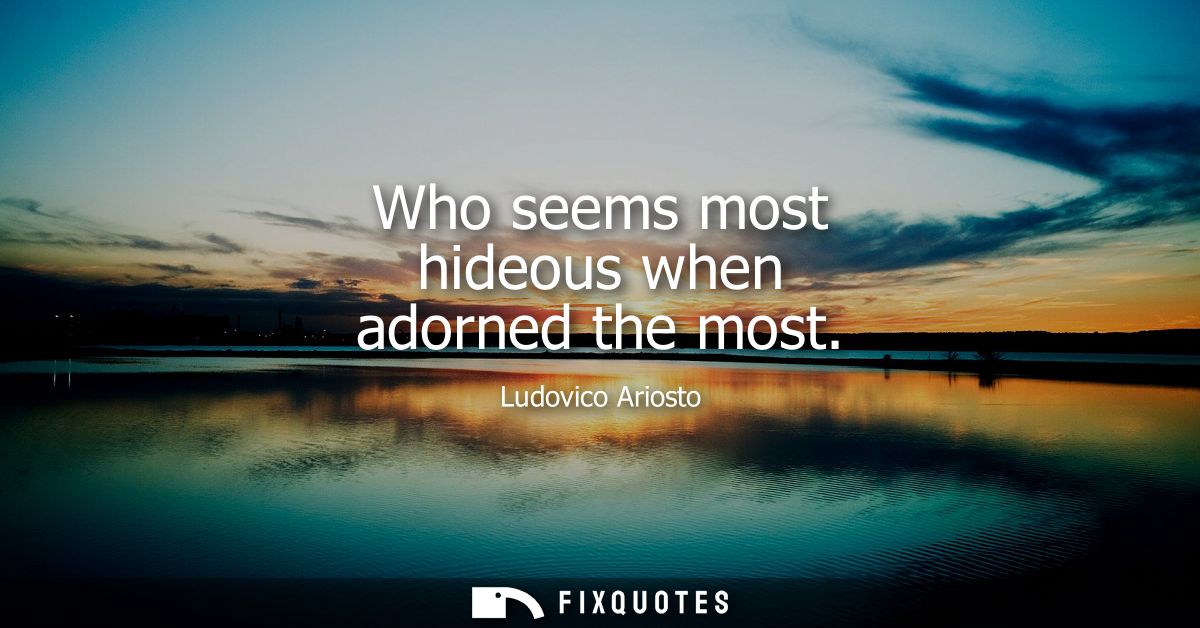
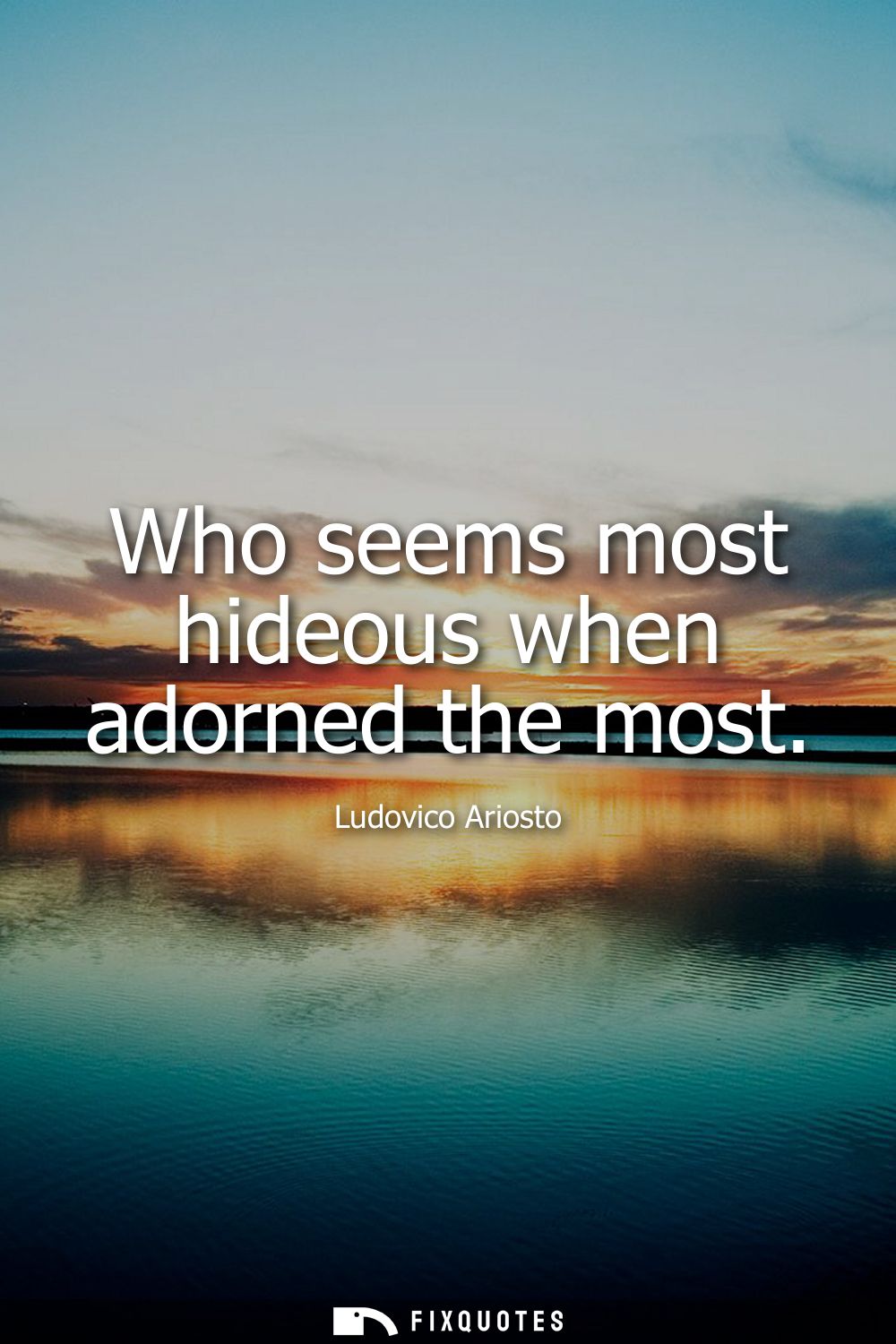
"Who seems most hideous when adorned the most"
About this Quote
Beauty, Ariosto suggests, is not a neutral glow-up; it is a stress test. "Who seems most hideous when adorned the most" flips the courtly promise that ornament refines the self. Instead, adornment becomes a spotlight so bright it exposes what polish was meant to conceal. The line is cruel in a controlled, Renaissance way: it implies that some people don’t merely fail to benefit from finery - they are actively betrayed by it.
The specific intent feels double-edged. On the surface, it reads like a jab at vanity, the kind of moral shorthand that could sit comfortably in a culture obsessed with decorum and rank. But the subtext is sharper: Ariosto is poking at the theatricality of status. In a world where identity is performed through clothing, jewels, and ritual display, the mismatch between surface and substance becomes legible. Adornment is supposed to harmonize; when it doesn’t, it reveals an inner disorder - not just ugliness, but inauthenticity.
Context matters. Ariosto writes in the orbit of court culture and chivalric romance, where appearances are currency and virtue is often staged. This line plays like an aside from a poet who knows the pageantry intimately and doesn’t fully buy it. It works because it weaponizes a common assumption - that more polish equals more worth - and reverses it, turning elegance into indictment. In Ariosto’s hands, fashion isn’t self-expression; it’s evidence.
The specific intent feels double-edged. On the surface, it reads like a jab at vanity, the kind of moral shorthand that could sit comfortably in a culture obsessed with decorum and rank. But the subtext is sharper: Ariosto is poking at the theatricality of status. In a world where identity is performed through clothing, jewels, and ritual display, the mismatch between surface and substance becomes legible. Adornment is supposed to harmonize; when it doesn’t, it reveals an inner disorder - not just ugliness, but inauthenticity.
Context matters. Ariosto writes in the orbit of court culture and chivalric romance, where appearances are currency and virtue is often staged. This line plays like an aside from a poet who knows the pageantry intimately and doesn’t fully buy it. It works because it weaponizes a common assumption - that more polish equals more worth - and reverses it, turning elegance into indictment. In Ariosto’s hands, fashion isn’t self-expression; it’s evidence.
Quote Details
| Topic | Witty One-Liners |
|---|---|
| Source | Help us find the source |
| Cite |
Citation Formats
APA Style (7th ed.)
Ariosto, Ludovico. (2026, January 17). Who seems most hideous when adorned the most. FixQuotes. https://fixquotes.com/quotes/who-seems-most-hideous-when-adorned-the-most-63628/
Chicago Style
Ariosto, Ludovico. "Who seems most hideous when adorned the most." FixQuotes. January 17, 2026. https://fixquotes.com/quotes/who-seems-most-hideous-when-adorned-the-most-63628/.
MLA Style (9th ed.)
"Who seems most hideous when adorned the most." FixQuotes, 17 Jan. 2026, https://fixquotes.com/quotes/who-seems-most-hideous-when-adorned-the-most-63628/. Accessed 12 Feb. 2026.
More Quotes by Ludovico
Add to List