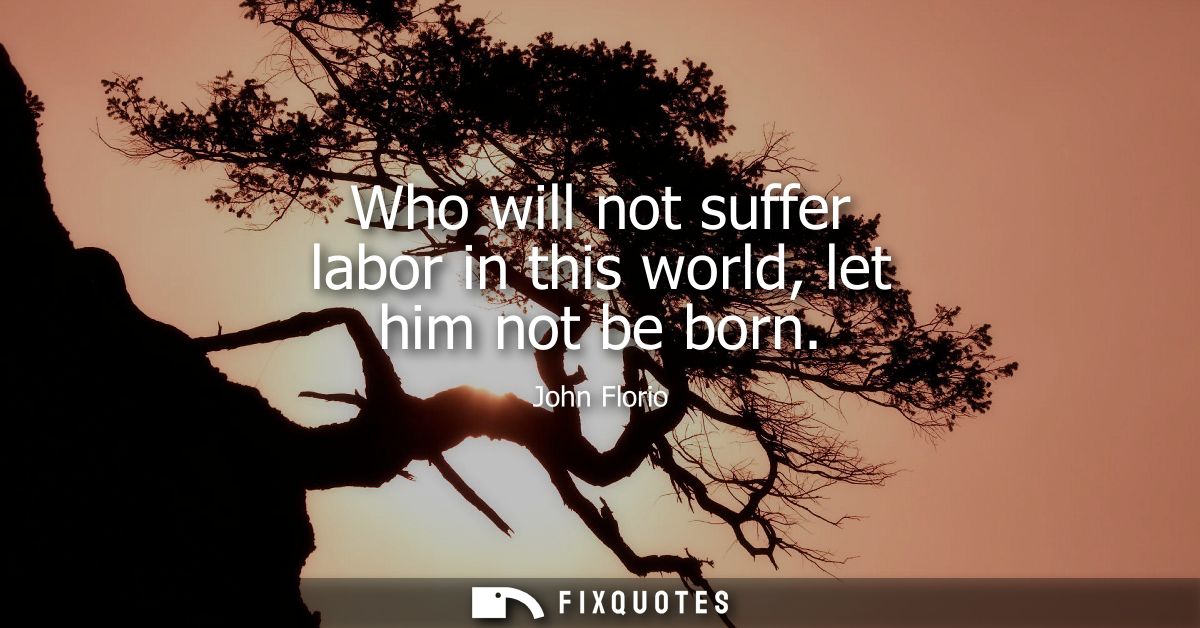
"Who will not suffer labor in this world, let him not be born"
About this Quote
Florio’s line lands like a moral slap delivered with a schoolmaster’s economy: existence comes with dues, and the entry fee is work. The phrasing is deliberately absolutist, almost mock-biblical in its cadence, turning personal complaint into a cosmic rule. “Suffer labor” isn’t just “work hard”; it frames effort as a kind of ordained discomfort, a necessary friction that proves you’re alive and accountable. Then the kicker - “let him not be born” - yanks the thought out of self-help territory and into stark social judgment. If you won’t shoulder the burden, you don’t merely fail; you forfeit the right to be here.
The context matters. Florio, an Italian-born English writer and translator working in late Elizabethan and early Jacobean England, lived in a culture obsessed with industry, discipline, and moral legibility. This is the era when idleness gets cast as a civic threat and work becomes a kind of public virtue-signaling - not just an economic necessity but a proof of character. As a linguistic mediator (the man who helps England “get” continental ideas), Florio also knew that words are status: he made his living through labor that was intellectual, precarious, and relentlessly judged.
Subtextually, the quote polices entitlement. It’s aimed at the fantasists who want the rewards of society without the grind that sustains it. The cruelty is part of the rhetoric: exaggeration functions as a gate, separating the serious from the soft. Florio isn’t offering comfort; he’s building a worldview where labor is the price of admission and complaining is evidence you don’t deserve the ticket.
The context matters. Florio, an Italian-born English writer and translator working in late Elizabethan and early Jacobean England, lived in a culture obsessed with industry, discipline, and moral legibility. This is the era when idleness gets cast as a civic threat and work becomes a kind of public virtue-signaling - not just an economic necessity but a proof of character. As a linguistic mediator (the man who helps England “get” continental ideas), Florio also knew that words are status: he made his living through labor that was intellectual, precarious, and relentlessly judged.
Subtextually, the quote polices entitlement. It’s aimed at the fantasists who want the rewards of society without the grind that sustains it. The cruelty is part of the rhetoric: exaggeration functions as a gate, separating the serious from the soft. Florio isn’t offering comfort; he’s building a worldview where labor is the price of admission and complaining is evidence you don’t deserve the ticket.
Quote Details
| Topic | Meaning of Life |
|---|---|
| Source | Help us find the source |
| Cite |
Citation Formats
APA Style (7th ed.)
Florio, John. (2026, January 16). Who will not suffer labor in this world, let him not be born. FixQuotes. https://fixquotes.com/quotes/who-will-not-suffer-labor-in-this-world-let-him-85893/
Chicago Style
Florio, John. "Who will not suffer labor in this world, let him not be born." FixQuotes. January 16, 2026. https://fixquotes.com/quotes/who-will-not-suffer-labor-in-this-world-let-him-85893/.
MLA Style (9th ed.)
"Who will not suffer labor in this world, let him not be born." FixQuotes, 16 Jan. 2026, https://fixquotes.com/quotes/who-will-not-suffer-labor-in-this-world-let-him-85893/. Accessed 28 Mar. 2026.
More Quotes by John
Add to List