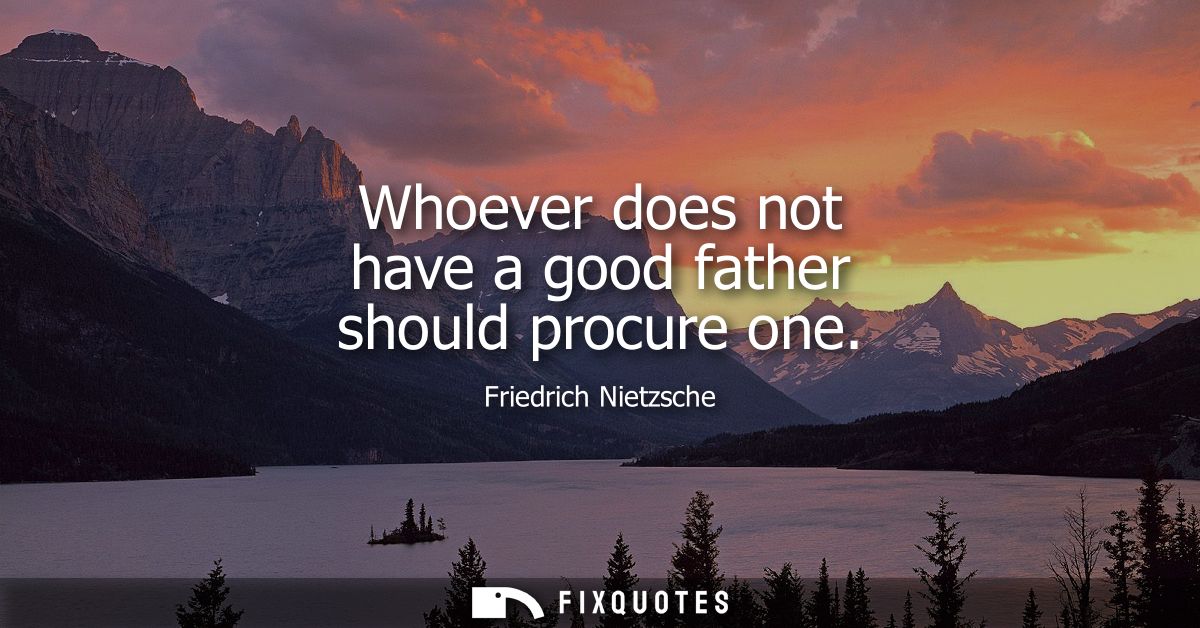
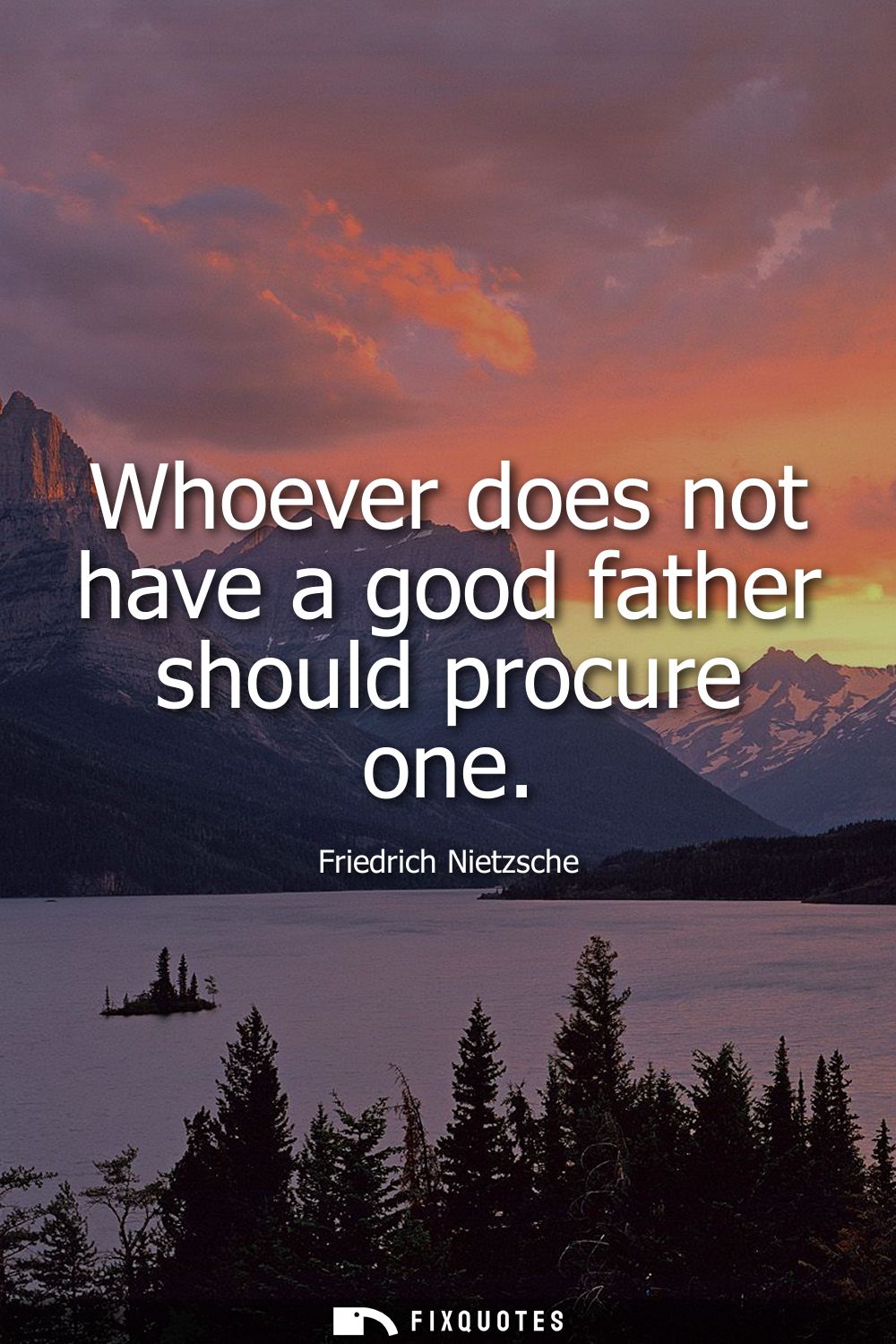
"Whoever does not have a good father should procure one"
About this Quote
Nietzsche’s line lands like a dare dressed up as advice: if you weren’t handed a “good father,” go get one. It’s a provocation aimed less at dads than at dependency. The verb “procure” is doing sly work here. It’s not “find” or “seek” or “discover,” but something closer to acquire, arrange, even smuggle in. Paternal authority becomes a tool, not a fate - which is very Nietzsche: origins don’t get veto power over your future.
The subtext is that a “father” is a function before it’s a person. It can mean a mentor, an intellectual lineage, a disciplinary ideal, a standard you submit to long enough to outgrow. Nietzsche is obsessed with how people borrow frameworks to stabilize themselves: religion, morality, nationalism, “culture.” He’s skeptical of inherited structures, yet he’s equally scornful of the modern soul that free-floats, mistaking rootlessness for freedom. This aphorism threads that needle. If your formation lacked a firm hand, you don’t earn liberation by staying unformed; you supply the missing constraint.
Context matters because Nietzsche is writing in a Europe where “the death of God” is not just a theological quip but a cultural emergency: old fathers are failing, metaphysical and biological alike. The line carries a whiff of self-help avant la lettre, but with steel underneath: choose your authority consciously, then use it to forge yourself. It’s less a sentimental lament for fatherhood than a strategy for survival in a world where the inherited scripts no longer hold.
The subtext is that a “father” is a function before it’s a person. It can mean a mentor, an intellectual lineage, a disciplinary ideal, a standard you submit to long enough to outgrow. Nietzsche is obsessed with how people borrow frameworks to stabilize themselves: religion, morality, nationalism, “culture.” He’s skeptical of inherited structures, yet he’s equally scornful of the modern soul that free-floats, mistaking rootlessness for freedom. This aphorism threads that needle. If your formation lacked a firm hand, you don’t earn liberation by staying unformed; you supply the missing constraint.
Context matters because Nietzsche is writing in a Europe where “the death of God” is not just a theological quip but a cultural emergency: old fathers are failing, metaphysical and biological alike. The line carries a whiff of self-help avant la lettre, but with steel underneath: choose your authority consciously, then use it to forge yourself. It’s less a sentimental lament for fatherhood than a strategy for survival in a world where the inherited scripts no longer hold.
Quote Details
| Topic | Father |
|---|---|
| Source | Help us find the source |
| Cite |
Citation Formats
APA Style (7th ed.)
Nietzsche, Friedrich. (2026, January 18). Whoever does not have a good father should procure one. FixQuotes. https://fixquotes.com/quotes/whoever-does-not-have-a-good-father-should-327/
Chicago Style
Nietzsche, Friedrich. "Whoever does not have a good father should procure one." FixQuotes. January 18, 2026. https://fixquotes.com/quotes/whoever-does-not-have-a-good-father-should-327/.
MLA Style (9th ed.)
"Whoever does not have a good father should procure one." FixQuotes, 18 Jan. 2026, https://fixquotes.com/quotes/whoever-does-not-have-a-good-father-should-327/. Accessed 13 Feb. 2026.
More Quotes by Friedrich
Add to List