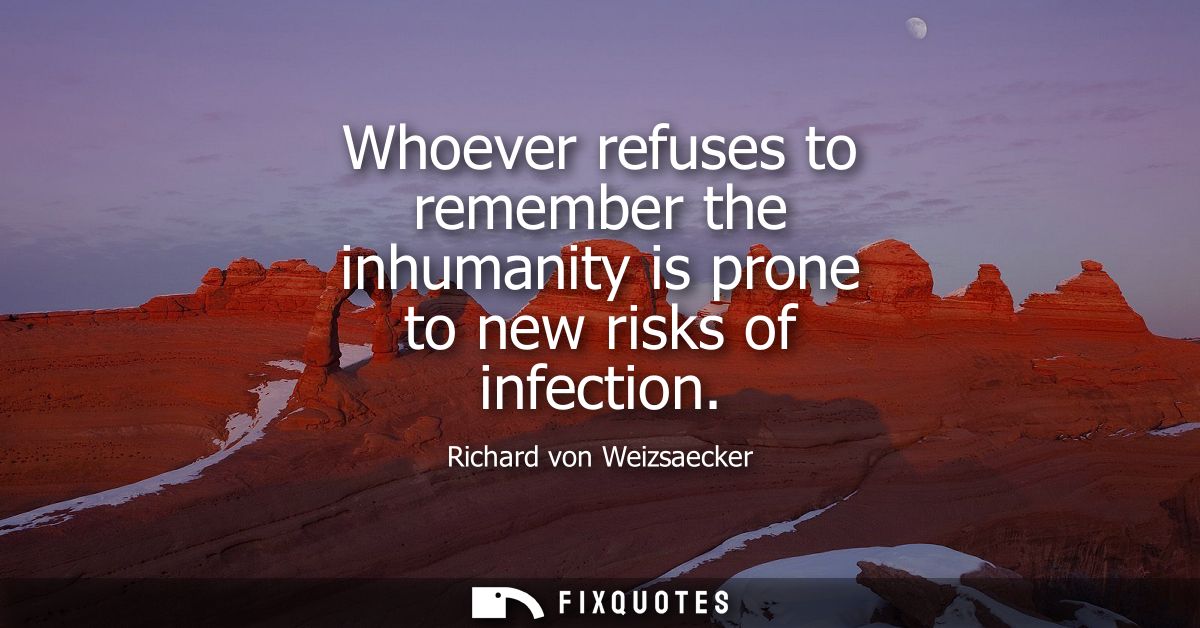
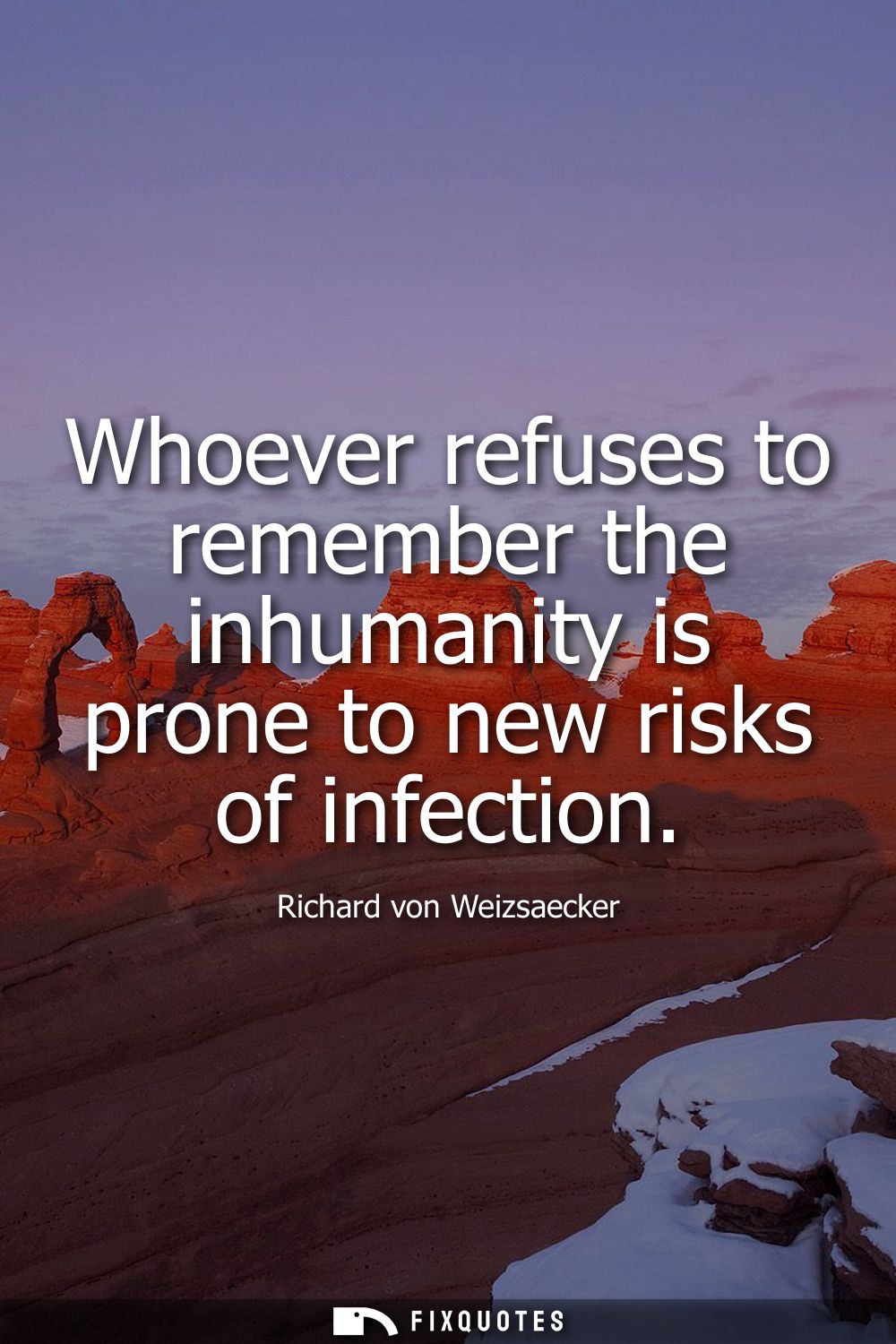
"Whoever refuses to remember the inhumanity is prone to new risks of infection"
About this Quote
The subtext is aimed at a familiar temptation in postwar societies: to treat historical atrocity as a closed chapter, an embarrassment to file away so national life can feel “normal” again. Weizsaecker rejects that bargain. His “refuses” matters: forgetting is not passive drift but an act of will, a decision to look away. That moral choice carries consequences, not only for victims’ dignity but for the political culture that follows. A society that won’t remember how ordinary systems and ordinary people can be recruited into cruelty is more likely to accept the next round of scapegoating, euphemism, and bureaucratic violence.
Context gives the warning its edge. Weizsaecker is associated with Germany’s mature phase of Vergangenheitsbewaltigung, the hard work of confronting Nazi crimes publicly rather than hiding behind myths of collective innocence. “New risks of infection” reads like a rebuke to complacency: the danger isn’t that history repeats with identical uniforms, but that its logic returns in updated forms. Remembrance, in this view, is less about guilt than about prevention.
Quote Details
| Topic | Legacy & Remembrance |
|---|---|
| Source | Help us find the source |
| Cite |
Citation Formats
APA Style (7th ed.)
Weizsaecker, Richard von. (2026, January 16). Whoever refuses to remember the inhumanity is prone to new risks of infection. FixQuotes. https://fixquotes.com/quotes/whoever-refuses-to-remember-the-inhumanity-is-106095/
Chicago Style
Weizsaecker, Richard von. "Whoever refuses to remember the inhumanity is prone to new risks of infection." FixQuotes. January 16, 2026. https://fixquotes.com/quotes/whoever-refuses-to-remember-the-inhumanity-is-106095/.
MLA Style (9th ed.)
"Whoever refuses to remember the inhumanity is prone to new risks of infection." FixQuotes, 16 Jan. 2026, https://fixquotes.com/quotes/whoever-refuses-to-remember-the-inhumanity-is-106095/. Accessed 23 Mar. 2026.