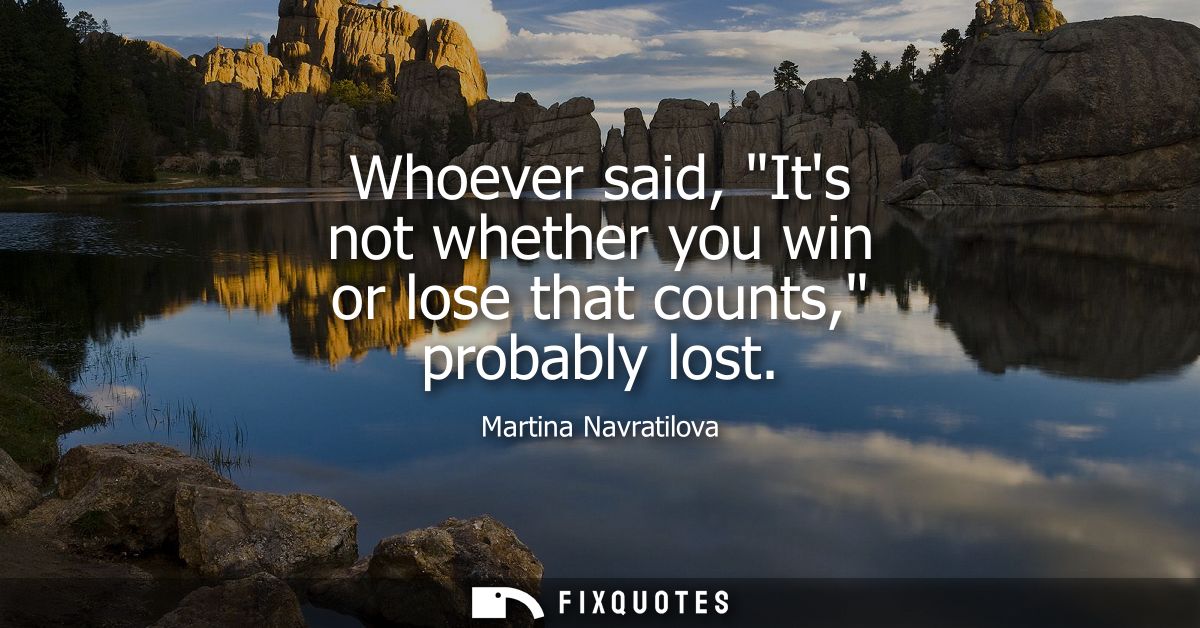
"Whoever said, "It's not whether you win or lose that counts," probably lost"
About this Quote
The intent isn’t just to glorify victory; it’s to expose the coping mechanism behind the consolation. “It’s not whether you win or lose” becomes, in her reading, a sentence you reach for when the scoreboard won’t cooperate. That’s the subtext: values talk can be a retroactive balm, a way to regain status when you’ve just been denied it. By flipping the phrase into an accusation, she turns sentimentality into a tell.
Context matters. Navratilova came up in an era of brutal professionalism, where women’s tennis was building its legitimacy in public, and where she personally carried the pressures of defection, scrutiny, and dominance. For an athlete whose identity was forged in repetition, risk, and consequence, winning isn’t a bonus; it’s the proof that the work translated. The joke also signals her brand: blunt, unsentimental, allergic to performative niceness.
It works because it doesn’t pretend sports are self-help. It admits the taboo truth: competition is about outcomes, and pretending otherwise is usually something you say after you’ve been beaten.
Quote Details
| Topic | Witty One-Liners |
|---|---|
| Source | Help us find the source |
| Cite |
Citation Formats
APA Style (7th ed.)
Navratilova, Martina. (2026, January 16). Whoever said, "It's not whether you win or lose that counts," probably lost. FixQuotes. https://fixquotes.com/quotes/whoever-said-its-not-whether-you-win-or-lose-that-87623/
Chicago Style
Navratilova, Martina. "Whoever said, "It's not whether you win or lose that counts," probably lost." FixQuotes. January 16, 2026. https://fixquotes.com/quotes/whoever-said-its-not-whether-you-win-or-lose-that-87623/.
MLA Style (9th ed.)
"Whoever said, "It's not whether you win or lose that counts," probably lost." FixQuotes, 16 Jan. 2026, https://fixquotes.com/quotes/whoever-said-its-not-whether-you-win-or-lose-that-87623/. Accessed 31 Mar. 2026.