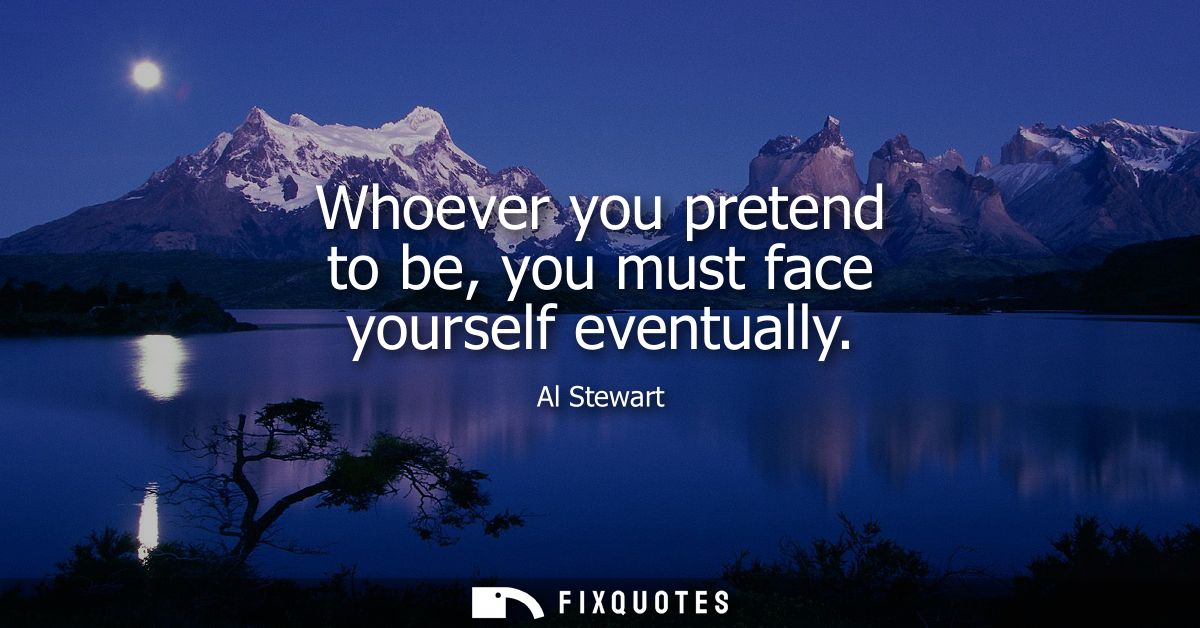
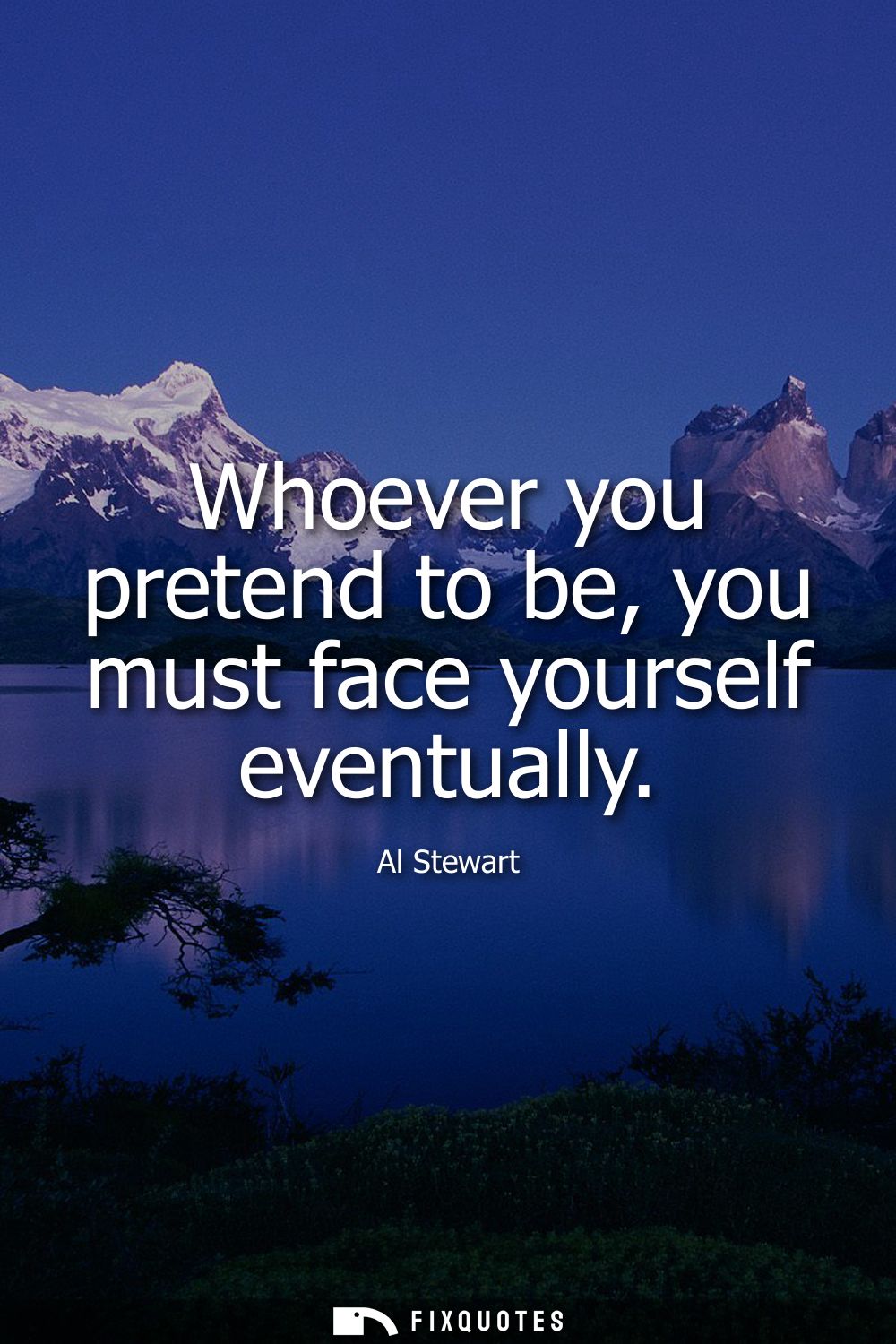
"Whoever you pretend to be, you must face yourself eventually"
About this Quote
A pop musician’s line that lands like a late-night reckoning: the masks don’t just slip, they accrue debt. “Whoever you pretend to be” doesn’t accuse you of simple lying; it frames identity as performance, a role you can inhabit for applause, protection, or survival. Stewart’s phrasing is gently relentless: “whoever” widens the net to include every persona we try on (the cool one, the unbothered one, the successful one), while “pretend” keeps it blunt. This isn’t reinvention-as-empowerment; it’s self-mythmaking with an expiration date.
The second clause is where the trap closes. “You must face yourself eventually” reads like inevitability, not advice. “Face” carries confrontation: not “meet,” not “remember,” but square up to. “Eventually” is the whole emotional engine of the quote, the delayed consequence that lets you keep acting for a while. It’s the morning-after word, the one that admits denial can be functional until it suddenly isn’t.
Coming from Stewart, a songwriter steeped in narrative and memory, it also nods to the way songs let artists hide in character, history, or cleverness. You can turn your life into story, but the body keeps the receipts. The subtext isn’t moralistic; it’s pragmatic. Performative identity works socially, even professionally, but privately it fractures. The line’s quiet power is that it refuses to dramatize the moment of reckoning. It just asserts the math: the self is the one audience you can’t outlast.
The second clause is where the trap closes. “You must face yourself eventually” reads like inevitability, not advice. “Face” carries confrontation: not “meet,” not “remember,” but square up to. “Eventually” is the whole emotional engine of the quote, the delayed consequence that lets you keep acting for a while. It’s the morning-after word, the one that admits denial can be functional until it suddenly isn’t.
Coming from Stewart, a songwriter steeped in narrative and memory, it also nods to the way songs let artists hide in character, history, or cleverness. You can turn your life into story, but the body keeps the receipts. The subtext isn’t moralistic; it’s pragmatic. Performative identity works socially, even professionally, but privately it fractures. The line’s quiet power is that it refuses to dramatize the moment of reckoning. It just asserts the math: the self is the one audience you can’t outlast.
Quote Details
| Topic | Truth |
|---|---|
| Source | Verified source: Last Days Of The Century (Al Stewart, 1988)
Evidence:
Song: "Last Days Of The Century" by Al Stewart |
| Cite |
Citation Formats
APA Style (7th ed.)
Stewart, Al. (2026, March 11). Whoever you pretend to be, you must face yourself eventually. FixQuotes. https://fixquotes.com/quotes/whoever-you-pretend-to-be-you-must-face-yourself-138843/
Chicago Style
Stewart, Al. "Whoever you pretend to be, you must face yourself eventually." FixQuotes. March 11, 2026. https://fixquotes.com/quotes/whoever-you-pretend-to-be-you-must-face-yourself-138843/.
MLA Style (9th ed.)
"Whoever you pretend to be, you must face yourself eventually." FixQuotes, 11 Mar. 2026, https://fixquotes.com/quotes/whoever-you-pretend-to-be-you-must-face-yourself-138843/. Accessed 2 Apr. 2026.
More Quotes by Al
Add to List