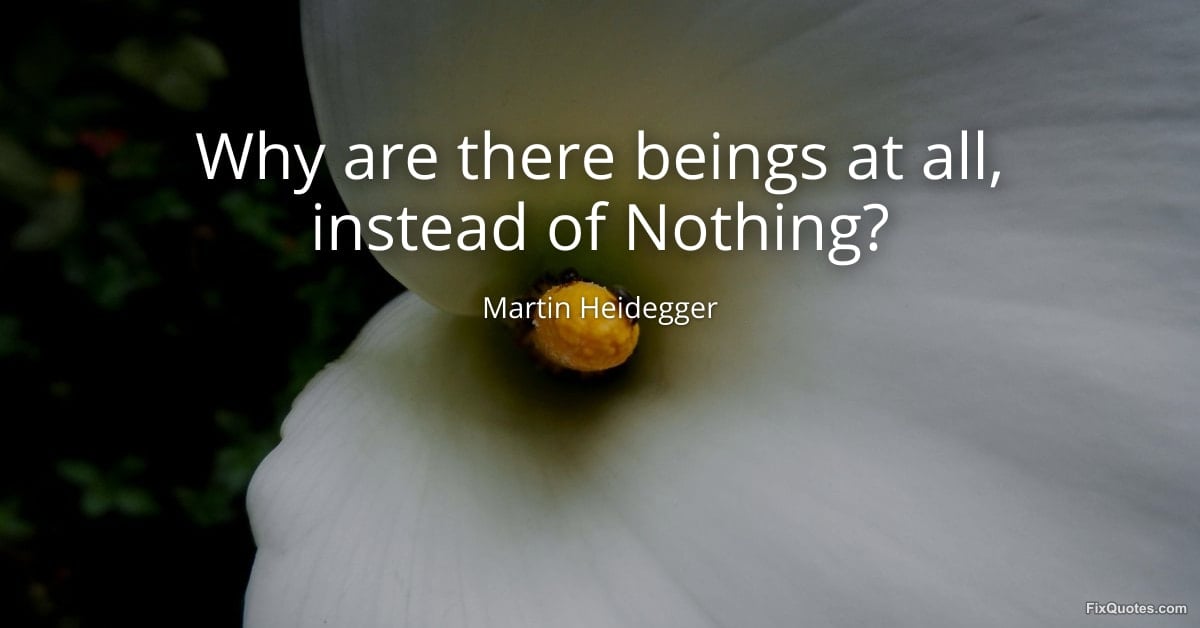
"Why are there beings at all, instead of Nothing?"
About this Quote
A trapdoor disguised as a simple question: Heidegger yanks the floor out from under everyday certainty and makes existence itself feel newly strange. The phrasing is doing more than flirting with metaphysics. It’s an attempt to short-circuit the modern habit of treating the world as a set of manageable objects and problems. “Beings” isn’t just “stuff” in the room; it’s everything that shows up for us at all. By pitting beings against “Nothing,” he stages an existential contrast that forces the mind to confront what it normally edits out: the fact that there could have been no world, no “there” there, and yet there is.
The intent is diagnostic. Heidegger is trying to expose a cultural condition: we live in an age of explanations (science, technique, administration) that can describe how things work while sidestepping the more scandalous question that makes “how” questions possible. The subtext is a critique of intellectual complacency. If you can’t even feel the shock of the question, you’re already trapped in what he calls the forgetfulness of Being, where reality is reduced to inventory.
Context matters because this line emerges from his 20th-century project of re-founding philosophy after the perceived exhaustion of traditional metaphysics. It also arrives in a Europe reeling from crisis, when the confidence of progress narratives was cracking. The question works because it’s unanswerable in the ordinary sense; its power is performative. It’s meant to unsettle, not to solve - to make the nothingness we avoid into a pressure that reveals how contingent, and therefore how precarious, our “normal” world really is.
The intent is diagnostic. Heidegger is trying to expose a cultural condition: we live in an age of explanations (science, technique, administration) that can describe how things work while sidestepping the more scandalous question that makes “how” questions possible. The subtext is a critique of intellectual complacency. If you can’t even feel the shock of the question, you’re already trapped in what he calls the forgetfulness of Being, where reality is reduced to inventory.
Context matters because this line emerges from his 20th-century project of re-founding philosophy after the perceived exhaustion of traditional metaphysics. It also arrives in a Europe reeling from crisis, when the confidence of progress narratives was cracking. The question works because it’s unanswerable in the ordinary sense; its power is performative. It’s meant to unsettle, not to solve - to make the nothingness we avoid into a pressure that reveals how contingent, and therefore how precarious, our “normal” world really is.
Quote Details
| Topic | Deep |
|---|---|
| Source | Was ist Metaphysik? ("What Is Metaphysics?"), lecture by Martin Heidegger, 1929 — contains his famous formulation often rendered in English as "Why are there beings at all, instead of Nothing?" |
| Cite |
Citation Formats
APA Style (7th ed.)
Heidegger, Martin. (2026, January 15). Why are there beings at all, instead of Nothing? FixQuotes. https://fixquotes.com/quotes/why-are-there-beings-at-all-instead-of-nothing-17116/
Chicago Style
Heidegger, Martin. "Why are there beings at all, instead of Nothing?" FixQuotes. January 15, 2026. https://fixquotes.com/quotes/why-are-there-beings-at-all-instead-of-nothing-17116/.
MLA Style (9th ed.)
"Why are there beings at all, instead of Nothing?" FixQuotes, 15 Jan. 2026, https://fixquotes.com/quotes/why-are-there-beings-at-all-instead-of-nothing-17116/. Accessed 9 Mar. 2026.
More Quotes by Martin
Add to List