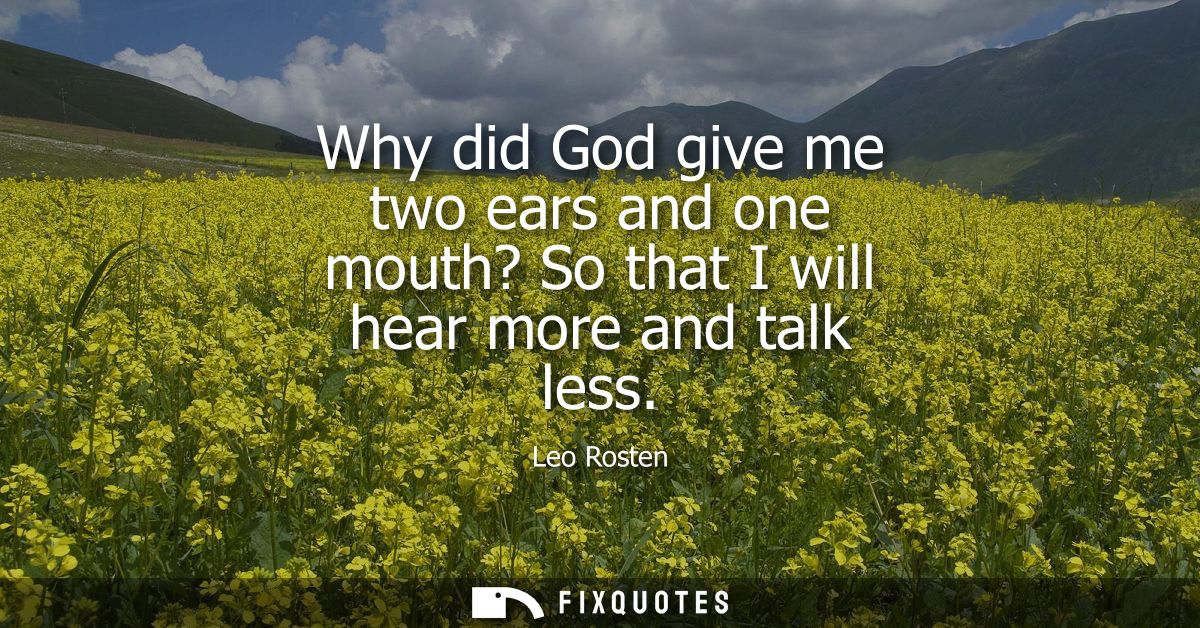
"Why did God give me two ears and one mouth? So that I will hear more and talk less"
About this Quote
The intent is behavioral, not mystical. Invoking God here isn’t theology; it’s a rhetorical shortcut that turns self-control into something as plain as counting. That’s the subtext: listening isn’t just polite, it’s what we were built for, and the person who won’t shut up is not merely annoying but resisting the basic architecture of social life.
Context matters: Rosten was a mid-century American humorist and novelist steeped in the immigrant, newsroom, and show-business worlds where conversation is currency and ego is loud. In that ecosystem, “talk less” isn’t anti-expression; it’s a warning about the cheapening of speech. If everyone is broadcasting, nobody is receiving, and the result is noise masquerading as connection.
The line endures because it flatters and scolds at once. It flatters the reader as someone who “gets it,” then quietly dares them to behave accordingly. In an attention economy built on commentary, Rosten’s punchline reads like a small act of resistance: shut up long enough to actually learn something.
Quote Details
| Topic | Humility |
|---|---|
| Source | Help us find the source |
| Cite |
Citation Formats
APA Style (7th ed.)
Rosten, Leo. (2026, January 16). Why did God give me two ears and one mouth? So that I will hear more and talk less. FixQuotes. https://fixquotes.com/quotes/why-did-god-give-me-two-ears-and-one-mouth-so-104263/
Chicago Style
Rosten, Leo. "Why did God give me two ears and one mouth? So that I will hear more and talk less." FixQuotes. January 16, 2026. https://fixquotes.com/quotes/why-did-god-give-me-two-ears-and-one-mouth-so-104263/.
MLA Style (9th ed.)
"Why did God give me two ears and one mouth? So that I will hear more and talk less." FixQuotes, 16 Jan. 2026, https://fixquotes.com/quotes/why-did-god-give-me-two-ears-and-one-mouth-so-104263/. Accessed 3 Apr. 2026.