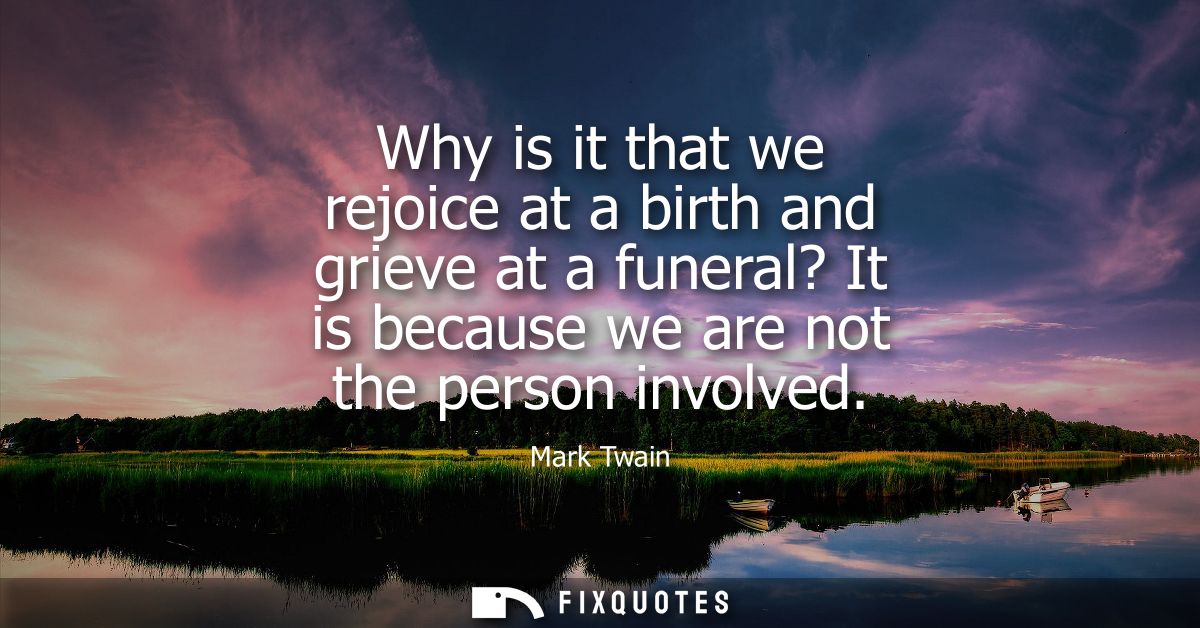
"Why is it that we rejoice at a birth and grieve at a funeral? It is because we are not the person involved"
About this Quote
The subtext is mildly brutal: grief can be a kind of self-pity in costume. A funeral is where the living mourn their own future loneliness, their own mortality, their own interrupted routines. Twain isn’t denying love; he’s indicting the way love and ego tangle. He also smuggles in an almost taboo possibility - that the dead might be relieved, that death could be an exit rather than a catastrophe, while birth might be an involuntary conscription into suffering.
Context matters. Twain wrote in an era soaked in public mourning and early death, when sentimentality was both social glue and performance. His skepticism toward polite pieties turns that culture inside out: the “proper” emotions look less like empathy and more like a crowd reassuring itself that it’s on the safe side of the coffin.
Quote Details
| Topic | Wisdom |
|---|---|
| Source | Help us find the source |
| Cite |
Citation Formats
APA Style (7th ed.)
Twain, Mark. (2026, January 15). Why is it that we rejoice at a birth and grieve at a funeral? It is because we are not the person involved. FixQuotes. https://fixquotes.com/quotes/why-is-it-that-we-rejoice-at-a-birth-and-grieve-22275/
Chicago Style
Twain, Mark. "Why is it that we rejoice at a birth and grieve at a funeral? It is because we are not the person involved." FixQuotes. January 15, 2026. https://fixquotes.com/quotes/why-is-it-that-we-rejoice-at-a-birth-and-grieve-22275/.
MLA Style (9th ed.)
"Why is it that we rejoice at a birth and grieve at a funeral? It is because we are not the person involved." FixQuotes, 15 Jan. 2026, https://fixquotes.com/quotes/why-is-it-that-we-rejoice-at-a-birth-and-grieve-22275/. Accessed 28 Mar. 2026.