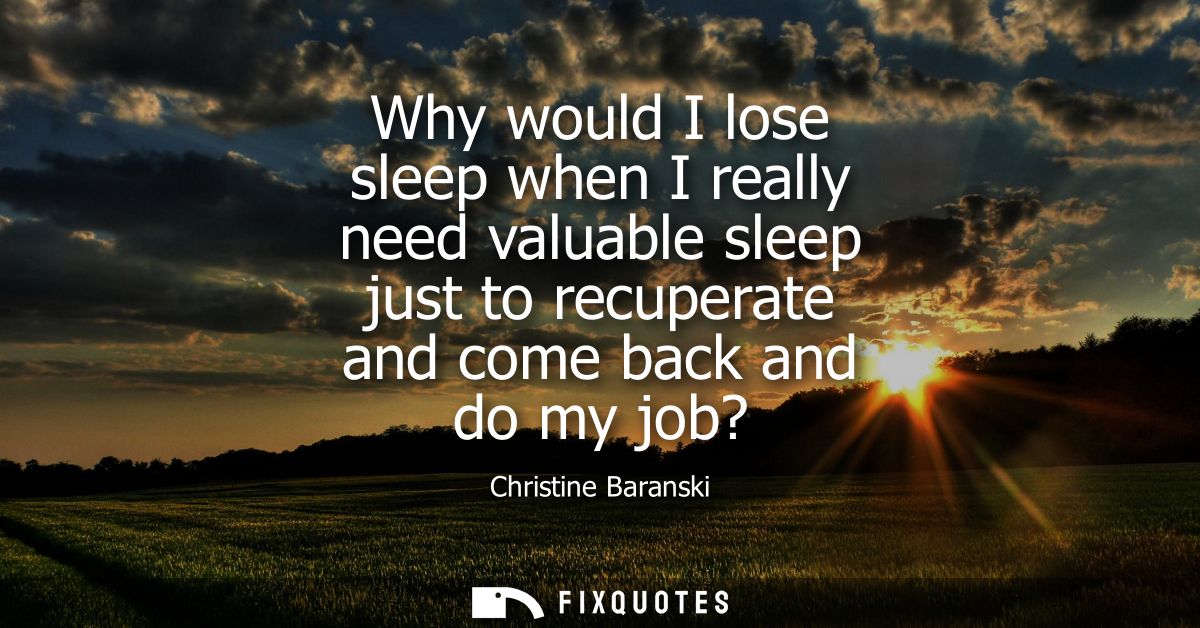
"Why would I lose sleep when I really need valuable sleep just to recuperate and come back and do my job?"
About this Quote
The intent is practical on the surface: I have a job, I need rest, end of story. The subtext is sharper. She’s drawing a boundary against the entertainment industry’s quiet religion of overextension, where women in particular are expected to be endlessly available, endlessly worried, endlessly “nice” about it. Instead, she frames sleep as a resource she’s entitled to protect. It’s not self-indulgence; it’s maintenance. Recuperation becomes part of the craft.
Context matters: Baranski’s persona - poised, precise, often cast as the woman who controls the room - primes the audience to hear this as strategy, not vulnerability. The line also works because it’s almost aggressively reasonable. No inspirational varnish, no wellness-speak. Just a calm refusal to donate her nervous system to whatever problem is trying to colonize her night.
In a culture that romanticizes burnout and treats stress like social currency, she offers a different status symbol: competence powered by sleep. That’s not softness. It’s leverage.
Quote Details
| Topic | Work-Life Balance |
|---|---|
| Source | Help us find the source |
| Cite |
Citation Formats
APA Style (7th ed.)
Baranski, Christine. (2026, January 17). Why would I lose sleep when I really need valuable sleep just to recuperate and come back and do my job? FixQuotes. https://fixquotes.com/quotes/why-would-i-lose-sleep-when-i-really-need-64723/
Chicago Style
Baranski, Christine. "Why would I lose sleep when I really need valuable sleep just to recuperate and come back and do my job?" FixQuotes. January 17, 2026. https://fixquotes.com/quotes/why-would-i-lose-sleep-when-i-really-need-64723/.
MLA Style (9th ed.)
"Why would I lose sleep when I really need valuable sleep just to recuperate and come back and do my job?" FixQuotes, 17 Jan. 2026, https://fixquotes.com/quotes/why-would-i-lose-sleep-when-i-really-need-64723/. Accessed 6 Mar. 2026.