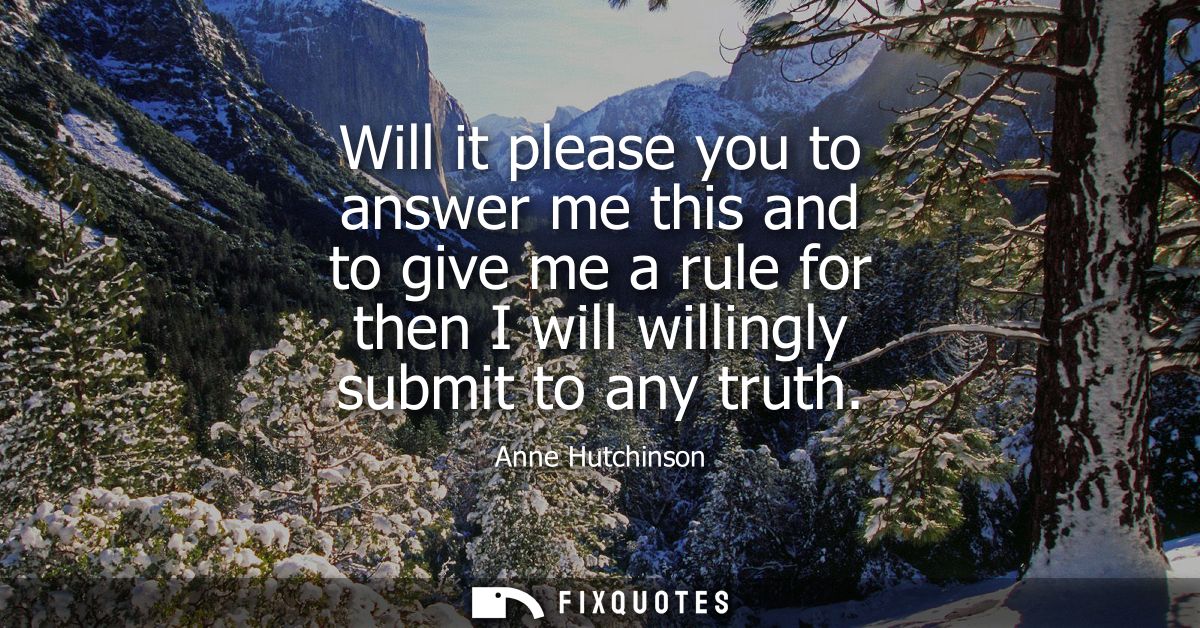
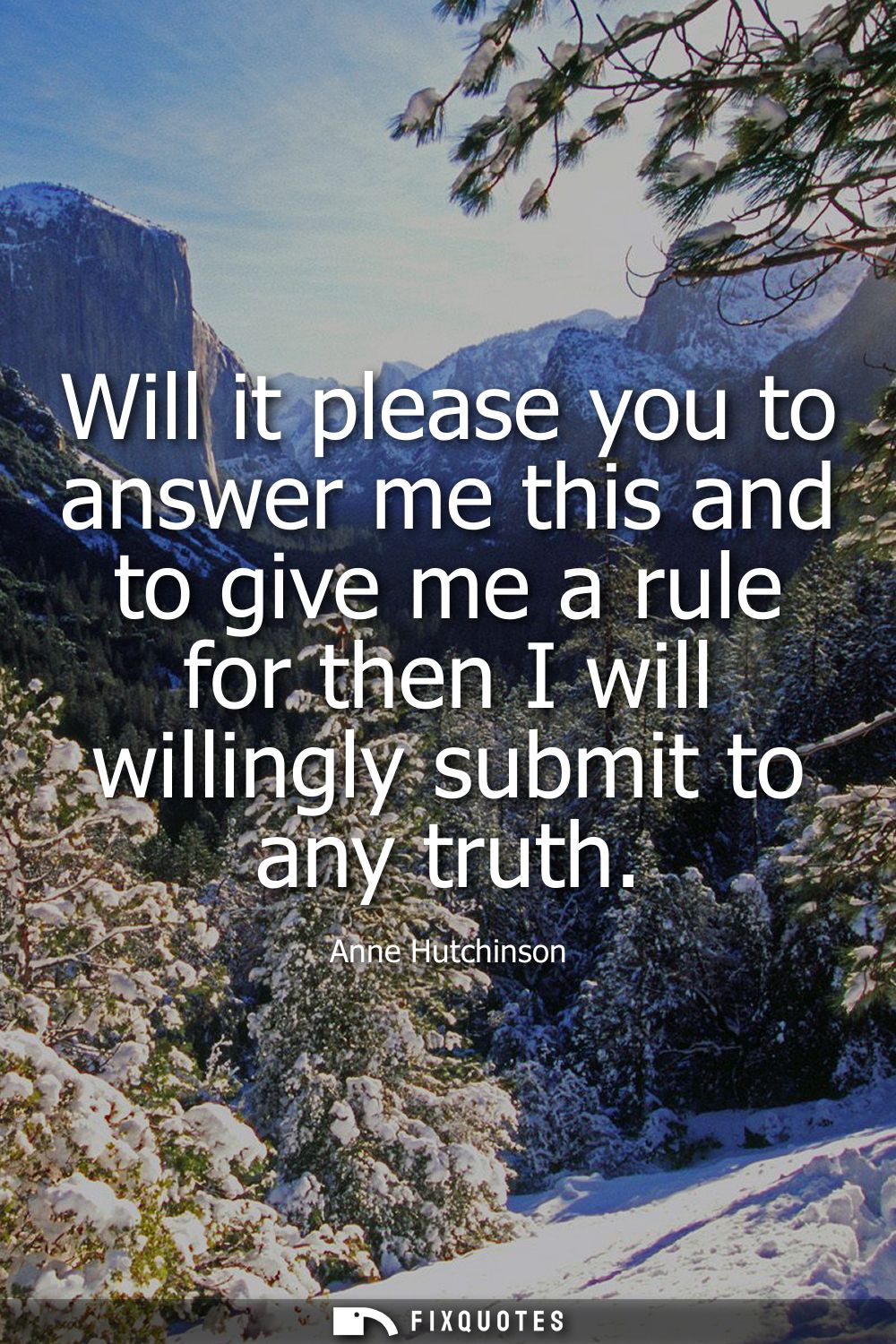
"Will it please you to answer me this, and to give me a rule; for then I will willingly submit to any truth?"
About this Quote
The line is built like a contract. Give me a rule, and “I will willingly submit to any truth.” That conditional “for then” is the fuse. Hutchinson isn’t rejecting truth; she’s calling out a system that labels her “error” without defining the standard by which she’s judged. In the Antinomian Controversy, she was accused of undermining the colony’s religious order by insisting that salvation comes from grace, not from visible “works,” and by holding meetings where she interpreted sermons. The prosecution wanted obedience, not clarity.
Her subtext is almost modern: if you claim to govern conscience, show your method. If doctrine is certain, it can withstand being articulated as a “rule.” And if it can’t, maybe the real issue isn’t her theology but the threat she poses - a laywoman insisting on theological due process.
The brilliance is how she weaponizes submission. She offers compliance so total it becomes an indictment: any truth, she says, as long as you can prove it’s truth and not just power wearing a collar.
Quote Details
| Topic | Truth |
|---|---|
| Source | Help us find the source |
| Cite |
Citation Formats
APA Style (7th ed.)
Hutchinson, Anne. (2026, February 18). Will it please you to answer me this, and to give me a rule; for then I will willingly submit to any truth? FixQuotes. https://fixquotes.com/quotes/will-it-please-you-to-answer-me-this-and-to-give-63538/
Chicago Style
Hutchinson, Anne. "Will it please you to answer me this, and to give me a rule; for then I will willingly submit to any truth?" FixQuotes. February 18, 2026. https://fixquotes.com/quotes/will-it-please-you-to-answer-me-this-and-to-give-63538/.
MLA Style (9th ed.)
"Will it please you to answer me this, and to give me a rule; for then I will willingly submit to any truth?" FixQuotes, 18 Feb. 2026, https://fixquotes.com/quotes/will-it-please-you-to-answer-me-this-and-to-give-63538/. Accessed 4 Apr. 2026.