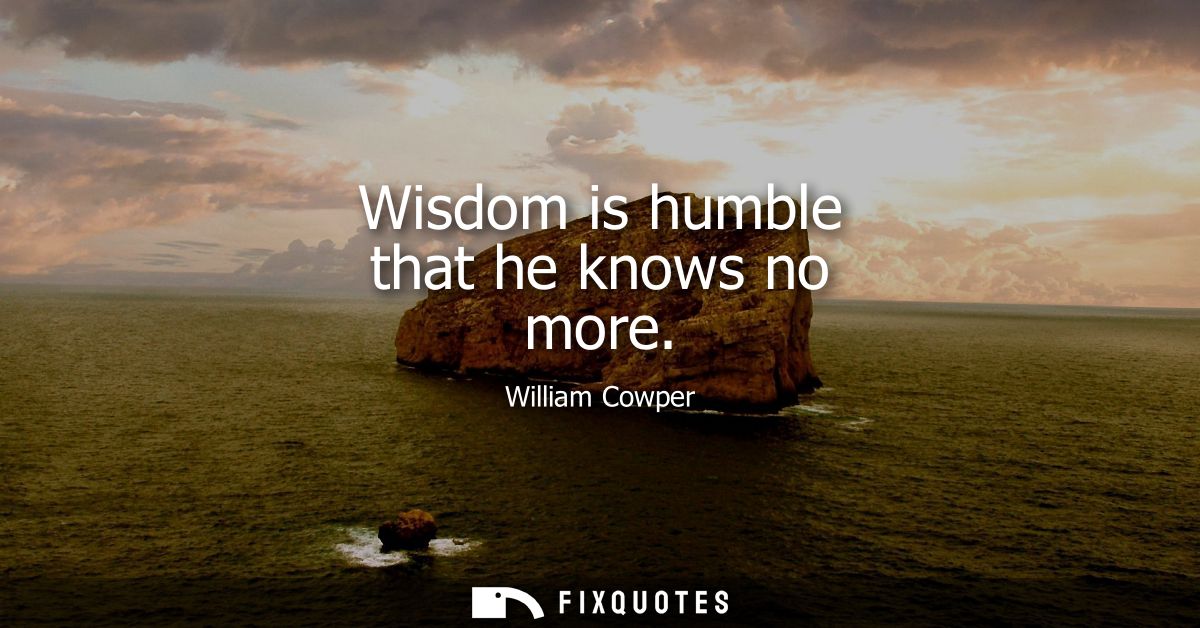
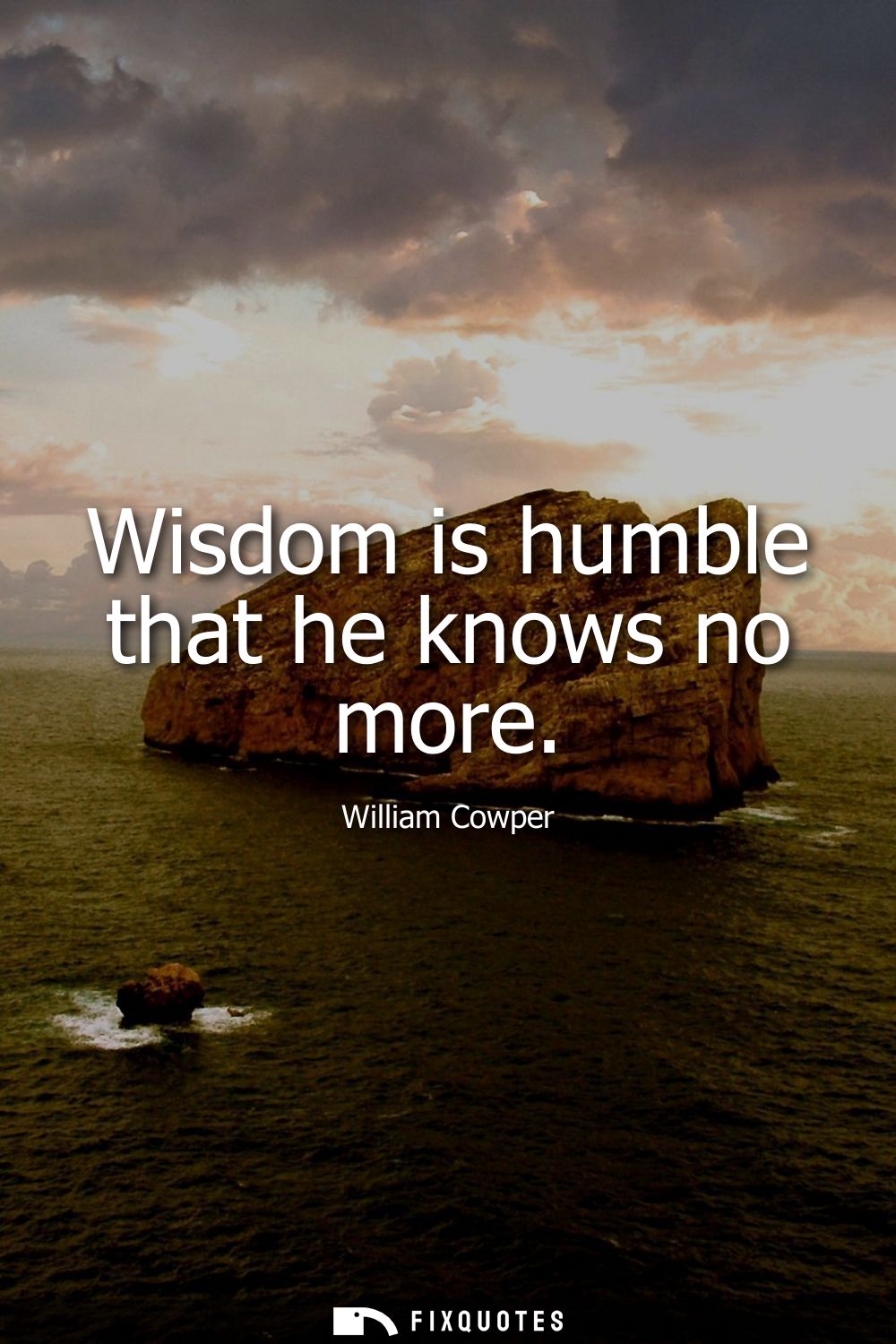
"Wisdom is humble that he knows no more"
About this Quote
Cowper turns a pious commonplace into a tight little paradox: wisdom isn’t the feeling of having arrived, it’s the disciplined refusal to pretend you have. The grammar does a lot of work. “Wisdom is humble” isn’t just advice; it’s a definition, a rebranding of intellect away from swagger and toward restraint. Then the line pivots on “that”: humble because he “knows no more.” Knowledge, in this frame, doesn’t inflate the self; it shrinks it by exposing the vastness of what remains unknown.
The subtext is quietly polemical. In an 18th-century culture that prized reason, system-building, and public certainty, Cowper’s couplet-sized aphorism needles the confident voice of the age. It’s also personal. Cowper lived with severe depression and religious anxiety; his writing often distrusts worldly assurance and elevates spiritual sincerity. Humility here reads less like etiquette and more like survival: a check against the mind’s appetite for total explanations, whether theological or intellectual.
What makes the line work is its reversal of status. “Wisdom” usually signals mastery; Cowper makes it an admission of limits. There’s a moral claim tucked inside the epistemology: the person who can say “I don’t know” is not weaker but steadier, less capturable by ideology, vanity, or the brittle performance of certainty. It’s a compressed argument for intellectual conscience, delivered with the plainness of someone who’s seen what false confidence costs.
The subtext is quietly polemical. In an 18th-century culture that prized reason, system-building, and public certainty, Cowper’s couplet-sized aphorism needles the confident voice of the age. It’s also personal. Cowper lived with severe depression and religious anxiety; his writing often distrusts worldly assurance and elevates spiritual sincerity. Humility here reads less like etiquette and more like survival: a check against the mind’s appetite for total explanations, whether theological or intellectual.
What makes the line work is its reversal of status. “Wisdom” usually signals mastery; Cowper makes it an admission of limits. There’s a moral claim tucked inside the epistemology: the person who can say “I don’t know” is not weaker but steadier, less capturable by ideology, vanity, or the brittle performance of certainty. It’s a compressed argument for intellectual conscience, delivered with the plainness of someone who’s seen what false confidence costs.
Quote Details
| Topic | Wisdom |
|---|---|
| Source | Help us find the source |
| Cite |
Citation Formats
APA Style (7th ed.)
Cowper, William. (2026, January 16). Wisdom is humble that he knows no more. FixQuotes. https://fixquotes.com/quotes/wisdom-is-humble-that-he-knows-no-more-87118/
Chicago Style
Cowper, William. "Wisdom is humble that he knows no more." FixQuotes. January 16, 2026. https://fixquotes.com/quotes/wisdom-is-humble-that-he-knows-no-more-87118/.
MLA Style (9th ed.)
"Wisdom is humble that he knows no more." FixQuotes, 16 Jan. 2026, https://fixquotes.com/quotes/wisdom-is-humble-that-he-knows-no-more-87118/. Accessed 7 Feb. 2026.
More Quotes by William
Add to List