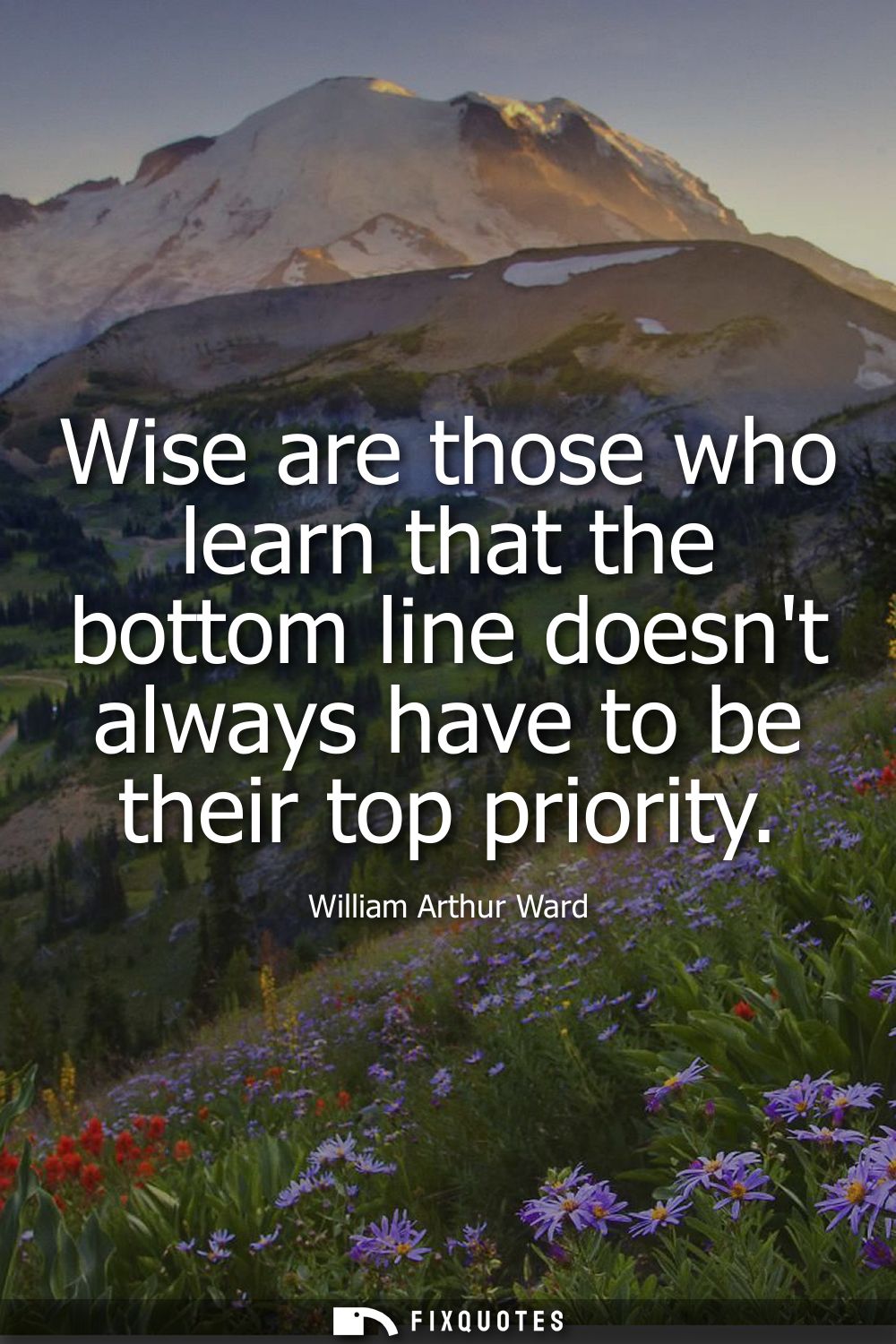
"Wise are those who learn that the bottom line doesn't always have to be their top priority"
About this Quote
The line lands like a quiet rebuke to the corporate catechism: that every decision must kneel to the bottom line. Ward isn’t arguing against profit so much as against profit as a moral alibi. “Wise are those” sets a proverb-like tone, borrowing the authority of timeless counsel, but the twist is modern and managerial. The phrase “bottom line” is deliberately concrete, almost accounting jargon, which makes the counterpoint feel practical rather than pious. This isn’t abstract virtue talk; it’s a critique aimed at people who live by quarterly reports.
The subtext is about power and permission. Ward gives the reader a socially acceptable way to prioritize things that don’t fit neatly into a spreadsheet: employee dignity, long-term trust, community impact, personal integrity. “Doesn’t always have to be” is the key hedge. He’s not advocating martyrdom or anti-capitalist purity. He’s offering a flexible ethic: choose profit when it’s appropriate, but refuse to let it be the only language you speak.
Context matters: Ward wrote in a mid-to-late 20th-century America where business culture was increasingly professionalized and metrics-driven, and where self-improvement literature often served as a softer counterweight to hard-edged economic rationalism. The intent is to smuggle a human-centered value system into a boardroom-friendly sentence. It works because it meets ambition where it lives, then quietly widens the definition of success.
The subtext is about power and permission. Ward gives the reader a socially acceptable way to prioritize things that don’t fit neatly into a spreadsheet: employee dignity, long-term trust, community impact, personal integrity. “Doesn’t always have to be” is the key hedge. He’s not advocating martyrdom or anti-capitalist purity. He’s offering a flexible ethic: choose profit when it’s appropriate, but refuse to let it be the only language you speak.
Context matters: Ward wrote in a mid-to-late 20th-century America where business culture was increasingly professionalized and metrics-driven, and where self-improvement literature often served as a softer counterweight to hard-edged economic rationalism. The intent is to smuggle a human-centered value system into a boardroom-friendly sentence. It works because it meets ambition where it lives, then quietly widens the definition of success.
Quote Details
| Topic | Wisdom |
|---|---|
| Source | Help us find the source |
More Quotes by William
Add to List