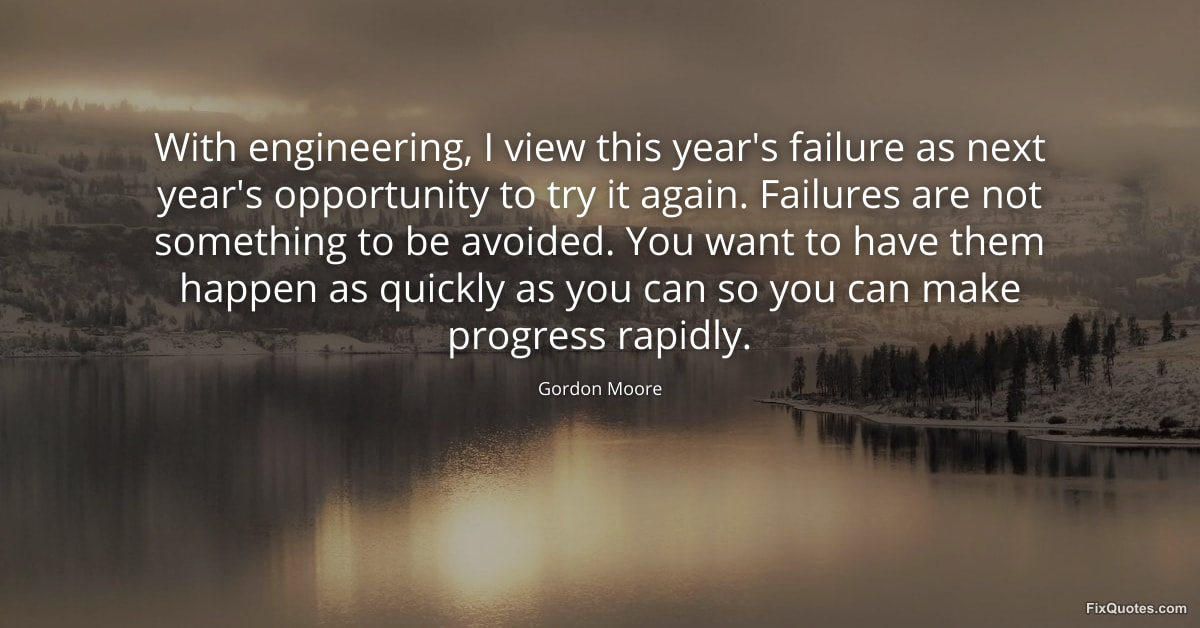
"With engineering, I view this year's failure as next year's opportunity to try it again. Failures are not something to be avoided. You want to have them happen as quickly as you can so you can make progress rapidly"
About this Quote
The subtext is Silicon Valley before it became a brand slogan. Today "fail fast" can read like hustle-culture wallpaper, a permission slip for recklessness. In Moore's world, it is closer to process discipline. Semiconductor progress is built on iteration, yield curves, and brutal physical constraints. You don't argue a wafer into working; you test, you break, you diagnose, you revise. Wanting failures "as quickly as you can" isn't romanticizing collapse. It's insisting on short feedback loops: prototypes over PowerPoints, experiments over meetings, learning cycles over reputation management.
Context matters: Moore co-founded Intel and helped set the tempo for an industry where time-to-learning becomes time-to-market, and time-to-market becomes dominance. So the quote doubles as management philosophy. It tells teams to surface bad news early, to treat embarrassment as waste, and to convert uncertainty into knowledge before a competitor does. It's optimism with a stopwatch.
Quote Details
| Topic | Failure |
|---|---|
| Source | Help us find the source |
| Cite |
Citation Formats
APA Style (7th ed.)
Moore, Gordon. (2026, January 17). With engineering, I view this year's failure as next year's opportunity to try it again. Failures are not something to be avoided. You want to have them happen as quickly as you can so you can make progress rapidly. FixQuotes. https://fixquotes.com/quotes/with-engineering-i-view-this-years-failure-as-47752/
Chicago Style
Moore, Gordon. "With engineering, I view this year's failure as next year's opportunity to try it again. Failures are not something to be avoided. You want to have them happen as quickly as you can so you can make progress rapidly." FixQuotes. January 17, 2026. https://fixquotes.com/quotes/with-engineering-i-view-this-years-failure-as-47752/.
MLA Style (9th ed.)
"With engineering, I view this year's failure as next year's opportunity to try it again. Failures are not something to be avoided. You want to have them happen as quickly as you can so you can make progress rapidly." FixQuotes, 17 Jan. 2026, https://fixquotes.com/quotes/with-engineering-i-view-this-years-failure-as-47752/. Accessed 5 Mar. 2026.