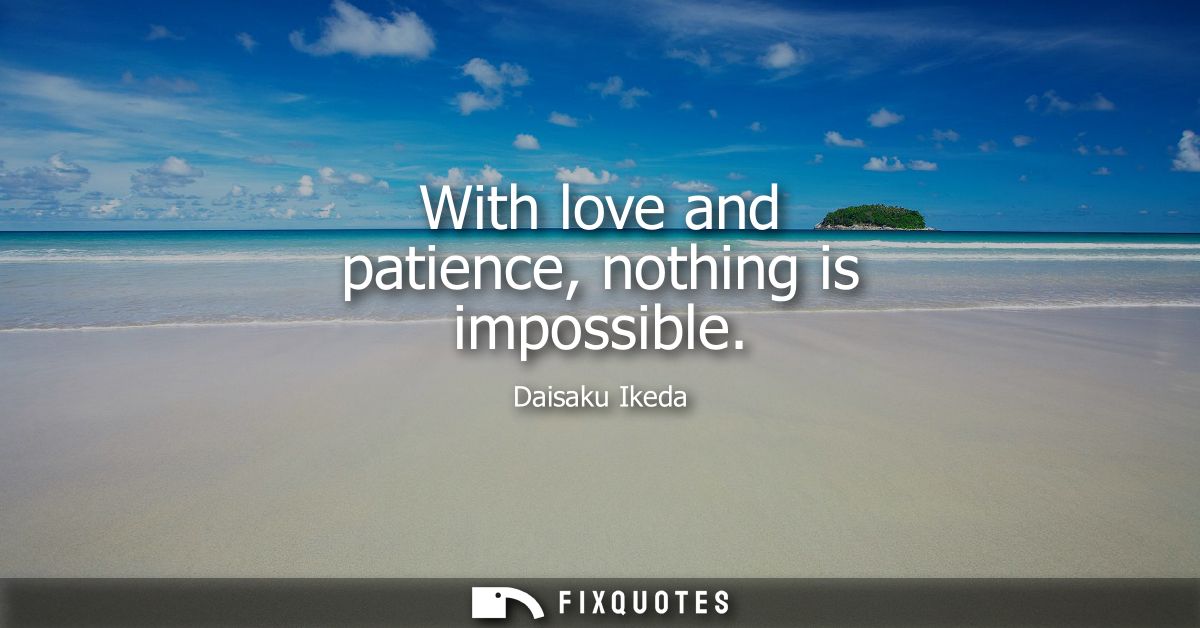
"With love and patience, nothing is impossible"
About this Quote
Ikeda’s line reads like a fortune-cookie promise, but its real power is how it smuggles discipline into the language of tenderness. “Love and patience” aren’t presented as feelings; they’re framed as tools. The pairing matters: love without patience is impulse, patience without love is endurance for its own sake. Together, they become a moral technology for staying in the room - with a person, a project, a cause - long after the dopamine has worn off.
The absolutism of “nothing is impossible” is the tell. On the surface it’s motivational, but the subtext is organizational and spiritual: don’t confuse slow progress with failure, and don’t treat obstacles as permission to quit. Ikeda, as the public face of Soka Gakkai International, spent decades translating a Buddhist-inflected practice into a modern self-help cadence that travels well across cultures. This sentence is built to be repeated, memorized, and shared; it’s portable doctrine.
Contextually, it lands in the postwar Japanese landscape that shaped Ikeda’s worldview: reconstruction, social volatility, the hunt for meaning in mass society. The quote offers a counter-program to cynicism. It doesn’t argue with structural limits directly; it sidesteps them by focusing on inner posture and relational stamina. That’s also its risk: “nothing is impossible” can slide into blaming the struggling for not loving hard enough. Still, the intent is clear - a call to persistent, humane effort as a form of power.
The absolutism of “nothing is impossible” is the tell. On the surface it’s motivational, but the subtext is organizational and spiritual: don’t confuse slow progress with failure, and don’t treat obstacles as permission to quit. Ikeda, as the public face of Soka Gakkai International, spent decades translating a Buddhist-inflected practice into a modern self-help cadence that travels well across cultures. This sentence is built to be repeated, memorized, and shared; it’s portable doctrine.
Contextually, it lands in the postwar Japanese landscape that shaped Ikeda’s worldview: reconstruction, social volatility, the hunt for meaning in mass society. The quote offers a counter-program to cynicism. It doesn’t argue with structural limits directly; it sidesteps them by focusing on inner posture and relational stamina. That’s also its risk: “nothing is impossible” can slide into blaming the struggling for not loving hard enough. Still, the intent is clear - a call to persistent, humane effort as a form of power.
Quote Details
| Topic | Perseverance |
|---|
More Quotes by Daisaku
Add to List