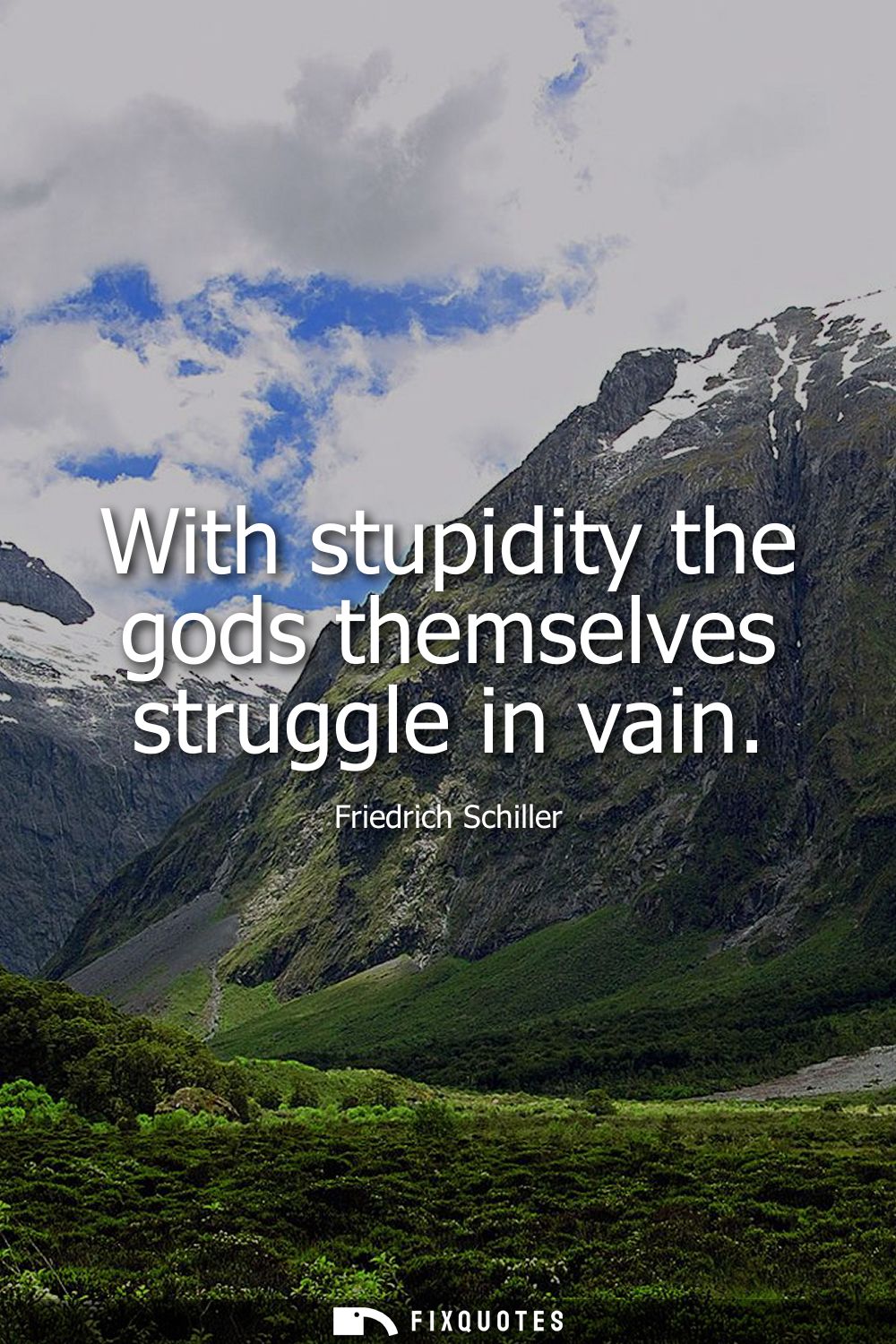
"With stupidity the gods themselves struggle in vain"
About this Quote
Schiller’s line lands like a slap precisely because it drags the divine down into the mud of human error. “With stupidity the gods themselves struggle in vain” isn’t a grand theological claim so much as a dramatist’s bleak stage direction: don’t expect providence to rescue you from entrenched foolishness. The wit is in the escalation. We’re used to thinking of stupidity as a minor flaw, curable by education or experience. Schiller makes it a force so inert, so self-sealing, that even omnipotence can’t get purchase. It’s not that the gods lack power; it’s that stupidity doesn’t present an argument to defeat. It’s a closed loop.
The subtext is pointedly political. Schiller wrote in an era when Enlightenment ideals collided with reactionary power and the chaos of revolutionary fervor. In that context, “stupidity” reads less like a casual insult and more like a civic pathology: the refusal to see consequences, the comfort of slogans, the herd instinct that turns moral complexity into a chant. His warning is anti-romantic in the best way: history doesn’t bend toward justice just because justice is right. Catastrophe can be banal, powered by people who don’t feel like villains.
As a line from a dramatist, it also carries a theatrical realism: tragedy doesn’t require evil masterminds. It only needs enough people convinced they already know, immune to doubt, and proud of it. Schiller’s dark joke is that stupidity is the one antagonist that can’t be reasoned with, bribed, or even struck down heroically. It just persists, undefeated by spectacle, and quietly wins.
The subtext is pointedly political. Schiller wrote in an era when Enlightenment ideals collided with reactionary power and the chaos of revolutionary fervor. In that context, “stupidity” reads less like a casual insult and more like a civic pathology: the refusal to see consequences, the comfort of slogans, the herd instinct that turns moral complexity into a chant. His warning is anti-romantic in the best way: history doesn’t bend toward justice just because justice is right. Catastrophe can be banal, powered by people who don’t feel like villains.
As a line from a dramatist, it also carries a theatrical realism: tragedy doesn’t require evil masterminds. It only needs enough people convinced they already know, immune to doubt, and proud of it. Schiller’s dark joke is that stupidity is the one antagonist that can’t be reasoned with, bribed, or even struck down heroically. It just persists, undefeated by spectacle, and quietly wins.
Quote Details
| Topic | Wisdom |
|---|---|
| Source | "Mit der Dummheit kämpfen Götter selbst vergebens." , commonly attributed to Friedrich Schiller (German original). See general Schiller quotations. |
| Cite |
Citation Formats
APA Style (7th ed.)
Schiller, Friedrich. (2026, January 14). With stupidity the gods themselves struggle in vain. FixQuotes. https://fixquotes.com/quotes/with-stupidity-the-gods-themselves-struggle-in-70789/
Chicago Style
Schiller, Friedrich. "With stupidity the gods themselves struggle in vain." FixQuotes. January 14, 2026. https://fixquotes.com/quotes/with-stupidity-the-gods-themselves-struggle-in-70789/.
MLA Style (9th ed.)
"With stupidity the gods themselves struggle in vain." FixQuotes, 14 Jan. 2026, https://fixquotes.com/quotes/with-stupidity-the-gods-themselves-struggle-in-70789/. Accessed 13 Feb. 2026.
More Quotes by Friedrich
Add to List