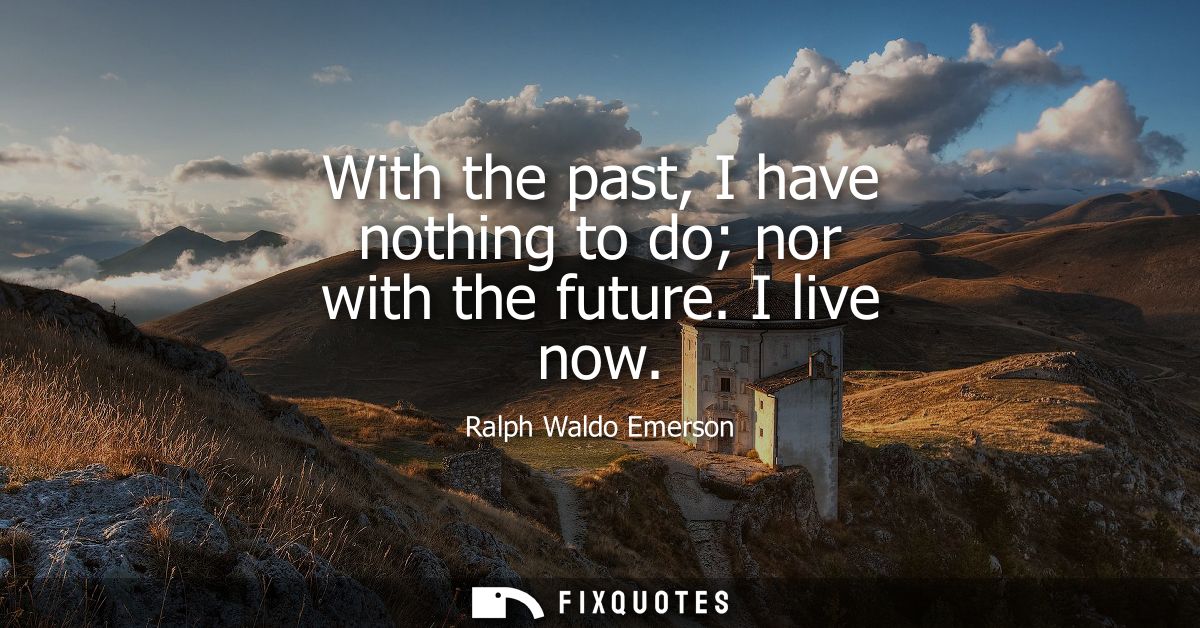
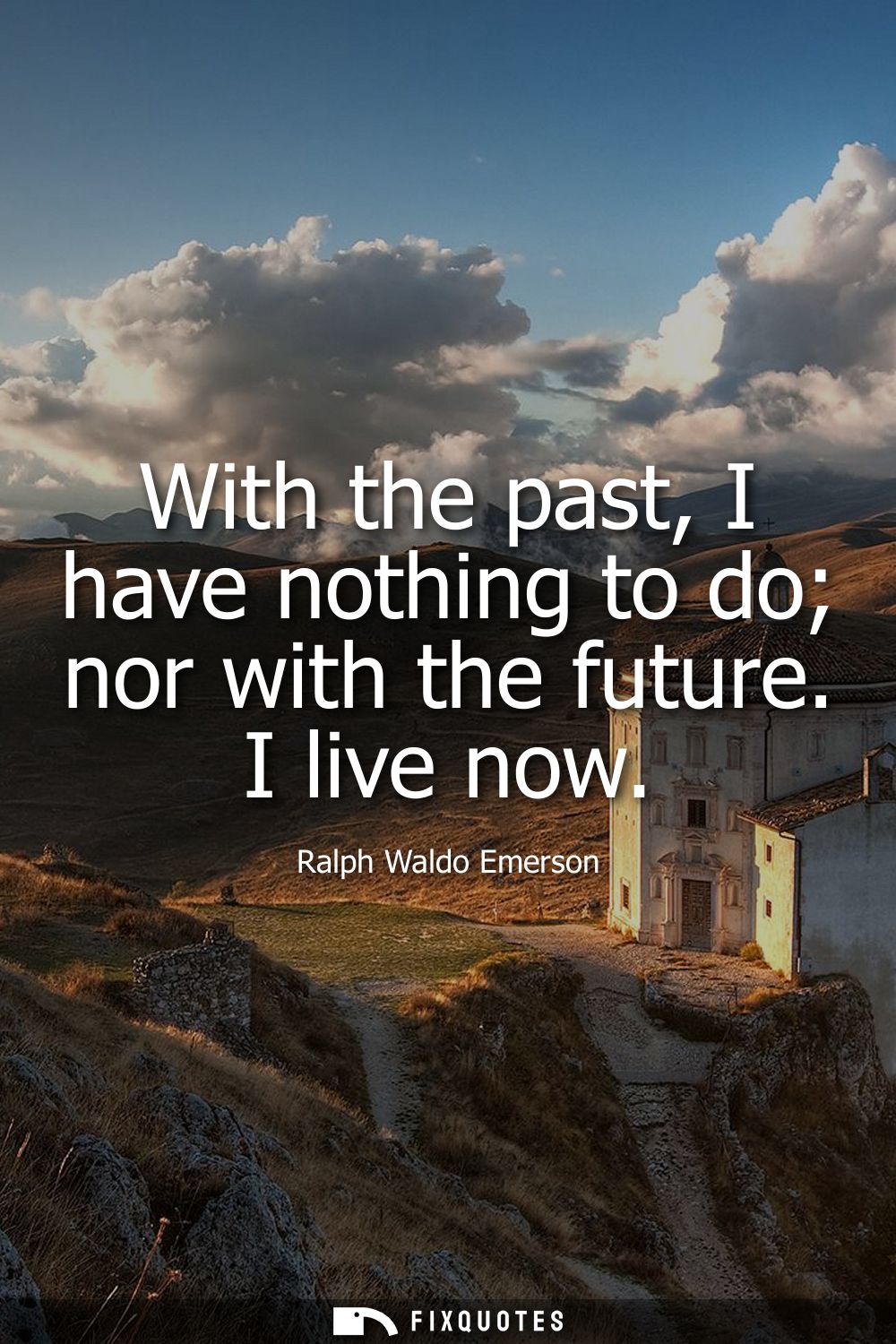
"With the past, I have nothing to do; nor with the future. I live now"
About this Quote
Context matters. Emerson is writing in a 19th-century America that’s speed-running modernity - expanding, industrializing, reinventing itself - while still measuring worth through European tradition and Calvinist moral accounting. Transcendentalism, his project, isn’t just nature worship; it’s a revolt against secondhand living. The past becomes a script you didn’t author. The future becomes a promissory note you can’t cash. “I live now” is his countercultural claim that the self has direct access to truth in the present tense, without intermediaries.
The subtext is less “be mindful” and more “stop outsourcing your life.” He’s challenging the reader’s favorite alibis: trauma as destiny, history as excuse, ambition as virtue. It’s also a quietly political stance. A citizen who can’t be bullied by tradition or bribed by futurity is harder to govern through fear and reverence.
Still, Emerson’s insistence carries a provocation: the luxury to “have nothing to do” with the past is not evenly distributed. The line works because it’s both liberating and bracingly uncompromising - a mantra that dares you to become present enough to be responsible.
Quote Details
| Topic | Live in the Moment |
|---|---|
| Source | Verified source: Journals and Miscellaneous Notebooks, Vol. VII (1838–1842) (Ralph Waldo Emerson, 1969)ISBN: 9780674484573
Evidence: With the past as past I have nothing to do, nor with the future as future. I live now, and will verify all past history in my own moments. (Page 241). The popular shortened form (“With the past, I have nothing to do; nor with the future. I live now”) appears to be an abridgment of this journal sentence. Multiple secondary reference pages attribute the line to an 1839 journal entry, but I was not able to directly open/quote the underlying manuscript transcription online in a primary scholarly edition during this check. The strongest verifiable attribution I could substantiate with a stable bibliographic pointer is the Belknap/Harvard Univ. Press critical edition (Journals and Miscellaneous Notebooks), Vol. VII (covering 1838–1842), p. 241, which quotes the longer sentence. Note: the *first publication* of Emerson’s private journals is later than the *date written*; the quote was written in his journal (commonly dated 1839) but first published posthumously in edited journal volumes. Other candidates (1) The Book of Positive Quotations (Steve Deger, Leslie Ann Gibson, 2024) compilation95.0% ... W. Newbern TODAY RELATIVE TO YESTERDAY OR TOMORROW The future is made of the same stuff as the present ... With t... |
| Cite |
Citation Formats
APA Style (7th ed.)
Emerson, Ralph Waldo. (2026, February 11). With the past, I have nothing to do; nor with the future. I live now. FixQuotes. https://fixquotes.com/quotes/with-the-past-i-have-nothing-to-do-nor-with-the-28894/
Chicago Style
Emerson, Ralph Waldo. "With the past, I have nothing to do; nor with the future. I live now." FixQuotes. February 11, 2026. https://fixquotes.com/quotes/with-the-past-i-have-nothing-to-do-nor-with-the-28894/.
MLA Style (9th ed.)
"With the past, I have nothing to do; nor with the future. I live now." FixQuotes, 11 Feb. 2026, https://fixquotes.com/quotes/with-the-past-i-have-nothing-to-do-nor-with-the-28894/. Accessed 12 Feb. 2026.