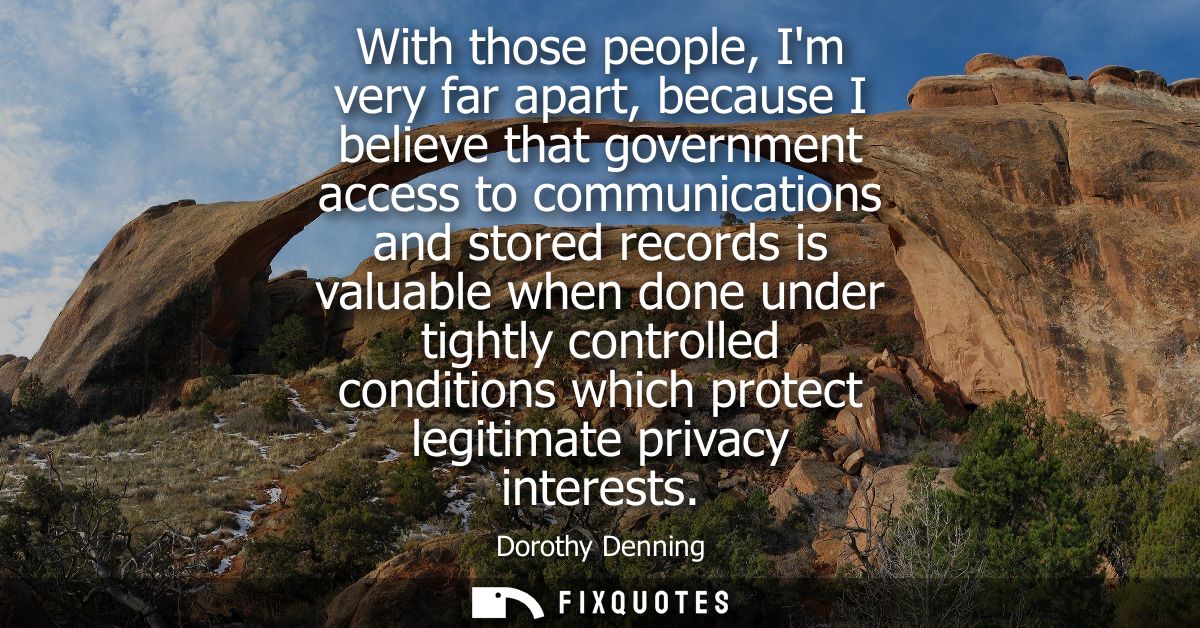
"With those people, I'm very far apart, because I believe that government access to communications and stored records is valuable when done under tightly controlled conditions, which protect legitimate privacy interests"
About this Quote
The phrase “government access” is doing heavy work. It’s sanitized language for powers that, in practice, can look like wiretaps, subpoenas, metadata collection, and compelled disclosure. By pairing it with “communications and stored records,” she quietly collapses a major distinction in digital life: real-time listening versus rummaging through your history. That blending is strategic; it frames both as comparable, manageable categories rather than morally different intrusions.
“Valuable” is a technocratic value judgment that sidesteps the emotionally loaded terrain of rights. It signals her background in security policy and computer science debates where the key question is often utility: does this help prevent harm, catch criminals, deter attacks? The subtext is an argument for legitimacy: the state can be trusted if it is constrained.
But the real pivot is “tightly controlled conditions.” It’s reassurance with an asterisk. Control by whom? Courts, legislatures, internal oversight, classified processes? Denning invokes safeguards to pre-answer the most common critique: that surveillance powers expand, leak, and outlive their original rationale. “Legitimate privacy interests” adds another gate, implying some privacy claims are less legitimate than others. That’s the quiet political wager: that privacy is negotiable, and that the right rules can keep the bargain from curdling into abuse.
Quote Details
| Topic | Privacy & Cybersecurity |
|---|---|
| Source | Help us find the source |
| Cite |
Citation Formats
APA Style (7th ed.)
Denning, Dorothy. (2026, February 18). With those people, I'm very far apart, because I believe that government access to communications and stored records is valuable when done under tightly controlled conditions, which protect legitimate privacy interests. FixQuotes. https://fixquotes.com/quotes/with-those-people-im-very-far-apart-because-i-76881/
Chicago Style
Denning, Dorothy. "With those people, I'm very far apart, because I believe that government access to communications and stored records is valuable when done under tightly controlled conditions, which protect legitimate privacy interests." FixQuotes. February 18, 2026. https://fixquotes.com/quotes/with-those-people-im-very-far-apart-because-i-76881/.
MLA Style (9th ed.)
"With those people, I'm very far apart, because I believe that government access to communications and stored records is valuable when done under tightly controlled conditions, which protect legitimate privacy interests." FixQuotes, 18 Feb. 2026, https://fixquotes.com/quotes/with-those-people-im-very-far-apart-because-i-76881/. Accessed 19 Feb. 2026.