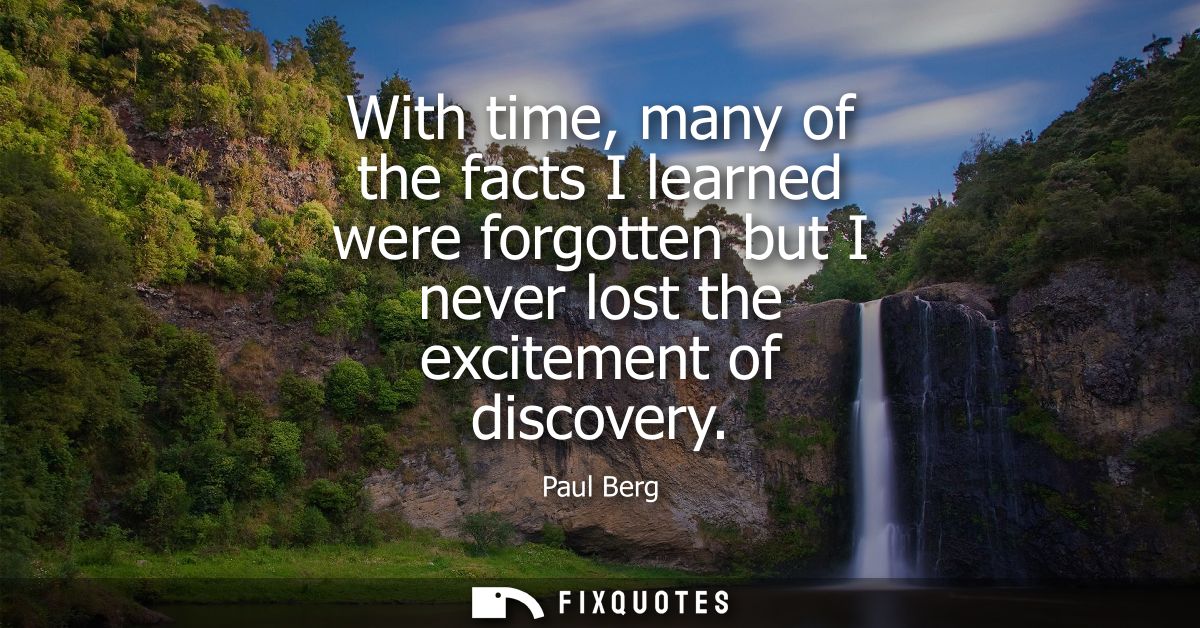
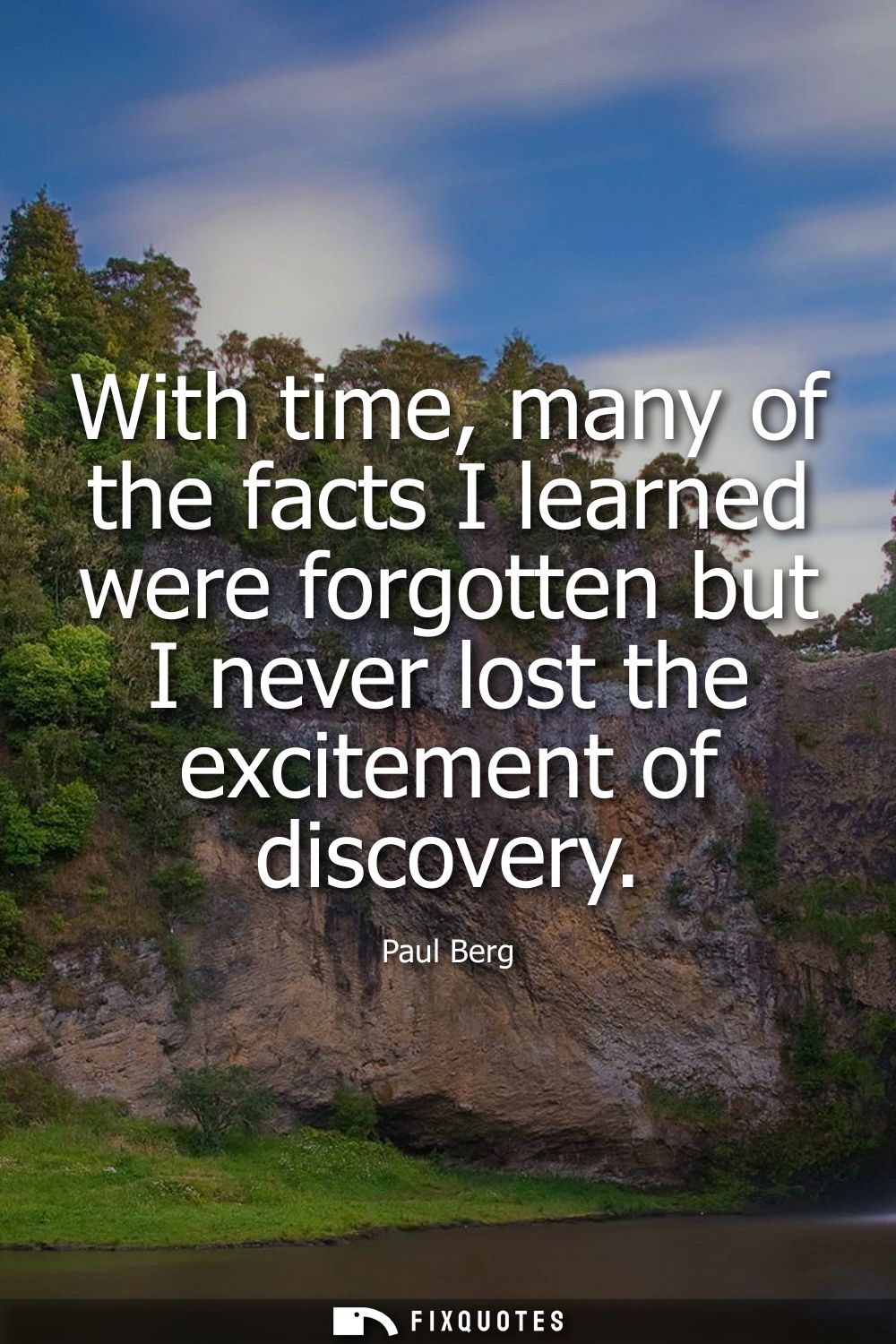
"With time, many of the facts I learned were forgotten but I never lost the excitement of discovery"
About this Quote
Science runs less on perfect recall than on a certain durable kind of thrill. Paul Berg’s line is a quiet rebuke to the way we mythologize intellect as a warehouse of facts. He admits the unglamorous truth: most details fade. What remains, and what matters, is a temperament - the craving to find out. That’s the intent: to shift the prestige from memorization to curiosity, from possession of knowledge to pursuit of it.
The subtext is almost pedagogical, but it’s also protective. For students and young researchers, forgetting can feel like failure; Berg reframes it as normal collateral in a life spent learning. The excitement of discovery becomes a North Star that outlasts any single dataset, lecture, or technique. It’s also a subtle portrait of how scientific careers actually work: today’s “facts” are often tomorrow’s footnotes, revised by new methods and better evidence. What’s durable isn’t the catalog, it’s the willingness to be surprised.
Context sharpens the message. Berg helped pioneer recombinant DNA, a field that didn’t just add facts; it rewired biology’s possibilities and sparked ethical debates about what humans should be allowed to do with that power. In that world, clinging too tightly to settled knowledge is a liability. His sentence honors the emotional engine that makes risky, slow, communal work sustainable: the moment when nature gives up a secret. It’s a scientist’s confession, and a scientist’s invitation: don’t worship the notes; chase the spark.
The subtext is almost pedagogical, but it’s also protective. For students and young researchers, forgetting can feel like failure; Berg reframes it as normal collateral in a life spent learning. The excitement of discovery becomes a North Star that outlasts any single dataset, lecture, or technique. It’s also a subtle portrait of how scientific careers actually work: today’s “facts” are often tomorrow’s footnotes, revised by new methods and better evidence. What’s durable isn’t the catalog, it’s the willingness to be surprised.
Context sharpens the message. Berg helped pioneer recombinant DNA, a field that didn’t just add facts; it rewired biology’s possibilities and sparked ethical debates about what humans should be allowed to do with that power. In that world, clinging too tightly to settled knowledge is a liability. His sentence honors the emotional engine that makes risky, slow, communal work sustainable: the moment when nature gives up a secret. It’s a scientist’s confession, and a scientist’s invitation: don’t worship the notes; chase the spark.
Quote Details
| Topic | Learning |
|---|---|
| Source | Paul Berg, autobiographical essay on NobelPrize.org (biographical page for the 1980 Nobel Prize in Chemistry laureate). |
More Quotes by Paul
Add to List