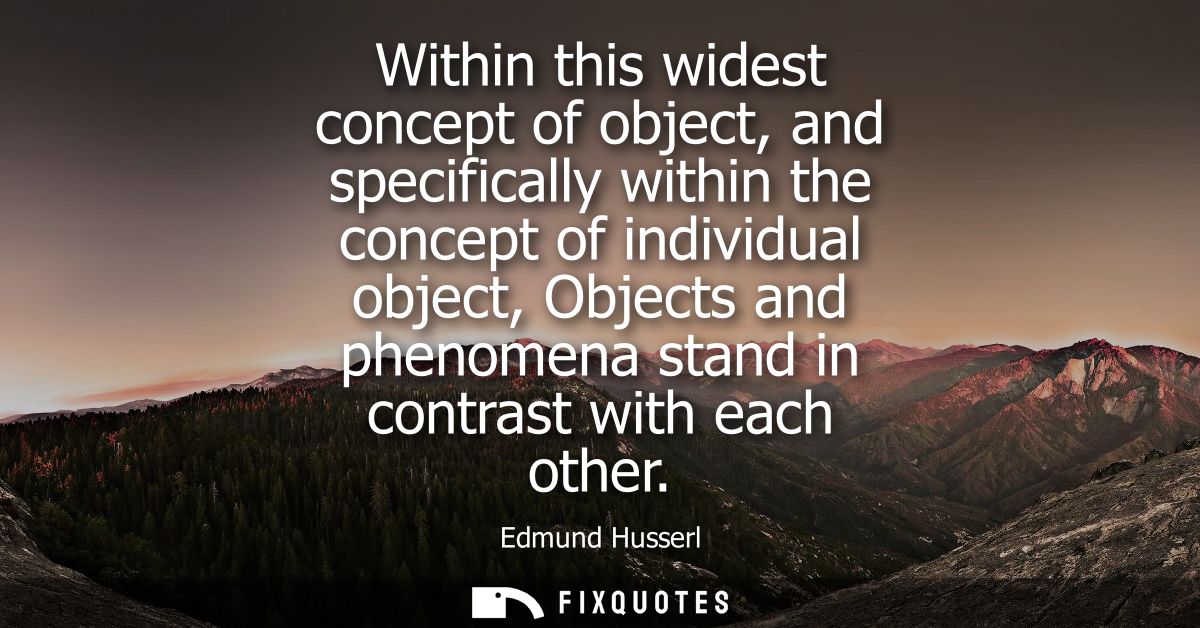
"Within this widest concept of object, and specifically within the concept of individual object, Objects and phenomena stand in contrast with each other"
About this Quote
Husserl is doing a classic phenomenological two-step: widening the net, then insisting on a crucial cut. By starting with “this widest concept of object,” he’s not being vague for sport; he’s setting up a methodological playing field where “object” means anything that can show up for consciousness at all. That’s the real power move of phenomenology: it refuses to let “object” be owned exclusively by physics, common sense, or metaphysics. If it can be intended, experienced, meant, it qualifies.
Then comes the pivot: “specifically within the concept of individual object.” Husserl narrows to what we take to be a single, identifiable something - the cup, the melody, the number, the remembered face. Inside that everyday-seeming category, he draws a sharp contrast between “Objects and phenomena.” The subtext is a warning against a lazy equivalence: what appears is not automatically what is. Phenomena are the modes of givenness - profiles, adumbrations, shifts in viewpoint, the way the cup is always more than any single glimpse. The “object” is the unity we continue to intend across those changing appearances.
Contextually, this sits in Husserl’s campaign against psychologism and naive realism. He wants rigor without pretending we access things “as they are” outside experience. The contrast he names is the engine of his whole project: describe the structures that let us treat a flickering stream of appearances as stable individuals, without smuggling in metaphysical assumptions. It’s dry on the surface, but it’s the philosophical equivalent of noticing the camera and the movie at the same time.
Then comes the pivot: “specifically within the concept of individual object.” Husserl narrows to what we take to be a single, identifiable something - the cup, the melody, the number, the remembered face. Inside that everyday-seeming category, he draws a sharp contrast between “Objects and phenomena.” The subtext is a warning against a lazy equivalence: what appears is not automatically what is. Phenomena are the modes of givenness - profiles, adumbrations, shifts in viewpoint, the way the cup is always more than any single glimpse. The “object” is the unity we continue to intend across those changing appearances.
Contextually, this sits in Husserl’s campaign against psychologism and naive realism. He wants rigor without pretending we access things “as they are” outside experience. The contrast he names is the engine of his whole project: describe the structures that let us treat a flickering stream of appearances as stable individuals, without smuggling in metaphysical assumptions. It’s dry on the surface, but it’s the philosophical equivalent of noticing the camera and the movie at the same time.
Quote Details
| Topic | Deep |
|---|
More Quotes by Edmund
Add to List