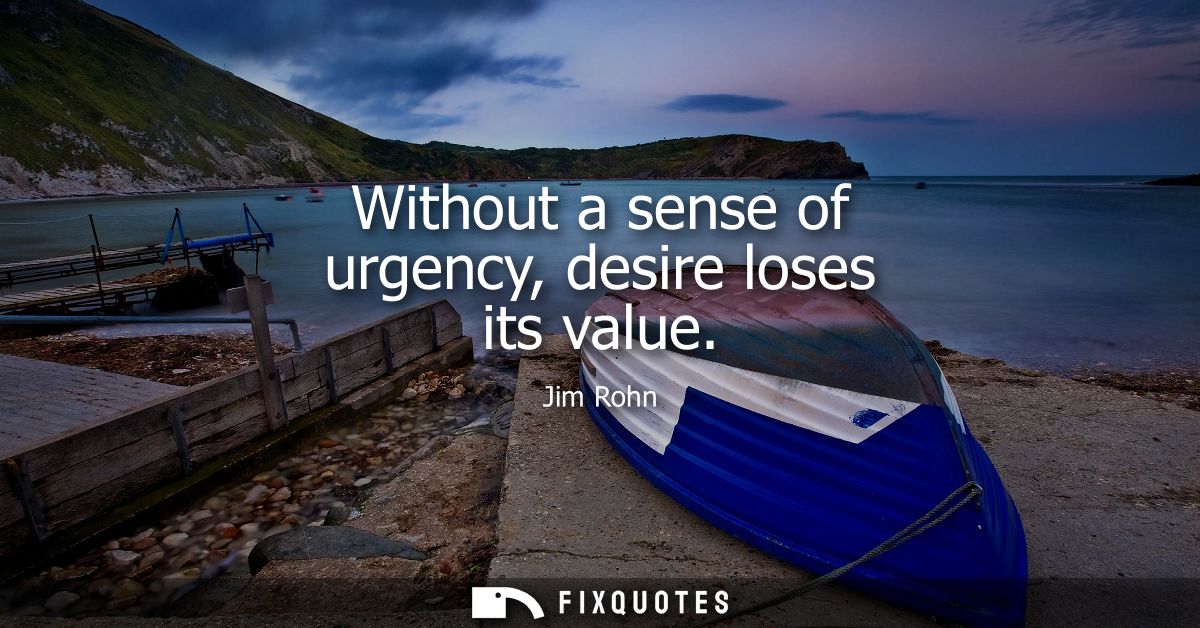
"Without a sense of urgency, desire loses its value"
About this Quote
Urgency is the accelerant Jim Rohn smuggles into what sounds like a calm, motivational maxim. He is not praising anxiety for its own sake; he is arguing that desire, left unpressured by time, becomes a decorative feeling. The line is built like a business principle: value isn’t inherent, it’s created by scarcity. Without a deadline, “want” stays soft, endlessly revisable, easy to postpone without consequence. Rohn’s intent is practical and a little disciplinary: stop romanticizing ambition and start converting it into behavior.
The subtext is a critique of the modern habit of treating desire as identity. People say they “want” things the way they say they “like” things: as self-description, not commitment. Urgency forces desire to declare itself. It separates the goals you’ll restructure your day around from the ones you merely enjoy imagining. That’s why the phrasing matters: not “desire fades,” but “loses its value.” He frames procrastination as devaluation, the way a product depreciates when it sits unsold. Time doesn’t just pass; it discounts.
Contextually, this is classic Rohn-era self-help capitalism: personal growth as a pipeline, motivation as a management problem, the self as an enterprise. Urgency becomes a tool of agency, but it also echoes the pressure logic of markets: act now, or miss out. That duality is what makes it work. It flatters you with control (“create urgency”) while warning you that dreams without timelines are just emotional clutter.
The subtext is a critique of the modern habit of treating desire as identity. People say they “want” things the way they say they “like” things: as self-description, not commitment. Urgency forces desire to declare itself. It separates the goals you’ll restructure your day around from the ones you merely enjoy imagining. That’s why the phrasing matters: not “desire fades,” but “loses its value.” He frames procrastination as devaluation, the way a product depreciates when it sits unsold. Time doesn’t just pass; it discounts.
Contextually, this is classic Rohn-era self-help capitalism: personal growth as a pipeline, motivation as a management problem, the self as an enterprise. Urgency becomes a tool of agency, but it also echoes the pressure logic of markets: act now, or miss out. That duality is what makes it work. It flatters you with control (“create urgency”) while warning you that dreams without timelines are just emotional clutter.
Quote Details
| Topic | Goal Setting |
|---|---|
| Source | Evidence: Without a sense of urgency, desire loses its value. (Chapter/section: Desire / Motivation (exact page not reliably accessible from available preview)). This wording appears verbatim in Jim Rohn’s own book *The Treasury of Quotes*, in the section labeled “Desire / Motivation.” Open Library catalogs an edition published in 1994 by Jim Rohn International (Southlake, TX) with ISBN-13 9780939490042 / ISBN-10 0939490048. A later reprint/redistribution exists under SUCCESS Books/SUCCESS Media with expanded copyright years, but that does not establish first publication. I could not access a fully page-numbered scan from a library-controlled viewer in this environment (Archive.org required JavaScript), so I can’t provide a definitive page number, only the section location. Other candidates (1) 101 Best Ways to Get Ahead (Michael E. Angier, Sarah Pond, 2004) compilation95.0% ... Jim Rohn : “ Without a sense of urgency , desire loses its value . " P Take action now . If you only had six mont... |
| Cite |
Citation Formats
APA Style (7th ed.)
Rohn, Jim. (2026, March 4). Without a sense of urgency, desire loses its value. FixQuotes. https://fixquotes.com/quotes/without-a-sense-of-urgency-desire-loses-its-value-29372/
Chicago Style
Rohn, Jim. "Without a sense of urgency, desire loses its value." FixQuotes. March 4, 2026. https://fixquotes.com/quotes/without-a-sense-of-urgency-desire-loses-its-value-29372/.
MLA Style (9th ed.)
"Without a sense of urgency, desire loses its value." FixQuotes, 4 Mar. 2026, https://fixquotes.com/quotes/without-a-sense-of-urgency-desire-loses-its-value-29372/. Accessed 31 Mar. 2026.
More Quotes by Jim
Add to List