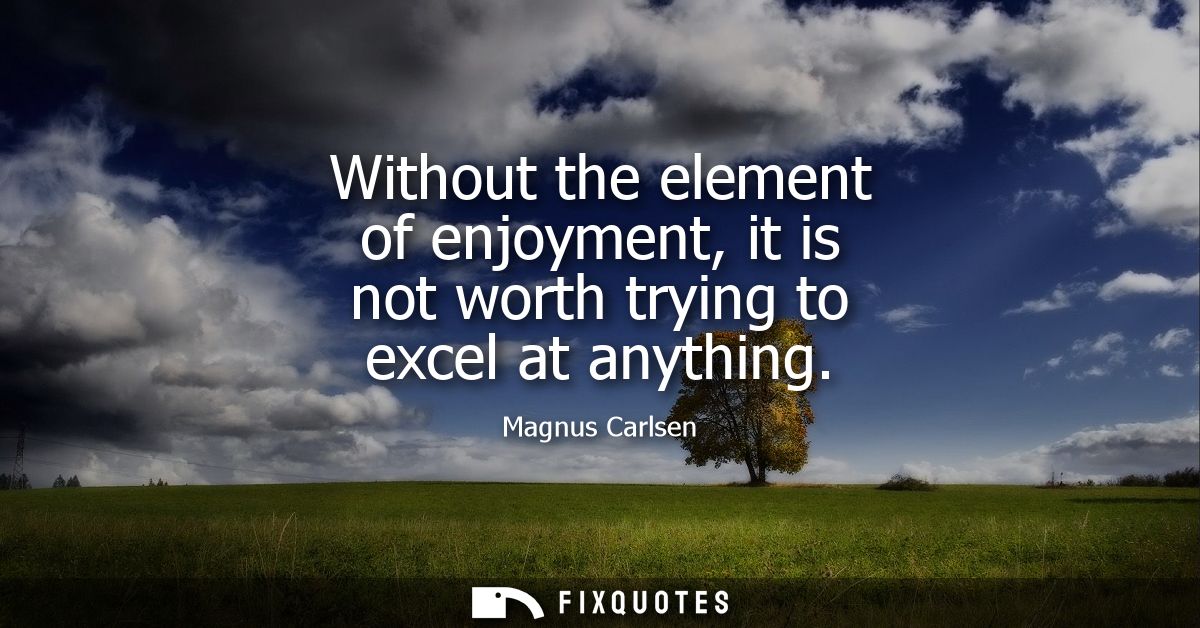
"Without the element of enjoyment, it is not worth trying to excel at anything"
About this Quote
Carlsen is sneaking a Trojan horse into the culture of optimization: the most dominant chess player of his era insisting that fun, not discipline cosplay, is the engine of mastery. In a world that treats excellence like a spreadsheet problem (inputs: grit, hours, suffering; output: success), he flips the premise. Enjoyment isn’t the dessert you earn after the grind; it’s the fuel that makes the grind survivable and, more importantly, sustainable.
The intent is almost practical. Chess is famously brutal: solitary, evaluative, and indifferent to your self-esteem. If you don’t genuinely like the problem-solving, the aesthetic of a good move, the psychological cat-and-mouse, you’ll burn out or plateau. Carlsen’s career embodies that logic. He’s long been portrayed as playing with a kind of restless curiosity, often choosing lines that keep the game complex and alive rather than merely “correct.” That posture turns excellence into an ongoing relationship, not a punishment regimen.
The subtext is a critique of performative ambition. “Trying to excel” for status alone makes you fragile: you need constant external validation, and every loss becomes existential. Enjoyment creates internal insulation; it lets you lose, learn, and return without collapsing into self-loathing. It also nudges at a healthier definition of winning: not just dominating others, but staying engaged long enough to become terrifyingly good.
Context matters: this comes from someone who has already “made it.” Carlsen can afford to say the quiet part out loud: excellence that costs your joy is a bad trade, even when it works.
The intent is almost practical. Chess is famously brutal: solitary, evaluative, and indifferent to your self-esteem. If you don’t genuinely like the problem-solving, the aesthetic of a good move, the psychological cat-and-mouse, you’ll burn out or plateau. Carlsen’s career embodies that logic. He’s long been portrayed as playing with a kind of restless curiosity, often choosing lines that keep the game complex and alive rather than merely “correct.” That posture turns excellence into an ongoing relationship, not a punishment regimen.
The subtext is a critique of performative ambition. “Trying to excel” for status alone makes you fragile: you need constant external validation, and every loss becomes existential. Enjoyment creates internal insulation; it lets you lose, learn, and return without collapsing into self-loathing. It also nudges at a healthier definition of winning: not just dominating others, but staying engaged long enough to become terrifyingly good.
Context matters: this comes from someone who has already “made it.” Carlsen can afford to say the quiet part out loud: excellence that costs your joy is a bad trade, even when it works.
Quote Details
| Topic | Motivational |
|---|---|
| Source | Help us find the source |
More Quotes by Magnus
Add to List