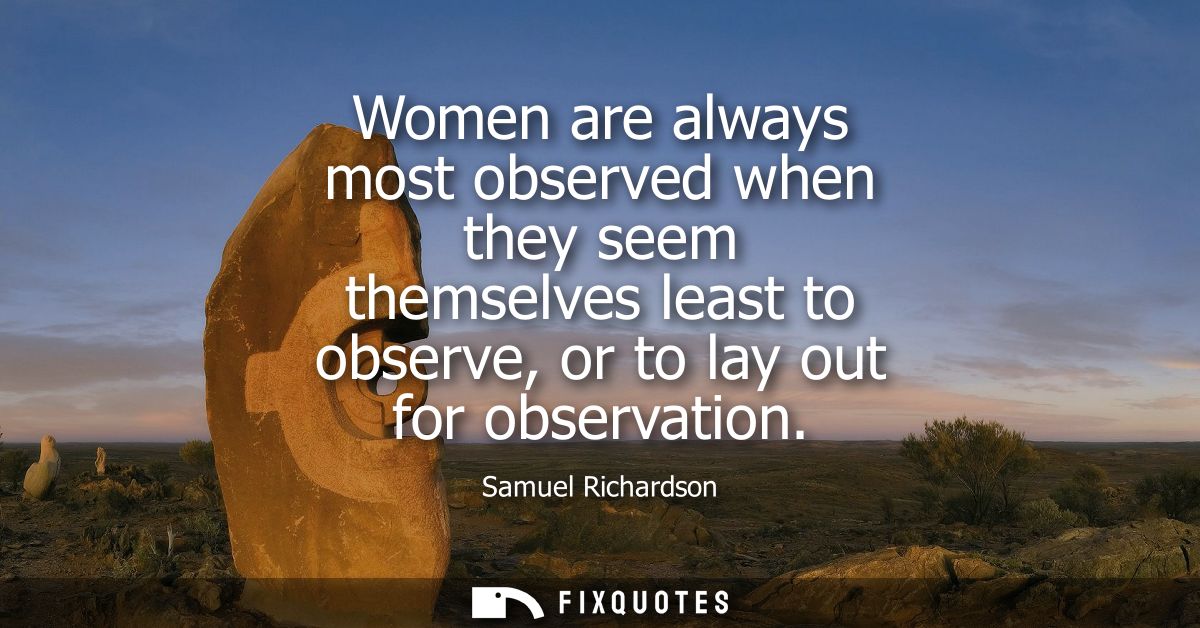
"Women are always most observed when they seem themselves least to observe, or to lay out for observation"
About this Quote
The subtext is uneasy. Richardson implies a moral hierarchy between the woman who “lays out” (suggesting vanity, performance, sexual availability) and the woman who doesn’t (suggesting virtue, modesty, purity). Yet the irony is that both positions are shaped by surveillance. A woman is scrutinized for trying to be seen and scrutinized for not trying. The supposed compliment to naturalness becomes a trap: the moment she’s unaware, she’s most possessed by others’ attention.
Context matters: Richardson’s novels (Pamela, Clarissa) are obsessed with virtue under siege, reputations made and unmade through observation, rumor, letters, and coercion. This sentence could sit comfortably inside that moral machinery, where “looking” is never just looking; it’s appraisal, suspicion, entitlement. Richardson isn’t merely describing flirtation at a ball. He’s articulating an early modern version of a modern problem: the fetish for the unperformed self, and the way society uses that fetish to police women’s behavior while pretending it’s just noticing.
Quote Details
| Topic | Deep |
|---|---|
| Source | Help us find the source |
| Cite |
Citation Formats
APA Style (7th ed.)
Richardson, Samuel. (2026, January 15). Women are always most observed when they seem themselves least to observe, or to lay out for observation. FixQuotes. https://fixquotes.com/quotes/women-are-always-most-observed-when-they-seem-36558/
Chicago Style
Richardson, Samuel. "Women are always most observed when they seem themselves least to observe, or to lay out for observation." FixQuotes. January 15, 2026. https://fixquotes.com/quotes/women-are-always-most-observed-when-they-seem-36558/.
MLA Style (9th ed.)
"Women are always most observed when they seem themselves least to observe, or to lay out for observation." FixQuotes, 15 Jan. 2026, https://fixquotes.com/quotes/women-are-always-most-observed-when-they-seem-36558/. Accessed 22 Mar. 2026.