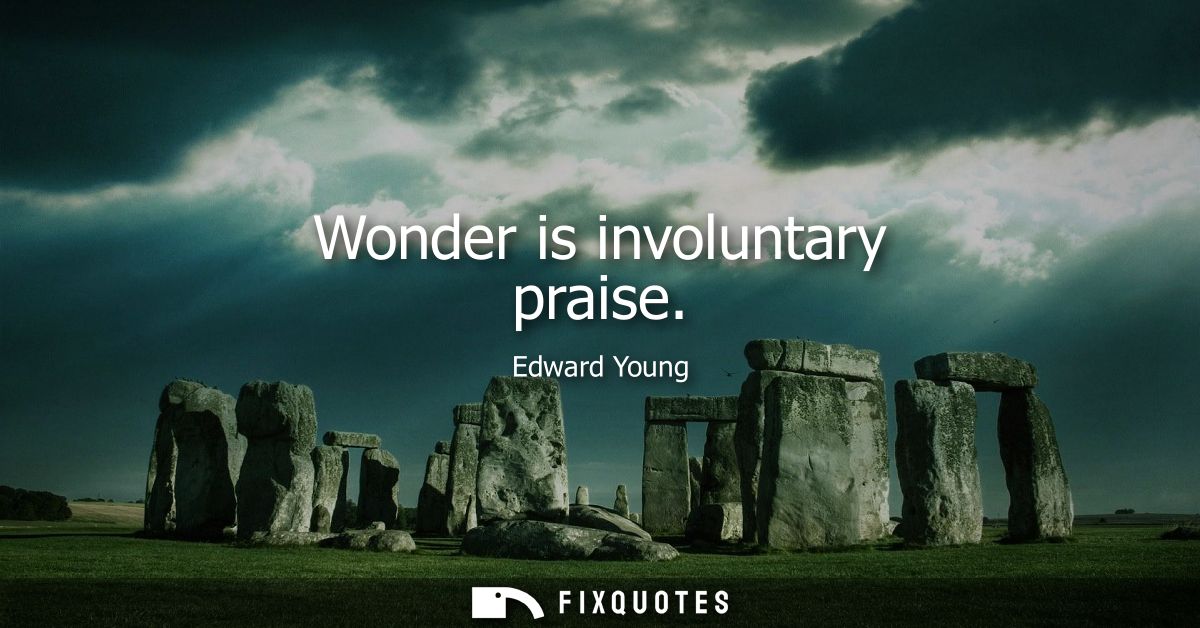
"Wonder is involuntary praise"
About this Quote
Wonder, for Edward Young, is admiration that slips past the mind’s gatekeepers. Calling it “involuntary praise” reframes awe as a reflex, not a decision: the body and imagination applaud before the intellect can negotiate terms. That’s a poet’s move, but it’s also a moral argument. Praise, in Young’s era, wasn’t just a nice feeling; it was a social and religious practice, a public language of value. By making wonder involuntary, Young suggests that the world (or God, in the theological air he breathed) can compel assent without persuasion. You don’t choose reverence; you’re seized by it.
The line also carries a sly critique of performative approval. Voluntary praise can be flattery, fashion, politics - a currency traded for favor. Wonder, by contrast, is unbribable. It arrives as evidence, almost forensic: if you’re struck dumb by the night sky or a work of genius, you’ve testified to greatness without intending to. Young’s phrasing flatters the reader’s better self while quietly distrusting their conscious motives.
Context matters: Young wrote in a culture balancing Enlightenment rationalism with revived religious seriousness, and in poetry that often sought to yank readers out of complacency. “Wonder is involuntary praise” offers a bridge between reason and devotion. It grants that skepticism exists, even that it’s fashionable, then insists there’s a deeper register where reality still wins. Awe becomes the soul’s truth serum, betraying what we value even when we’d rather not admit it.
The line also carries a sly critique of performative approval. Voluntary praise can be flattery, fashion, politics - a currency traded for favor. Wonder, by contrast, is unbribable. It arrives as evidence, almost forensic: if you’re struck dumb by the night sky or a work of genius, you’ve testified to greatness without intending to. Young’s phrasing flatters the reader’s better self while quietly distrusting their conscious motives.
Context matters: Young wrote in a culture balancing Enlightenment rationalism with revived religious seriousness, and in poetry that often sought to yank readers out of complacency. “Wonder is involuntary praise” offers a bridge between reason and devotion. It grants that skepticism exists, even that it’s fashionable, then insists there’s a deeper register where reality still wins. Awe becomes the soul’s truth serum, betraying what we value even when we’d rather not admit it.
Quote Details
| Topic | Wisdom |
|---|---|
| Source | Unverified source: The Revenge: A Tragedy (Edward Young, 1721)
Evidence: Late time shall wonder; that my joys will raise: For wonder is involuntary praise.[exeunt. (Act III (exact page varies by edition)). This line appears in Edward Young’s tragedy The Revenge. In the Project Gutenberg transcription, it occurs in Act the Third, during Zanga’s dialogue (near the end o... Other candidates (1) Talking with God (J. Ben Pickering, 2014) compilation95.0% ... Edward Young said, “Wonder is involuntary praise.” Playing a little on that phrase, 40. |
| Cite |
Citation Formats
APA Style (7th ed.)
Young, Edward. (2026, February 15). Wonder is involuntary praise. FixQuotes. https://fixquotes.com/quotes/wonder-is-involuntary-praise-36595/
Chicago Style
Young, Edward. "Wonder is involuntary praise." FixQuotes. February 15, 2026. https://fixquotes.com/quotes/wonder-is-involuntary-praise-36595/.
MLA Style (9th ed.)
"Wonder is involuntary praise." FixQuotes, 15 Feb. 2026, https://fixquotes.com/quotes/wonder-is-involuntary-praise-36595/. Accessed 22 Mar. 2026.
More Quotes by Edward
Add to List