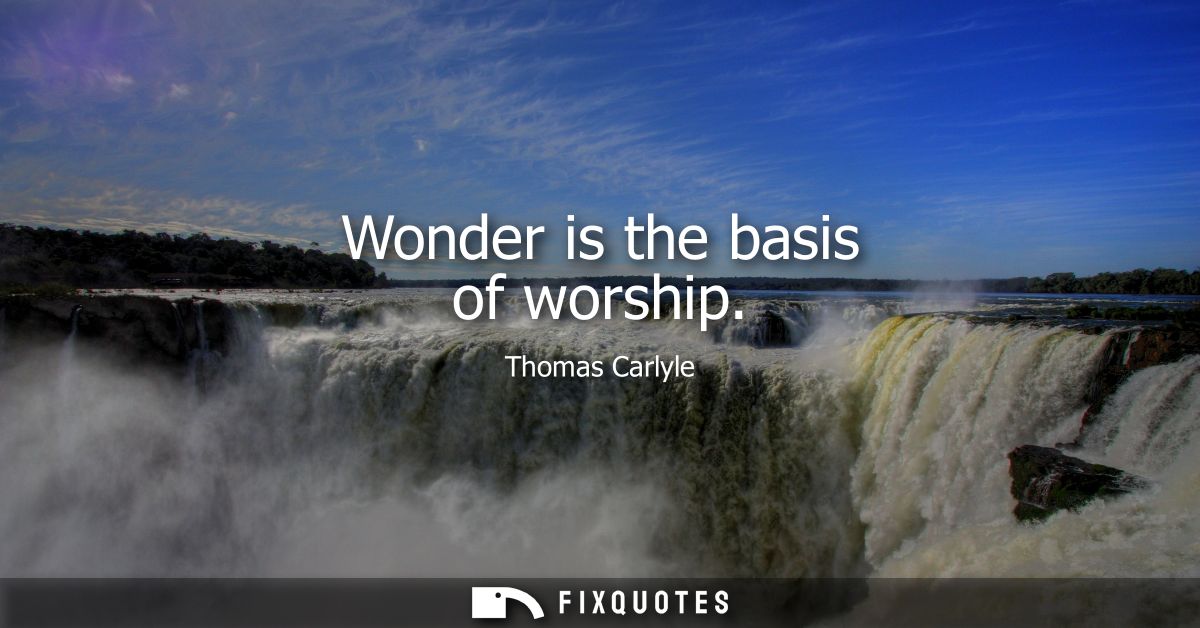
"Wonder is the basis of worship"
About this Quote
Carlyle’s line is a neat piece of theological judo: he grabs a soft, almost childlike feeling - wonder - and flips it into something with institutional gravity: worship. Coming from a 19th-century writer who distrusted smug rationalism and the flattening effects of industrial modernity, the intent isn’t to sentimentalize awe. It’s to argue that religion begins upstream of doctrine, before creeds, before priests, before the argument about whether God “exists” in the terms of the day. Wonder is the original evidence, the bodily sensation that the world exceeds our categories.
The subtext is a critique of his era’s self-satisfaction. Carlyle watched a Britain drunk on progress, measurement, and utilitarian bookkeeping. “Wonder” names what that worldview can’t quantify: the shiver of encountering scale, mystery, moral weight. By calling it the basis of worship, he implies that disbelief is less an intellectual position than a spiritual numbness - a failure of perception. It’s also a warning to religion itself: when worship loses wonder, it curdles into rote performance or moral policing, a machine that imitates devotion without its spark.
Context matters because Carlyle isn’t offering a feel-good motto; he’s staking a claim about authority. If wonder is foundational, then the modern person’s posture toward the world becomes a civic problem, not just a private mood. Awe disciplines the ego. It makes room for reverence, and reverence, in Carlyle’s imagination, is the emotional infrastructure that holds societies together when facts alone can’t tell you what to live for.
The subtext is a critique of his era’s self-satisfaction. Carlyle watched a Britain drunk on progress, measurement, and utilitarian bookkeeping. “Wonder” names what that worldview can’t quantify: the shiver of encountering scale, mystery, moral weight. By calling it the basis of worship, he implies that disbelief is less an intellectual position than a spiritual numbness - a failure of perception. It’s also a warning to religion itself: when worship loses wonder, it curdles into rote performance or moral policing, a machine that imitates devotion without its spark.
Context matters because Carlyle isn’t offering a feel-good motto; he’s staking a claim about authority. If wonder is foundational, then the modern person’s posture toward the world becomes a civic problem, not just a private mood. Awe disciplines the ego. It makes room for reverence, and reverence, in Carlyle’s imagination, is the emotional infrastructure that holds societies together when facts alone can’t tell you what to live for.
Quote Details
| Topic | Faith |
|---|---|
| Source | Evidence: ... Wonder is the basis of worship ; the reign of wonder is perennial , indestructible ; only at certain stages ( as the present ) it is ( for some short season ) in partibus infidelium . August , 1830. - What is a man if you look at him ... Other candidates (1) On Heroes, Hero-Worship, and the Heroic in History (Thomas Carlyle, 1840)50.0% Worship is transcendent wonder; wonder for which there is now no limit or measure; that is worship. (Lecture I, "The ... |
| Cite |
Citation Formats
APA Style (7th ed.)
Carlyle, Thomas. (2026, March 13). Wonder is the basis of worship. FixQuotes. https://fixquotes.com/quotes/wonder-is-the-basis-of-worship-133899/
Chicago Style
Carlyle, Thomas. "Wonder is the basis of worship." FixQuotes. March 13, 2026. https://fixquotes.com/quotes/wonder-is-the-basis-of-worship-133899/.
MLA Style (9th ed.)
"Wonder is the basis of worship." FixQuotes, 13 Mar. 2026, https://fixquotes.com/quotes/wonder-is-the-basis-of-worship-133899/. Accessed 22 Mar. 2026.
More Quotes by Thomas
Add to List