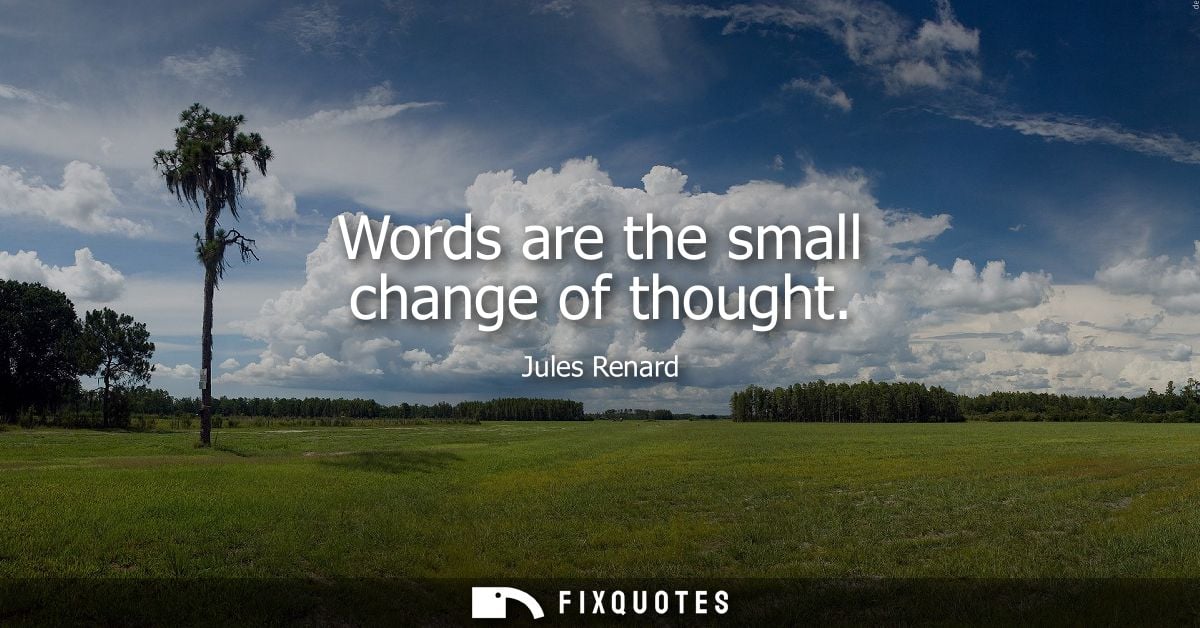
"Words are the small change of thought"
About this Quote
Renard’s line lands like a coin on a countertop: casual, bright, faintly insulting. Calling words “small change” demotes language from noble vessel to everyday currency, the stuff you flick across a table without thinking too hard. It’s a dramatist’s jab at the marketplace of talk, where people spend phrases the way they spend nickels: quickly, habitually, often without checking what anything is worth.
The intent isn’t anti-language so much as anti-inflation. Renard suggests that thought is the real wealth; words are merely its spendable form, necessary for exchange but also a source of distortion. “Small change” implies loss in conversion. Big ideas get broken down to fit the pocket of conversation, traded in for what can be counted and passed along. The subtext carries a warning to writers and speakers: your job isn’t to mint more coins, it’s to protect the gold from being shaved down by cliché, rhetoric, and performance.
Context matters. Renard wrote in fin-de-siecle France, a period thick with salons, manifestos, and literary posing, when cleverness could be a social sport. As a playwright and diarist, he lived inside speech: dialogue that has to sound natural while secretly being engineered. The line reads like a backstage note to himself: don’t confuse the script with the mind behind it. It also needles audiences who treat eloquence as proof of intelligence. In Renard’s economy, fluency is not fortune; it’s just what you use to buy time, attention, and agreement.
The intent isn’t anti-language so much as anti-inflation. Renard suggests that thought is the real wealth; words are merely its spendable form, necessary for exchange but also a source of distortion. “Small change” implies loss in conversion. Big ideas get broken down to fit the pocket of conversation, traded in for what can be counted and passed along. The subtext carries a warning to writers and speakers: your job isn’t to mint more coins, it’s to protect the gold from being shaved down by cliché, rhetoric, and performance.
Context matters. Renard wrote in fin-de-siecle France, a period thick with salons, manifestos, and literary posing, when cleverness could be a social sport. As a playwright and diarist, he lived inside speech: dialogue that has to sound natural while secretly being engineered. The line reads like a backstage note to himself: don’t confuse the script with the mind behind it. It also needles audiences who treat eloquence as proof of intelligence. In Renard’s economy, fluency is not fortune; it’s just what you use to buy time, attention, and agreement.
Quote Details
| Topic | Writing |
|---|---|
| Source | Help us find the source |
| Cite |
Citation Formats
APA Style (7th ed.)
Renard, Jules. (2026, January 15). Words are the small change of thought. FixQuotes. https://fixquotes.com/quotes/words-are-the-small-change-of-thought-59391/
Chicago Style
Renard, Jules. "Words are the small change of thought." FixQuotes. January 15, 2026. https://fixquotes.com/quotes/words-are-the-small-change-of-thought-59391/.
MLA Style (9th ed.)
"Words are the small change of thought." FixQuotes, 15 Jan. 2026, https://fixquotes.com/quotes/words-are-the-small-change-of-thought-59391/. Accessed 15 Mar. 2026.
More Quotes by Jules
Add to List