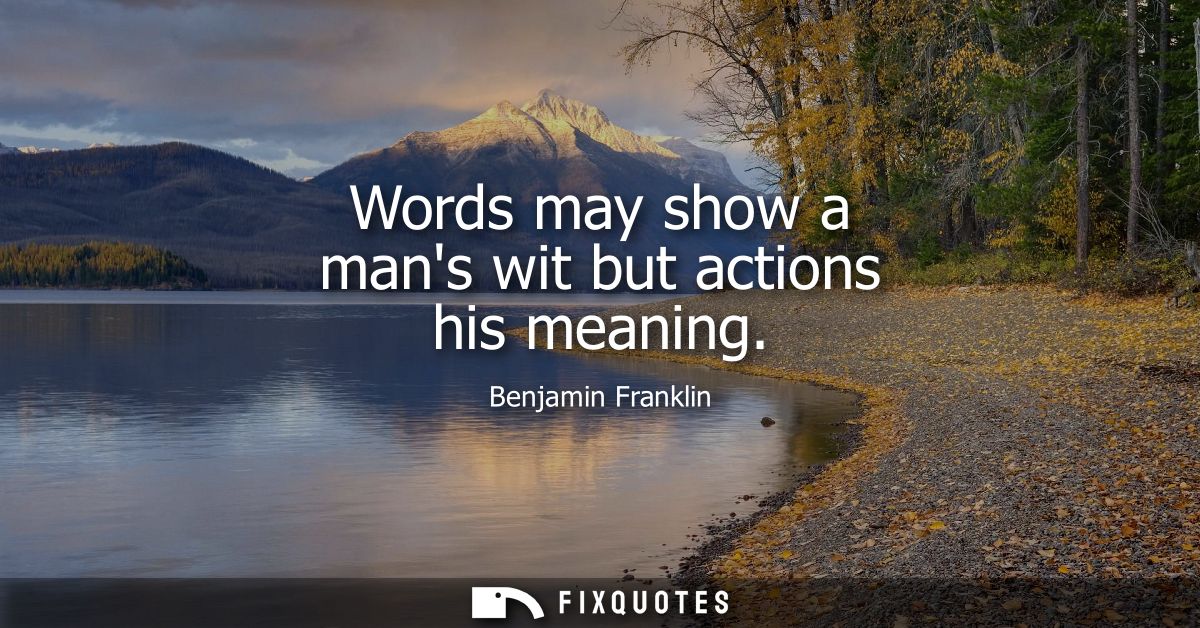
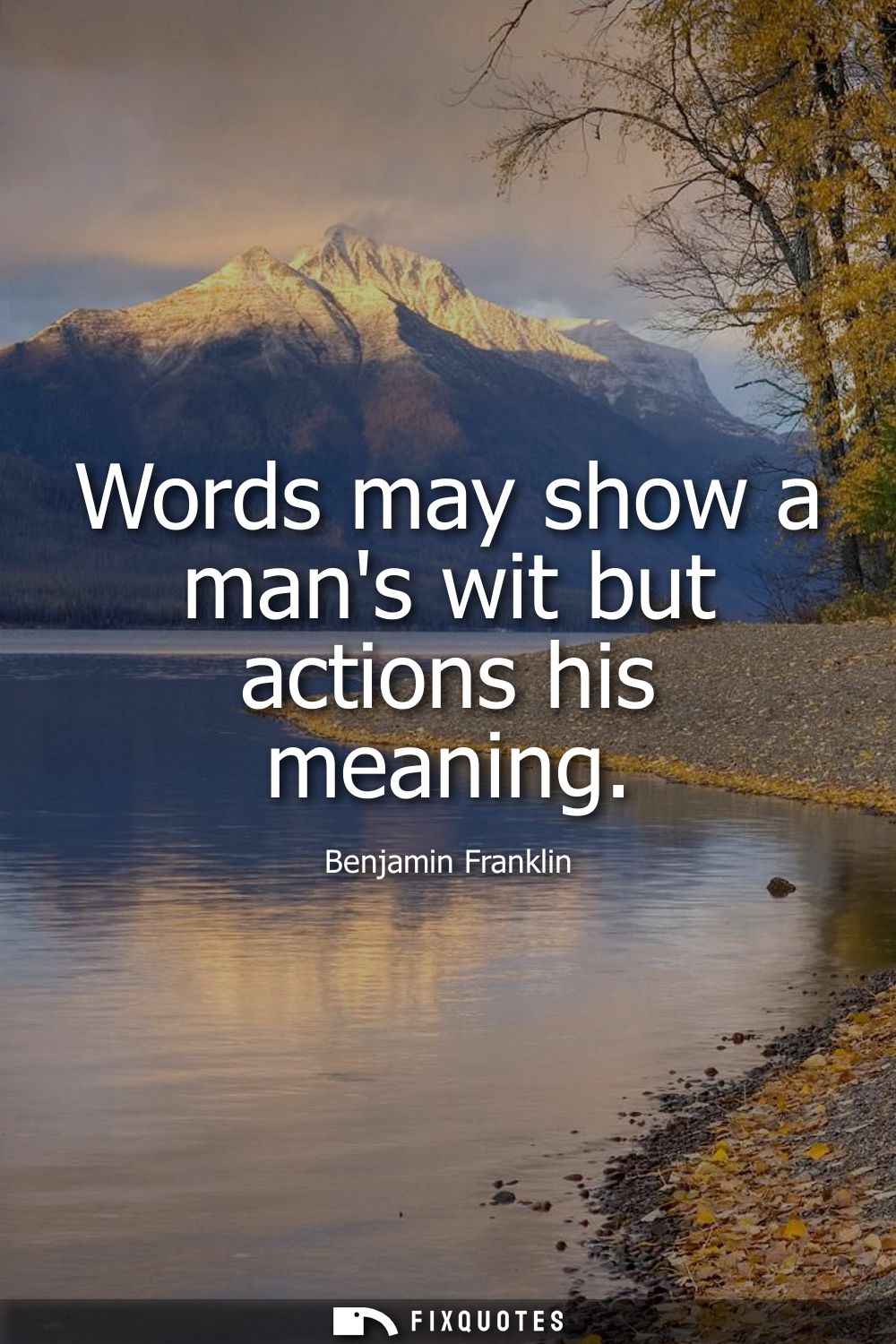
"Words may show a man's wit, but actions his meaning"
About this Quote
Franklin’s line lands like a raised eyebrow at the entire culture of persuasive talk. “Wit” is the bait: charming, quick, socially rewarded. In Franklin’s world of pamphlets, salons, and assemblies, words were currency, and cleverness could pass for competence. He grants language its sparkle, then quietly demotes it. Wit is surface. Meaning is where the body ends up.
The sentence is engineered to sound balanced, almost proverbially fair, but it’s a moral trapdoor. “May show” signals how easily speech can be staged; “his meaning” insists that intention isn’t what you claim in public, it’s what your choices purchase in private. Franklin, the printer-turned-statesman, knew better than most how rhetoric manufactures reality. He also lived in a political moment when the new American experiment depended on credibility: declarations needed to survive contact with sacrifice, enforcement, and compromise. The Revolution was, among other things, a test of whether soaring ideals would materialize as institutions.
The subtext is a warning to citizens as much as to leaders: don’t be hypnotized by performance. Evaluate the vote, the policy, the labor, the risk assumed, the check actually written. It’s also a nudge toward self-suspicion. You can talk yourself into believing you’re virtuous; your calendar and your conduct keep better records.
Franklin isn’t dismissing language; he’s quarantining it. Words are how politics persuades. Actions are how politics tells the truth.
The sentence is engineered to sound balanced, almost proverbially fair, but it’s a moral trapdoor. “May show” signals how easily speech can be staged; “his meaning” insists that intention isn’t what you claim in public, it’s what your choices purchase in private. Franklin, the printer-turned-statesman, knew better than most how rhetoric manufactures reality. He also lived in a political moment when the new American experiment depended on credibility: declarations needed to survive contact with sacrifice, enforcement, and compromise. The Revolution was, among other things, a test of whether soaring ideals would materialize as institutions.
The subtext is a warning to citizens as much as to leaders: don’t be hypnotized by performance. Evaluate the vote, the policy, the labor, the risk assumed, the check actually written. It’s also a nudge toward self-suspicion. You can talk yourself into believing you’re virtuous; your calendar and your conduct keep better records.
Franklin isn’t dismissing language; he’s quarantining it. Words are how politics persuades. Actions are how politics tells the truth.
Quote Details
| Topic | Wisdom |
|---|---|
| Source | Help us find the source |
| Cite |
Citation Formats
APA Style (7th ed.)
Franklin, Benjamin. (2026, February 20). Words may show a man's wit, but actions his meaning. FixQuotes. https://fixquotes.com/quotes/words-may-show-a-mans-wit-but-actions-his-meaning-25557/
Chicago Style
Franklin, Benjamin. "Words may show a man's wit, but actions his meaning." FixQuotes. February 20, 2026. https://fixquotes.com/quotes/words-may-show-a-mans-wit-but-actions-his-meaning-25557/.
MLA Style (9th ed.)
"Words may show a man's wit, but actions his meaning." FixQuotes, 20 Feb. 2026, https://fixquotes.com/quotes/words-may-show-a-mans-wit-but-actions-his-meaning-25557/. Accessed 7 Apr. 2026.
More Quotes by Benjamin
Add to List