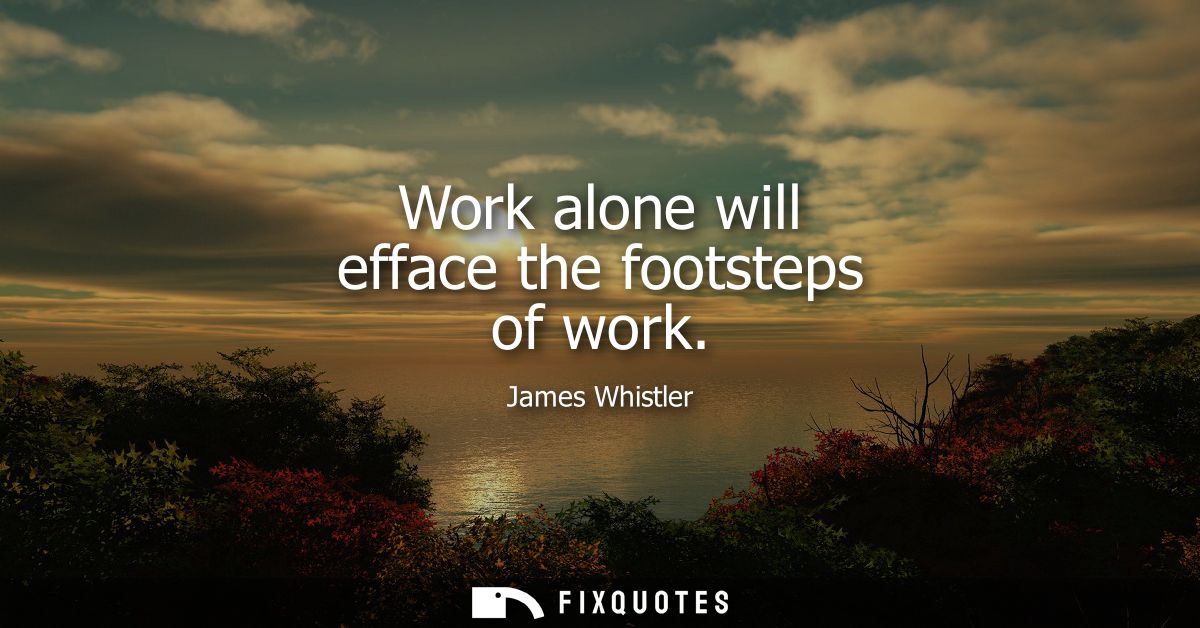
"Work alone will efface the footsteps of work"
About this Quote
Work, for Whistler, is both the engine and the eraser. “Work alone will efface the footsteps of work” lands like a paradox, but it’s really a studio truth: the only way to make art look inevitable is to labor until the labor disappears. He’s describing that uncanny finish in great painting where brushwork reads as effortless even when it’s the product of repetition, scraping back, repainting, and ruthless editing. The “footsteps” are the marks of trying too hard - the telltale tracks of overstatement, sentimentality, and technical showing-off.
The line also smuggles in Whistler’s aesthetic politics. As a leading voice in the “art for art’s sake” orbit, he resisted Victorian expectations that painting should justify itself with moral lessons or narrative clarity. By insisting that only more work can erase the evidence of work, he elevates craft over explanation and execution over sermon. It’s a jab at critics who want to see the seams - who equate visible effort with seriousness - and at artists who confuse busyness with depth.
Context matters: Whistler lived in public combat with reviewers and institutions (his famous libel suit against John Ruskin is the emblem). This aphorism reads like a cooler, sharper version of that fight. Don’t ask for proof of value in the grind marks. The real proof is the surface that refuses to confess how it was made. In an attention economy that fetishizes “behind the scenes,” Whistler’s line still stings: mastery is the work that hides the work.
The line also smuggles in Whistler’s aesthetic politics. As a leading voice in the “art for art’s sake” orbit, he resisted Victorian expectations that painting should justify itself with moral lessons or narrative clarity. By insisting that only more work can erase the evidence of work, he elevates craft over explanation and execution over sermon. It’s a jab at critics who want to see the seams - who equate visible effort with seriousness - and at artists who confuse busyness with depth.
Context matters: Whistler lived in public combat with reviewers and institutions (his famous libel suit against John Ruskin is the emblem). This aphorism reads like a cooler, sharper version of that fight. Don’t ask for proof of value in the grind marks. The real proof is the surface that refuses to confess how it was made. In an attention economy that fetishizes “behind the scenes,” Whistler’s line still stings: mastery is the work that hides the work.
Quote Details
| Topic | Work |
|---|
More Quotes by James
Add to List