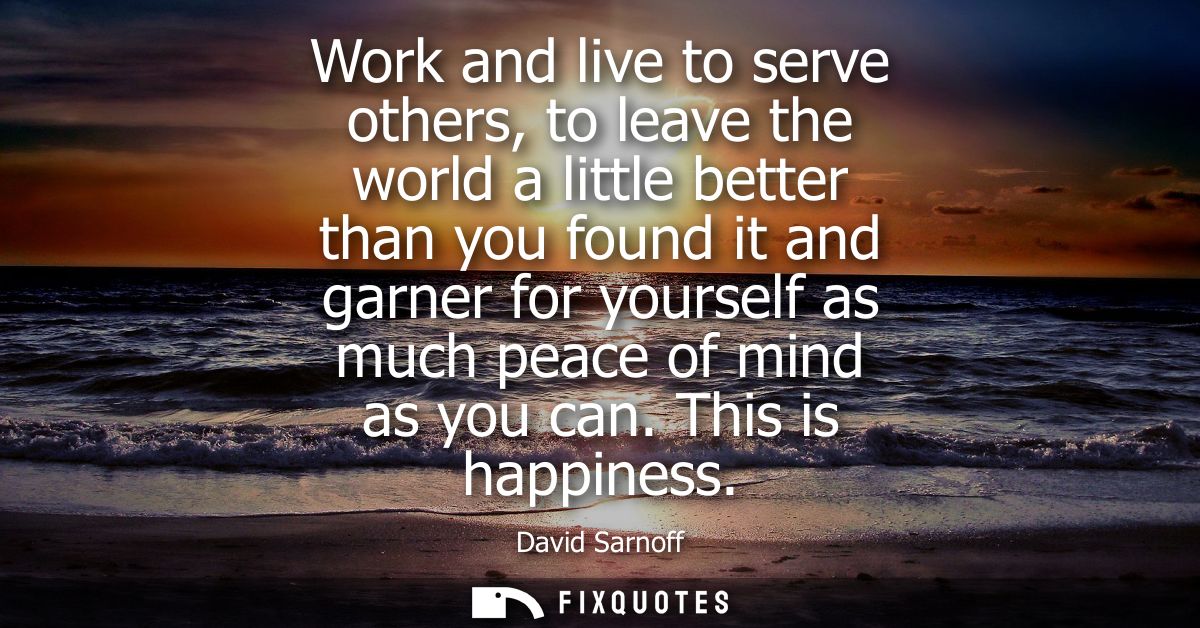
"Work and live to serve others, to leave the world a little better than you found it and garner for yourself as much peace of mind as you can. This is happiness"
About this Quote
Sarnoff packages an entire industrial-era moral code into one clean circuit: service, improvement, inner calm. Coming from the man who helped turn radio and television into mass infrastructure, the line reads less like soft altruism and more like a blueprint for how to justify scale. When you’re wiring a nation’s attention, “serve others” isn’t just virtue; it’s a claim of legitimacy. It frames ambition as public utility, a way to make expansion feel like stewardship.
The syntax does quiet persuasive work. “Work and live” collapses the boundary between vocation and identity, the kind of fusion that modern hustle culture sells as empowerment but that also conveniently keeps you productive. “Leave the world a little better” is calibrated modesty: small enough to sound achievable, large enough to moralize whatever project you’re pursuing. It’s incremental progress as absolution, a useful ethic for an inventor and corporate builder who operated inside systems that could both enlighten and manipulate.
Then the pivot: “garner for yourself as much peace of mind as you can.” The verb “garner” is telling - you harvest serenity like a resource, not a mystical reward. Happiness becomes less a feeling than a management strategy: do good (or at least do work that can be narrated as good), and secure internal quiet. The subtext is pragmatic, almost transactional: meaning is what you can live with after the day’s outputs are tallied.
In Sarnoff’s century - wars, propaganda, the birth of consumer media - “peace of mind” wasn’t a luxury; it was a survival skill. This isn’t sentimental humanism. It’s a credo for building big things and sleeping at night.
The syntax does quiet persuasive work. “Work and live” collapses the boundary between vocation and identity, the kind of fusion that modern hustle culture sells as empowerment but that also conveniently keeps you productive. “Leave the world a little better” is calibrated modesty: small enough to sound achievable, large enough to moralize whatever project you’re pursuing. It’s incremental progress as absolution, a useful ethic for an inventor and corporate builder who operated inside systems that could both enlighten and manipulate.
Then the pivot: “garner for yourself as much peace of mind as you can.” The verb “garner” is telling - you harvest serenity like a resource, not a mystical reward. Happiness becomes less a feeling than a management strategy: do good (or at least do work that can be narrated as good), and secure internal quiet. The subtext is pragmatic, almost transactional: meaning is what you can live with after the day’s outputs are tallied.
In Sarnoff’s century - wars, propaganda, the birth of consumer media - “peace of mind” wasn’t a luxury; it was a survival skill. This isn’t sentimental humanism. It’s a credo for building big things and sleeping at night.
Quote Details
| Topic | Happiness |
|---|---|
| Source | Help us find the source |
More Quotes by David
Add to List